
August 14, 2008
|
|
Monitoring & Testing Newsletter August 14, 2008 |
|---|
  |
|---|
| This Week´s Featured News Stories |
|---|
 |
Space sensor perks up environmental protection and medical analysis
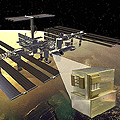
Miniaturised ceramic gas sensors, originally developed for measuring oxygen levels for spacecraft re-entry vehicles, enables improved human breath measurement apparatus, better control of heater combustion thereby reducing pollution, and higher safety in fuel cell manufacturing. It all began in 1993 when the Institute of Space Systems (IRS) of the University of Stuttgart started to develop special ceramic gas sensors to measure oxygen distribution in the plasma wind tunnels used to test heat-shield materials for re-entry spacecraft in extreme conditions. `So we had to develop a new type of ... |
||||
 |
Experts to study aerosols’ impact on Australia’s climate
The impact that human-generated and natural atmospheric particles (aerosols) could be having on Australia’s climate will be discussed next week in Canberra at a workshop involving some of the world’s leading experts in the area. CSIRO Marine and Atmospheric Research scientist, Dr Leon Rotstayn, says the influence aerosols have on climate is still one of the ‘great unknowns’ in climate science. “We recently identified that the extensive pollution haze emanating from Asia may be re-shaping rainfall patterns and monsoonal winds in northern Australia. Establishing the impacts of aerosols across ... |
||||
| |||||
|
|||||
| Advertise in this Newsletter For information on advertising in this newsletter, contact us or call USA 1-888-244-5029 / Europe +34 91 395 2969. |
