


BMT - External Membrane Filtration Technology
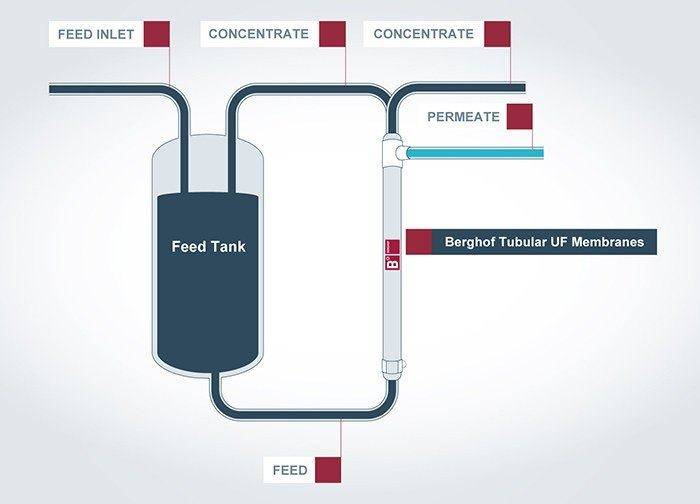
We at Berghof Membranes believe in external membrane filtration and it is the passion that drives us to “think outside the box” of membrane technology for wastewater treatment. The external filtration systems are positioned outside the bioreactor and utilize variable crossflow velocity to keep the membranes working at optimal conditions. If necessary, this process is supported with permeate backwash (temporarily reversed permeate flow) or chemical backwash protocols. Tubular membrane filtration is frequently applied for wastewater treatment in the external configuration because of the greater ease in cleaning, zero odor emissions and overall superior robustness.
- Easier operation, maintenance and replacement of modules
- Higher flux rates (50-150 LMH)
- Lower fouling potential
- Less chemical usage due to extended cleaning periods
- Modular “plug-and-play” design
- Quick commissioning and superior flexibility
- Zero odor emissions
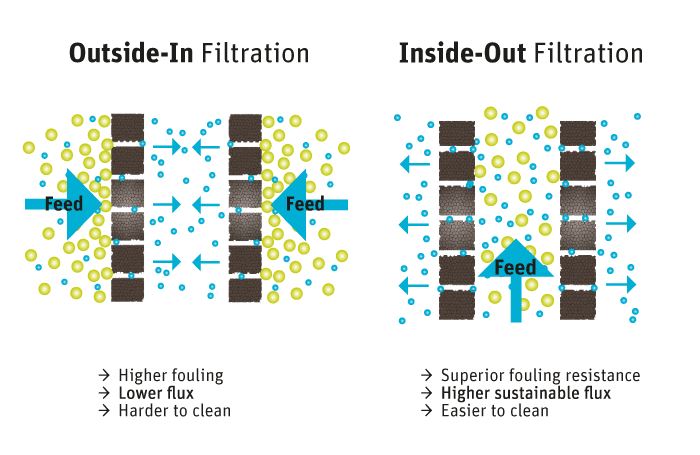
To prevent fouling and clogging, Berghof Membranes developed its robust tubular UF membranes based on cross-flow filtration technology (inside-out fitration), resulting in more fouling-resistant membranes that are ideal for the separation and filtration of challenging industrial effluent and wastewater.
Minimizing Capital Expenditures
In a typical tubular UF application, fluids (such as pre treated wastewater) flow through the tubular modules at a high velocity, sufficient to maintain a turbulent flow. At a typical transmembrane pressure (TMP) of 1 – 3 bar, the permeate stream is forced through the pores of the membrane while suspended particles remain in the retentate stream.
High cross-flow on the membrane´s surface prevents the build-up of particles on the inner surface of the tube, ensuring high flux and prolonged membrane lifetime.
Automated cleaning
Our intelligent technology enables several cleaning procedures to automatically remove membrane fouling. The intelligent combination of variable crossflow velocity, backwashing, chemical enhanced backwash and cleaning in place makes our technology a revolutionary solution for the treatment of any effluent.
Optimal fouling control
Our well-established crossflow filtration technology keeps the membranes working at optimal conditions. The combination of intelligent soft- and hardware, continuously analyses the situation and responds automatically to varying conditions whenever this is required. Water quality and therefore fouling levels are bound to change during the process resulting in increasing Transmembrane Pressure (TMP)-values.
The membranes technology designed by Berghof Membranes will respond to these changes automatically to prevent fouling of the membranes.
Industries worldwide are facing increasing challenges in (waste)water treatment to reduce their impact on the environment. In order to stay cost-effective, most companies decide to treat their own wastewater. Therefore, many water treatment plants have been built, not only to reduce discharge costs to municipalities but also to reuse valuable effluent.
To meet these challenges, the interest in using membrane technology has emerged in wastewater treatment and process water production. However, there is the perception that membrane filtration has the disadvantage of membrane fouling and therefore consequently higher operating and membrane replacement costs.
Inside Out Filtration
The Berghof tubular membranes are known for their rugged construction, long membrane life, high flux rates and easy cleaning. Our membranes are based on the inside-out filtration principle. Wastewater flows in an axial direction inside the tube and penetrates as clean water through the membrane to the outside, while the thickened concentrate is separated.
Unlike other wastewater filtration methods, this filtration principle is the single requirement for optimized fouling control. Ultrafiltration processes in industrial applications rely strongly on regular backwashing (outside-in) to maintain their performance. Permeate is used for the backwash in order to keep the membrane free of particles. With permeate, the cake is removed from the pores and from the membrane surface.
As a result, fouling is eliminated and membrane functionality and – lifespan are assured.
Chemical Resistance
The practice has shown that cleansing of wastewater systems with chemicals that contain high pH values, produces the best results. A major disadvantage is that many polymeric membranes are not sufficiently resistant to highly concentrated alkaline detergents. This generally results in wear and tear of the membrane and associated inferior filtration performance. In addition to lower performance, the same applies at the expense of service life of the membrane.
With this in mind, Berghof Membranes have developed the Chemical Resistant (CR) membrane. The resistance to a wide variety of chemicals and pH values (2-12) means that our CR membrane is very suitable for applications with high strength wastewater or process streams.
In addition, intensive cleaning with strong alkaline will not affect the quality of the CR membrane. The result is a long service life and optimal filtration results.