


- Home
- Companies
- Jiangsu Grand-Hope New Materials ...
- Applications
- Carbon Felt Fiber Optics for Optical ...
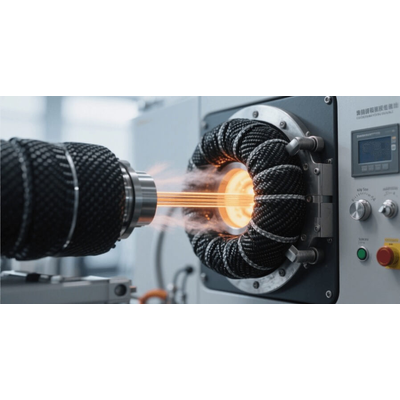
Carbon Felt Fiber Optics for Optical Fiber Field Industry - Manufacturing, Other
High-Performance Carbon Fiber Insulation Materials in the Fiber Optics Industry. High-performance carbon fiber insulation materials combine the advantages of carbon fiber, such as high strength, low thermal expansion coefficient, high thermal conductivity, and the design flexibility of composite materials, while also offering excellent thermal insulation properties. These characteristics enable them to address the limitations of traditional materials in critical stages of fiber optic technology.
Advantages:
- Extremely low thermal expansion coefficient: Highly compatible with the CTE of quartz glass fiber, preventing stress caused by temperature changes that could affect fiber performance.
- High strength-to-weight ratio/high modulus: Extremely robust yet lightweight, ideal for weight-sensitive, demanding environments.
- Excellent thermal stability and heat resistance: Capable of long-term operation in high-temperature environments without performance degradation.
- Customizable anisotropic thermal conductivity/insulation properties: Enables efficient heat conduction (cooling) in one direction and extreme thermal insulation (heating) in another direction.
- Corrosion-resistant and fatigue-resistant: Suitable for complex chemical environments and high-vibration scenarios.
High-precision insulation body for optical fiber drawing towers
In the process of drawing optical fiber preforms into optical fibers, the drawing furnace is a critical piece of equipment. The furnace temperature exceeds 2000°C, requiring an extremely stable and uniform thermal field to ensure uniform fiber diameter (even micron-level fluctuations can cause signal attenuation).
The “protective housing” for aerospace fiber optic sensing systems
Aircraft, satellites, and other aerospace vehicles extensively use fiber Bragg grating (FBG) sensors to monitor strain, temperature, and vibration in critical areas such as wings and fuselages in real time. These sensor systems are highly sensitive to temperature and mechanical vibrations.
The “Thermal Management Guardian” for High-Power Fiber Lasers
The laser gain fibers in high-power fiber lasers generate a significant amount of waste heat during operation. If this heat is not promptly and directionally dissipated, it can cause temperature increases,leading to thermal lensing effects, mode instability, or even fiber damage.
High-performance carbon fiber composite insulation materials, with their unique comprehensive properties, have found indispensable high-value applications in the fiber optic field from the manufacturing end (drawing towers) to the application end (optical cables, sensors, lasers), making them one of the key advanced materials driving the development of fiber optic technology toward higher performance, greater reliability, and energy efficiency.