


- Home
- Companies
- Edinburgh Instruments - TECHCOMP Group
- Applications
- Excitation-Emission Spectroscopy of ...
Excitation-Emission Spectroscopy of Single-Wall Carbon Nanotubes - Energy
Single-Wall Carbon Nanotubes (SWCNT) can be described as quasi-one dimensional structures of graphene. Due to their low dimensional structure, their optical and electronic properties are directly connected to their size. Steady-state fluorescence measuremSingle-Wall Carbon Nanotubes (SWCNT) can be described as quasi-one dimensional structures of graphene. Due to their low dimensional structure, their optical and electronic properties are directly connected to their size. Determination of the physical dimensions of nanotubes is important to elucidate their structure and open routes for
large scale applications. Ratiometric methods relying on photoluminescence, photoluminescence excitation and Raman measurements provide useful insights, since each
transition depends on the number of scattering centres in a sample.1,2 Different non-destructive optical techniques have been also proposed, such as Raman spectroscopy,3 ellipsometry,4 and more recently, white-light spectroscopy.5 However, fluorescence spectroscopy remains the preferred method due to its simplicity and speed, as will be outlined in this application note.
Steady-state fluorescence measurements of SWCNT produced by high pressure CO decomposition (HiPCO) method,6,7 were carried out in an FLS980 Photoluminescence
Spectrometer. The system was equipped with double excitation and single emission monochromators. A continuous 450 W xenon lamp was used for excitation and a NIR-PMT detector was used for photon detection. The system was equipped with 750 nm blazed gratings on the excitation arm and 1200 nm blazed gratings on the emission arm. The sample was measured in a front-face configuration in a quartz cuvette of path-length 10 mm.
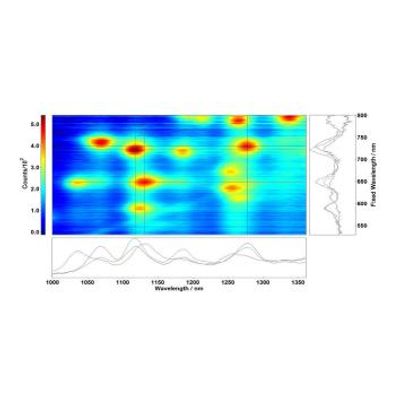
Each absorption-emission transition corresponds to one SWCNT species as shown in the excitation-emission map (EEM) of Figure 1.
The emission peaks from 1000 nm to 1300 nm can be seen. In particular, three excitation-emission pairs are marked, 742 nm-1118 nm (green), 648 nm-1132 nm (red), 728 nm-1278 nm (blue). Each transition is highly dependent on the size of each SWCNT. Consequently, each excitation-emission pair can be assigned to a single pair of diameter (d) and chiral angle (a), and further to a pair of integers n-m. However, the latter is subject to matching with the radial breathing mode of each SWCNT.3
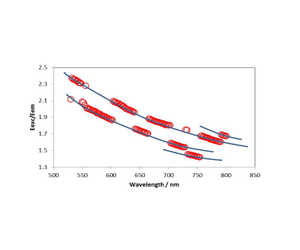
For the maximum of each emission spectrum of the EEM in Figure 1, the ratio of excitation energy Eexc=hc/λexc to emission energy Eem=hc/λem(max) was calculated and displayed in Figure 2. It can be seen that the maxima are grouped into nanotube families sharing common n–m values as calculated by the tight-binding model,8,9 or empirical fitting.10
To conclude, fluorescence spectroscopy was used to obtain excitation-emission maps of single-wall carbon nanotubes. This enabled initial insights into the structural characteristics of the nanotubes and is preferred for analysis of nanoscale materials due to the simplicity and fast acquisition of the technique.
- Bachilo, S. M. et al. Structure-Assigned Optical Spectra of Single-Walled Carbon Nanotubes. Science 298, 2361–2366 (2002).
- Jorio, A. et al. Carbon nanotube population analysis from Raman and photoluminescence intensities. Applied Physics Letters 88, 023109 (2006).
- Dresselhaus, M. S., Dresselhaus, G., Saito, R. & Jorio, A. Raman spectroscopy of carbon nanotubes. Physics Reports 409, 47–99 (2005).
- Battie, Y. et al. Diameter dependence of the optoelectronic properties of single walled carbon nanotubes determined by ellipsometry. Carbon 83, 32–39 (2015).
- Mehlenbacher, R. D. et al. Energy transfer pathways in semi-conducting carbon nano tubes revealed using two- dimensional white-light spectroscopy. Nat Commun 6, 6732 (2015).
- Nikolaev, P. et al. Gas-phase catalytic growth of single-walled carbon nanotubes from carbon monoxide. Chemical Physics Letters 313, 91–97 (1999).
- Kukovecz, A., Pichler, T., Pfeiffer, R. & Kuzmany, H. Diameter selective charge transfer in p- and n-doped single wall carbon nanotubes synthesized by the HiPCO method. Chem. Commun. 1730–1731 (2002).
- Kataura, H. et al. Optical properties of single-wall carbon nanotubes. Synthetic Metals 103, 2555–2558 (1999).
- Reich, S., Maultzsch, J., Thomsen, C. & Ordejón, P. Tight-binding description of graphene. Phys. Rev. B 66, 035412 (2002).
- Weisman, R. B. & Bachilo, S. M. Dependence of Optical Transition Energies on Structure for Single-Walled Carbon Nanotubes in Aqueous Suspension: An Empirical Kataura Plot. Nano Lett. 3, 1235–1238 (2003).