

Microgrids & Renewable Energy - Hil Testing for Renewable, Resilient and Reputable Grids - Energy - Renewable Energy
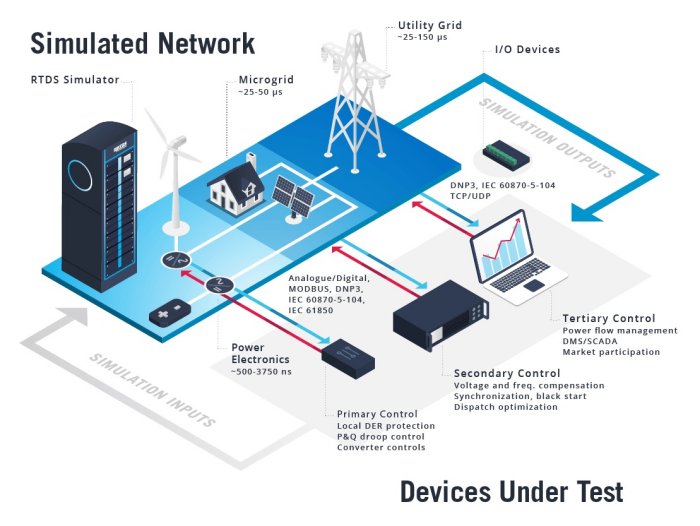
Combining HIL and PHIL testing creates a powerful microgrid testbed capable of physically connecting the simulated network, controllers requiring low-level or Ethernet-based signals, protection requiring secondary-level signals, and real power hardware exchanging real and reactive power with the simulated environment.
DER Models
Solar PV array, wind turbine, PEM fuel cell, Lithium Ion energy storage, reactive power compensation, dynamic loads, wound rotor / doubly fed induction machine, squirrel cage induction machine, permanent magnet synchronous machine.
Converter Models
2- and 3-level VSCs switching in the 50+ kHz range, custom topology VSCs, average VSC models (less computationally intensive).
Control Components (including MATLAB/Simulink)
Freely configurable controls components allow the modeling of: P&Q droop control, DQ-current control, MPPT, pitch angle control, sync check, startup/shutdown, governor/exciter models. Control systems developed in MATLAB/SIMULINK can be directly imported.
Communication
High-speed TCP/UDP, DNP3, IEC 60870-5-104, IEC 61850-9-2LE Sampled Values, IEC 61850 GOOSE Messaging, IEEE C37.118 for synchrophasor data.
Use DNP3, IEC 60870-5-104, and more to connect the simulated network to high-level controls and management systems including DMS and SCADA. Optimize power flow and market participation and quantify performance prior to energization.
Test centralized microgrid controllers against functional requirements in real time. De-risk against misoperation and instability during planned and unplanned disconnection and improve voltage and frequency resilience in contingency scenarios.
Mitigate negative interactions between parallel-connected converters using real time, instantaneous results. Combine virtual and physical DER protection and control in a testbed to comprehensively assess performance over a wide range of conditions.