

- Home
- Companies
- Fineamin SA
- Articles
- Alkali Boil-Out FAQ: Expert Advice for ...
Alkali Boil-Out FAQ: Expert Advice for Boiler Start-Up
Based on the actual alkali boil out procedure, emphasizing the steps and precautions necessary to ensure optimal boiler performance, this article is dedicated to briefly answering frequently asked questions surrounding the process, specifically when using FINEAMIN® water treatment chemicals for boiler cleaning.
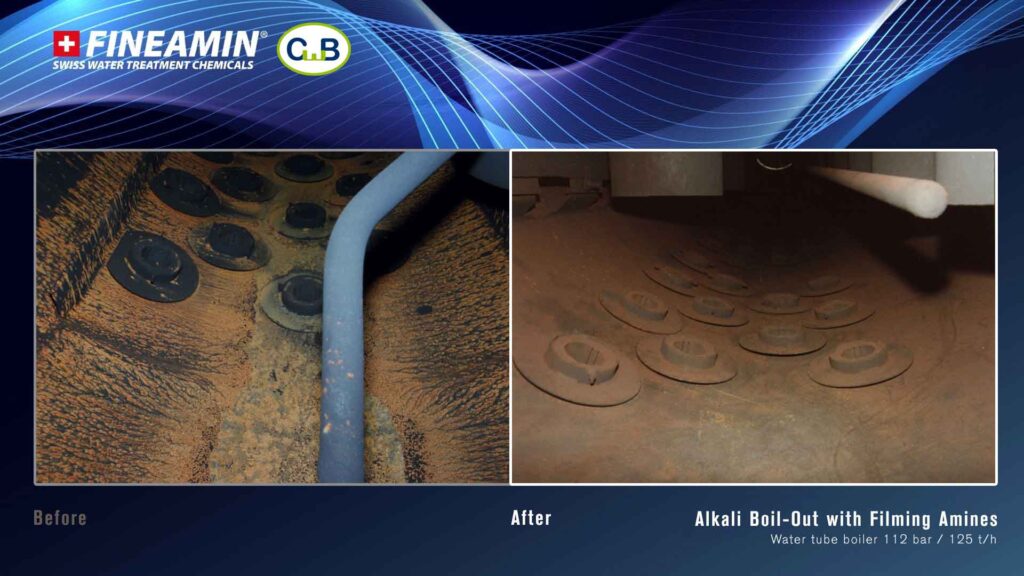
We recently hosted a webinar on the boil-out procedure (Recording) using film-forming amines, with a focus on Fineamin 15.
During the session, participants raised several questions about how this more modern method compares to traditional caustic soda boil out and how it works in practice. Some of these questions, along with other frequently asked ones, are worth sharing here for anyone preparing a boiler start-up.
An alkali boil-out is an essential cleaning process where a boiler is filled with water and treated with alkaline chemicals to remove oil, grease, welding debris, and oxides from internal surfaces to ensure safe, efficient, and reliable operation. The boiler is then heated to boiling, flushed, and rinsed before normal operation begins. This also helps in slowing down any corrosive reactions.
- Before the first startup of a new boiler
- After major repairs or tube replacements
- When recommissioning a boiler that has been idle for a long period
Traditional methods include chemicals such as caustic soda (sodium hydroxide) and trisodium phosphate. While effective, these substances are corrosive and pose safety and environmental risks.
However, FINEAMIN chemicals for boil out offer a greener alternative for with similar metal passivation properties as the ones already mentioned. Plus, an increased dispersing effect.
The dispersing effect, enhanced by the additional content of polymers, allows impurities to be more easily removed from the boiler by blowdown, making the cleaning process more efficient.
In addition to their alkalizing and impurity-dispersing capabilities, Fineamin chemicals create a protective polyamine layer on all internal boiler surfaces, ensuring corrosion prevention.
- Severe burns if it comes into contact with skin or eyes
- Requires extensive protective equipment
- Blowdown water is difficult to neutralize and may cause environmental compliance issues
FINEAMIN® products for boil out are more than 90% biodegradable, making them less impactful on the environment upon disposal compared to traditional boiler boil out methods.
Key parameters to be kept under close observation include conductivity, pH, Fe (iron), and POC (polyacrylate) and/or free film forming amine residual, measured every 4-6 hours.
A typical alkaline boil-out may take from 12 hours to multiple days depending on boiler size, system conditions and chemicals used, but using Fineamin reduces rinsing time since cleaning and passivation happen simultaneously.
No. A conventional alkali boil-out cleans only. Passivation is a separate step to create a protective oxide layer. Fineamin, for example, simplifies the process by combining cleaning and passivation in one step.
Yes — a boiler can be boiled out using Fineamin film-forming amine products and then operated under a conventional treatment program (e.g. oxygen scavengers, phosphates, dispersants). But many operators choose to continue with Fineamin long-term because of its combined protection and simplified dosing.
One of the key advantages of using Fineamin is its versatility. The same mixture can be used for:
- the initial alkaline boil-out procedure,
- ongoing protection against corrosion and scale during operation,
- and boiler preservation during shutdowns.
The polyamine film formed during a boil-out offers initial protection, but it does not remain stable indefinitely on its own. For the film to be maintained and reinforced over time, a continuous treatment program is required.