
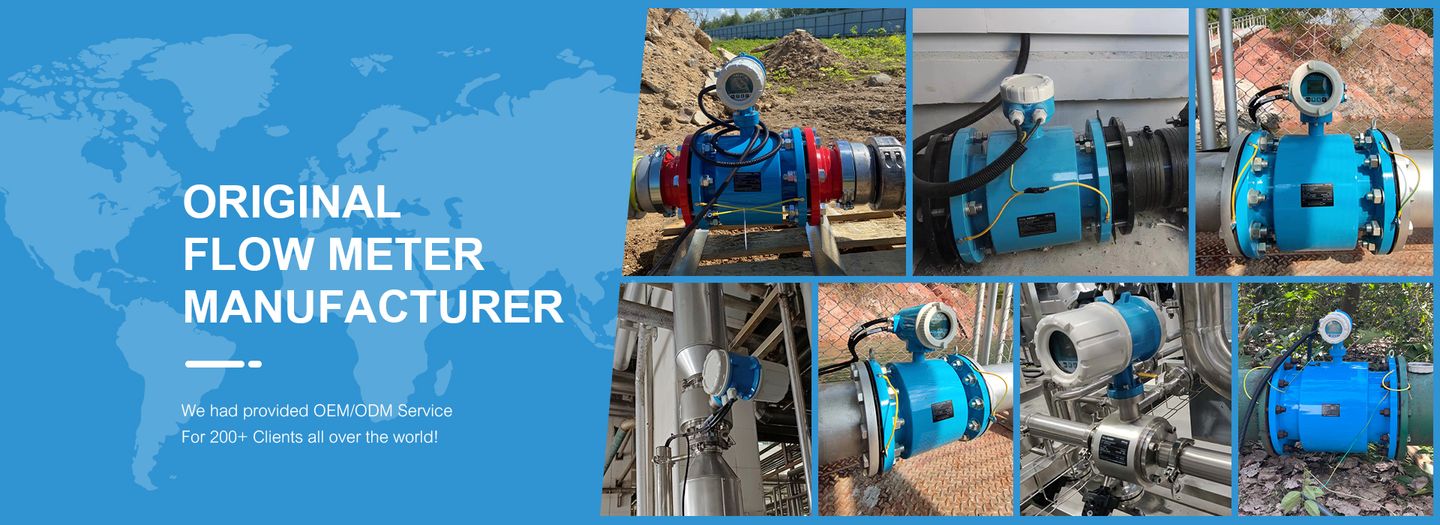

Application of flowmeter in sewage treatment measurement
The construction of sewage treatment plants is one of the important means of treating sewage. At present, Tianjin has built and put into operation 58 sewage treatment plants with a total daily treatment capacity of 2.6 million tons, making the sewage treatment rate of the city reach more than 85% (more than 90% in urban areas). Most of the existing sewage treatment plants are invested and built by enterprises, and the sewage treatment costs are settled by the government. Liquid flowmeters are the main measuring instruments in sewage treatment plants and are the basis for settlement between the two parties. Since other types of liquid flowmeters (such as turbine flowmeters, vortex flowmeters, etc.) have relatively high requirements for water quality, the commonly used liquid flowmeters in sewage treatment plants are electromagnetic flowmeters and ultrasonic flowmeters.
3. The two types of flowmeters have their own advantages and disadvantages:
(1) The advantages of electromagnetic flowmeters in sewage measurement are mainly in the following aspects:
(a) The pressure loss is relatively small. The sensor structure of the electromagnetic flowmeter is simple, there are no moving parts in the measuring tube, and there are no throttling parts that hinder the flow of fluid. When the fluid passes through the flowmeter, it will not cause any additional pressure loss. The resistance of the flowmeter is only the resistance along the same length of the pipeline. It is one of the flowmeters with the lowest operating energy consumption.
(b) It can measure the flow of dirty media and suspended liquid-solid two-phase flow. The measurement channel of the electromagnetic flowmeter is a smooth straight tube, without detection components that hinder the flow, and it is not easy to block the liquid-solid two-phase fluid containing solid particles or fibers.
(c) The volume flow measured by the electromagnetic flowmeter is actually not affected by changes in fluid density, viscosity, temperature, pressure and conductivity. The main disadvantage is that it cannot measure liquids containing a large amount of gas.
(2) The advantages of ultrasonic flowmeters in sewage measurement are mainly as follows:
(a) Non-contact measurement can be performed.
(b) Generally, like electromagnetic flowmeters, it is a flow-free measurement without pressure loss.
(c) It can measure non-conductive liquids, which is a supplement to electromagnetic flowmeters with unobstructed measurement.
Time-based ultrasonic flowmeters can only be used for clean liquids and are generally used to measure the flow of the outlet pipe of a sewage plant. Considering the impact of impurities and bubbles in the pipe on the electromagnetic flowmeter during sewage measurement, and the importance of ultrasonic flowmeters in daily maintenance, flowmeters dedicated to sewage measurement will be the future research direction of flow workers.