

- Home
- Companies
- Earth Shield Environmental Co., Ltd.
- Articles
- Benefits of Using Geomembranes for ...
Benefits of Using Geomembranes for Aquaculture as Lining
In the global aquaculture industry’s move towards intensification and sustainable development, Aquaculture geomembrane linings have transformed from an optional technology into a critical infrastructure, with their multiple advantages vividly demonstrated in practices across various countries. In the arid deserts of Saudi Arabia, their exceptional impermeability locks precious water resources in ponds, making mariculture possible on cement-scarce soil. In intensive shrimp ponds in Thailand, their smooth pond bottoms significantly improve the efficiency of shrimp harvesting and pond cleaning, achieving a management revolution. In coastal shrimp farms in Ecuador, their robust yet flexible properties adapt to complex terrain, effectively preventing the escape of high-value shrimp. In upgrade projects in Indonesia, the closed systems they create facilitate centralized wastewater treatment, addressing both environmental and market certification requirements. And on the saline-alkali wastelands of Egypt, they have become pioneers in transformation, turning barren land into fertile fish and shrimp ponds. These global success stories collectively demonstrate that geomembrane linings are reshaping the face of modern aquaculture with their diverse values. The use of geomembranes as linings in aquaculture offers the following significant benefits:
Prevents Water Loss: Geomembranes have extremely low permeability coefficients (typically less than 10?¹³ m/s), effectively preventing water from seeping into the soil and reducing water waste, especially suitable for arid or severely seeping areas.
Isolates Soil Pollution: Prevents contact between aquaculture water and underlying soil, preventing heavy metals, pathogens, and other pollutants from entering the aquaculture system and reducing disease risks.
Maintains Stable Water Quality Parameters: Reduces fluctuations in temperature, salinity, and pH caused by water exchange, which is beneficial for aquatic organism growth.
Case Study Country: EarthShield Saudi Arabia Aquaculture Client
Purchased Product: 1.0mm HDPE Geomembrane
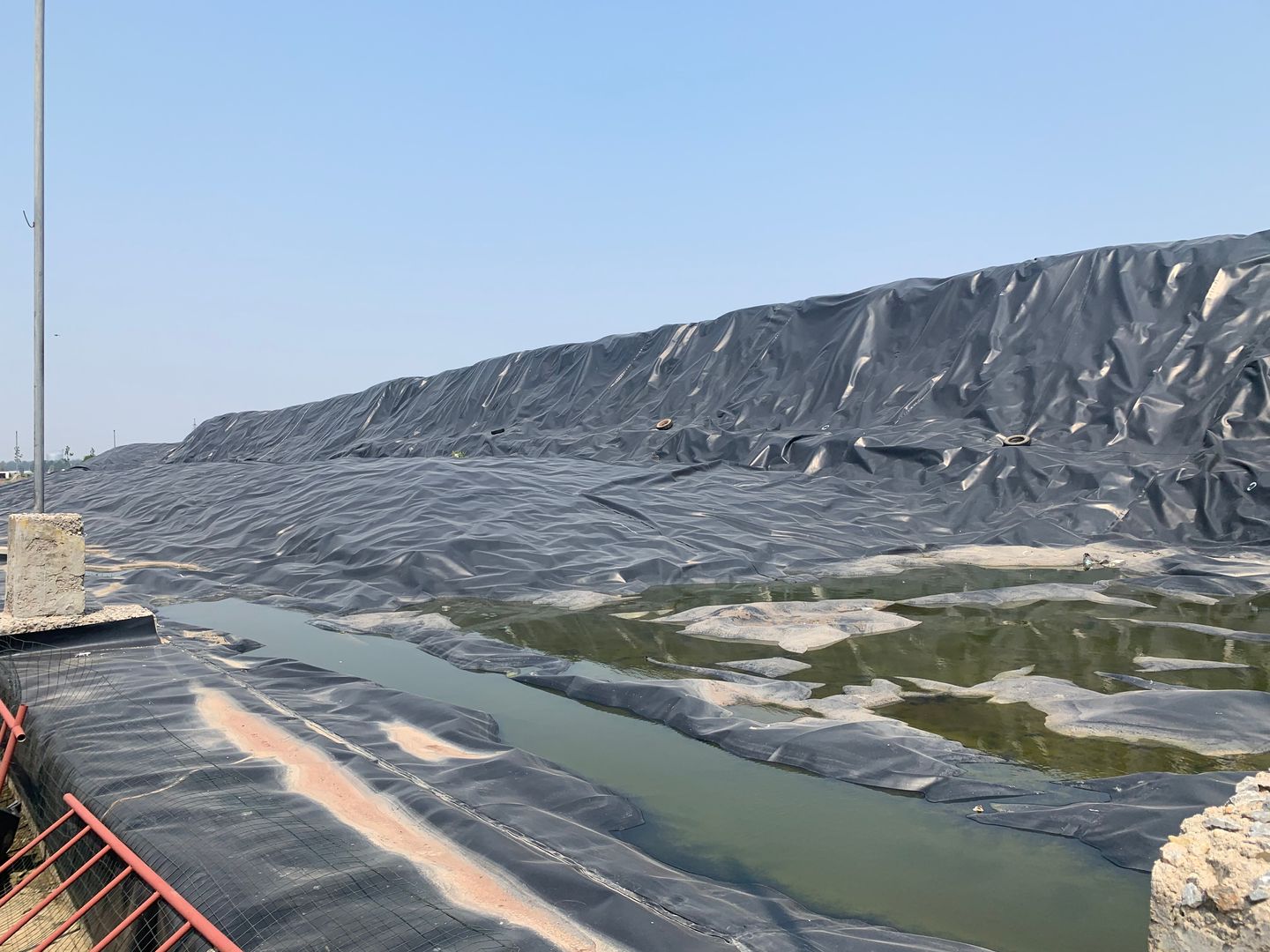
Case Description: Saudi Arabia has an arid climate, making water resources extremely precious, and its soil is mostly sandy with extremely high permeability. The use of HDPE geomembranes was key to the feasibility of its inland brackish water shrimp aquaculture project. The geomembrane completely blocked water seepage into the desert soil, making large-scale aquaculture possible in water-scarce areas. At the same time, it isolates the salt and impurities in the sand, allowing the farm to precisely control the salinity and temperature of the water, creating a stable breeding environment, thus enabling the successful production of seafood in the desert.
Precise Control of Feeding and Medication: Feed and medications are less likely to seep into the soil, improving utilization and reducing costs.
Simplified Pond Cleaning and Harvesting: The smooth surface facilitates drainage, sludge removal, and harvesting, reducing labor and time costs.
Prevention of Predatory Species Invasion: Isolates weeds, parasites, etc., from the soil, reducing competition and disease transmission.
Case Study Country: EarthShield’s Thai Aquaculture Client
Purchased Product: 1.5mm HDPE Geomembrane
Case Description: Thailand is a traditional major shrimp farming country, but traditional earthen ponds are prone to pathogens and difficult to manage. In intensive shrimp farms along the eastern coast of Thailand, old earthen ponds are commonly converted into geomembrane elevated ponds. The smooth membrane bottom eliminates the need for extensive manpower to search the pond during harvesting; harvesting can be completed efficiently by using nets or draining water, reducing time by more than 50%. With no sludge at the bottom of the pond, it can be easily cleaned with a high-pressure water gun during pond cleaning, which greatly saves labor and time costs, enables multiple harvests per year, and significantly improves production efficiency and land turnover rate.
Anti-aging and Puncture Resistance: High-quality geomembranes (such as HDPE and LLDPE) are UV-resistant and corrosion-resistant, with a service life of over 50 years.
Adaptable to Complex Topography: Flexible materials can be laid in ponds of various shapes to reinforce slopes and reduce the risk of erosion.
Escape-Proof Design: Can be used as the foundation for escape-proof walls to prevent farmed organisms such as shrimp and crabs from burrowing and escaping.
Case Study Country: EarthShield Ecuadorian Aquaculture Client
Purchased Product: 1.5mm HDPE Geomembrane
Case Description: Ecuador is a major shrimp farming country globally, with numerous shrimp ponds along its coast. In intensive shrimp farms in Guayas Province and other areas of Ecuador, high-strength HDPE geomembranes are commonly used to construct and line aquaculture ponds. In some local aquaculture areas with loose soil or uneven terrain, the geomembrane, with its excellent flexibility, can tightly adhere to and reinforce the pond walls and bottom, adapting to complex foundations. Its excellent puncture and corrosion resistance can withstand the long-term erosion of shrimp activity, machinery, and seawater salinity. More importantly, this sturdy, seamless barrier, combined with the buried escape-proof net, effectively prevents high-value shrimp from escaping due to burrowing or water flow, greatly ensuring the biosecurity of aquaculture profits.
Reduced Long-Term Costs: Although initial investment is higher, reduced leakage and maintenance costs lead to improved long-term returns.
Environmentally Controllable: Centralized collection of aquaculture wastewater facilitates treatment before discharge or recycling, reducing environmental pollution.
Enhanced Land Adaptability: Aquaculture ponds can be constructed even in sandy or gravelly areas with poor water retention, improving land utilization.
Case Study Country: EarthShield Indonesia Aquaculture Client
Purchased Product: 1.0mm HDPE Geomembrane
Case Description: In Indonesia, especially in the major shrimp farming areas of Sumatra and Java, traditional open aquaculture models are being upgraded due to increased environmental awareness and the promotion of sustainability certifications (such as ASC). Many large-scale farms are converting their ponds into closed aquaculture models with centralized wastewater treatment systems, where all aquaculture ponds, sedimentation tanks, and treatment tanks are lined with geomembranes. This design firstly completely prevents aquaculture wastewater from seeping into the ground, thus avoiding groundwater pollution. Secondly, it encloses all wastewater within a seepage-proof system, facilitating unified collection and treatment through biological filtration and aeration, achieving compliant discharge or partial recycling. This not only meets increasingly stringent environmental regulations and export market requirements but also reduces long-term operating costs through water resource recycling, enhancing the farm’s environmentally friendly image and market competitiveness.
Intensive Aquaculture: Suitable for high-density aquaculture (e.g., shrimp, bass, eel).
Saline-Alkali Land Conversion: Prevents salt and alkali from seeping into water bodies, reducing the impact of soil salinization.
Recirculating Water Systems: Used as an impermeable layer in sedimentation and purification ponds, in conjunction with water treatment facilities.
Case Study Country: EarthShield’s Tilapia and Shrimp Farming Client in Egypt
Purchased Product: 0.75mm HDPE Geomembrane
Case Description: Egypt developed aquaculture on saline-alkali land around the Nile Delta. This land was unsuitable for agriculture, but by laying geomembranes, it was successfully transformed into valuable aquaculture water surfaces. The geomembrane blocked the upward seepage of groundwater and also prevented the downward leakage of aquaculture water, which exacerbated soil salinization. Farmers used this model to build numerous tilapia and shrimp ponds on previously unusable land, significantly improving the comprehensive utilization rate of land resources and turning waste into treasure.
Aquaculture Pond Liner Installation Precautions:
Professional Installation: Installation must be carried out by a professional team to ensure strong welds at the joints and prevent damage.
Substrate Protection: Level the ground before installation; use non-woven geotextile to protect the membrane if necessary.
Water Quality Monitoring: Geomembranes are non-absorbent; therefore, strict water quality management is necessary to prevent the accumulation of metabolic waste.
Pond liner for aquaculture significantly enhances the controllability and sustainability of aquaculture through its functions such as efficient seepage prevention, pollution isolation, and improved management efficiency. Although the initial investment is slightly higher than traditional aquaculture methods, its long-term economic benefits, environmental friendliness, and adaptability to complex conditions make it an important choice for modern intensive aquaculture. In practical applications, scientific design and construction are necessary, taking into account the aquaculture species, geographical conditions, and management needs, to maximize its benefits. If you have an aquaculture project under construction or about to be constructed, please contact us. We can provide you with professional technical support 24 hours a day online, and can also provide you with free samples of aquaculture geomembrane liners for testing.