


- Home
- Companies
- BinMaster Sensors and Technologies LLC
- Articles
- Bulk Density is Key to Bulk Material ...
Bulk Density is Key to Bulk Material Storage
What is bulk density? In simple terms, it’s mass per unit volume of powder, liquid, granules, or any material in a solid state.
When handling solids or powders, a bulk material’s weight is usually stated as lb./ft.³ or g/cm³. Veteran processors often have their material weights memorized. While the graphics and easy-to-understand reports on BinCloud® software seem to generate easily, bulk inventory information is calculated using numerous traits, including vessel size, headspace, and bulk material density.
Measurements Rely on Density
Picture this: a food production company uses level sensors to monitor a silo of flour and ensure timely refills. Then... They switch brands of flour. The new flour holds a higher bulk density, which impacts measurements, which delays a refill, which stops production.
Another example: an animal feed operation uses a 3DLevelScanner to measure a mix in a storage tank. Density fluctuates with temperature. Operators didn’t anticipate or average density correctly. The result: the sensor underestimates supply and production stops.
Ouch.
“There’s a lot of promises about bulk level sensors out there, but getting the right system—and getting it configured correctly—takes some know-how,” said Mike Mossage, BinMaster Vice President – Sales for the eastern U.S. “We’ve built our software to account for things like bulk density and we always encourage operators to give us a call when material changes or level readings seem off.”
Level sensors on bins, tanks, and silos don’t directly account for bulk density. Instead, they assume a constant—or known—bulk density. Sensors typically measure headspace (the distance between material and the top of the vessel), along with vessel geometry, pressure, weight, and distance to create a level reading. Then, volume and weight can be derived. Mossage said strapping tables also help measurements and their accuracy.
BinMaster engineers continue to push developments in technology. Level systems can now include multiple sensors: 3D, continuous level monitoring, and high-tech software solutions like BinCloud to improve accuracy.
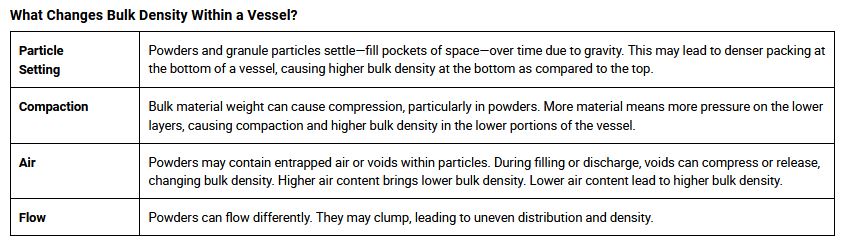
"The density of products can be different inside one silo," said Nathan Grube, BinMaster VP, Central U.S. "In some cases, material compacts at the bottom; not so much at the top. We’ll look at that. We’ll ask about how often material loads and unloads and we’ll come up with workable averages.”