

- Home
- Companies
- Coulson Ice Blast
- Articles
- Deflashing and Deburring (the best ...
Deflashing and Deburring (the best solutions & methods)
Deflashing, deburring, and/or edge finishing is a constant challenge for machinists and technicians in many different industries. Some of the industries requiring cost effective and efficient deflashing and deburring processes include; Medical, Electronics, Marine, Automotive, and Aerospace.
The Challenges of Deflashing and Deburring
Edge finishing, deburring and deflashing are essential stages in the manufacturing process, and it can be costly. Depending on the product(s) being produced, and the precision required to finish those products, the costs can be extreme.
"For some parts, burr removal represents 30% of the cost of fabrication." - Laroux K. Gillespie, B.S./M.S. Mechanical Engineering, 2012 DESA recipient (read full Deburring, Deflashing and Edge Finishing of Microparts abstract here)
The type of material used, size of the parts, and type of parts (precision, close-tolerance, medical, aviation, etc.) must all be factored in when estimating finishing costs. For some manufacturers removing burrs and flash might represent only 5-10% of their fabrication cost. However, that might still be a large number in the overall fabrication cost.
Regardless of the different expense levels each manufacturer deals with; they need to reduce their costs, and produce a better product than their competition.
What`s the Difference Between Deburring and Deflashing?
DEBURRING: "Deburring machines remove burrs from machining, grinding or drilling, round off sharp edges, and radius corners on machined parts, castings, forgings, molded components and welded assemblies.”
DEFLASHING: “Deflashing machines remove flash, dross or parting lines on castings, forgings, molded components and welded assemblies. The sharp edge of a parting line or flashing could be considered a burr, so in some respects a deflashing machine is a subset of deburring machinery."
List of Manufactering Materials for Deburring and Deflashing
Common materials used in manufacturing can include:
Silicone, Nylon, PEEK (polyetheretherketone thermoplastic), Polycarbonates, Polyurethanes, ABS (acrylonitrile butadiene styrene plastic), Acetals, Delrin, Polyphenylene Ether, Turcite, Ryton (olyphenylene sulfide), EPDM (synthetic rubber), PBT (polybutylene terephthalate), Acetal, LCP (Liquid Crystal Polymer), Nitinol, Plastics, Rubber, Stainless Steel, Aluminum, and Sheet Metal.
Deburring and Deflashing Different PARTS
The solution or machine required for deburring silver on an electronic circuit board is completely different than the deburring solution for silver jewellery.
The same goes for the different solutions needed when deflashing small plastic parts. The deflashing solution on that 1956 BMW 507 model kit your Mom or Dad gave you on your 12th birthday, is completely different than the solution used for deflashing a finished front grill on a REAL 1956 BMW 507 you bought for your retirement (or midlife crisis...or both).
Industrial Molding Processes Requiring Deflashing
Most mold production requires a deflashing process near the finishing stage. This may include:
Blow molding, Spin casting, Powder Metallurgy, Injection Molding, Compression Molding, Extrusion Molding, Thermoforming, Laminating, Reaction Injection Molding, Matrix Molding, Rotomolding, and Transfer Molding.
LIST of Deburring METHODS
The main methods of deburring can include: media blast deburring (which we cover in more length below), tumbling deburring, vibratory deburring, edge shearing, extrusion deburring with abrasive compounds, brushing, filing, cutting blade deburring, thermal deburring, trim press deburring, mounted point deburring, carbide deburring, abrasive disc, belt, and flap wheel deburring.
LIST OF Deflashing METHODS
The main methods of deflashing can include cryogenic deflashing, trim press deflashing, brush deflashing, media blast deflashing (below), thermal energy deflashing, magnetic abrasive deflashing, and ultrasonic vibration deflashing.
TRADITIONAL Media Blasting for Deflashing and Deburring
The use of media blasting technology has been ideal in the past for many different deburring and deflashing applications. The first media blasting methods included; glass bead blasting, plastic bead blasting, soda blasting, steel shot blasting, aluminum oxide blasting, silicone carbide blasting, walnut shell blasting, staurolite blasting, corn cob blasting, and sand blasting.
Some of these traditional blasting methods are too abrasive for some applications, while some of the methods aren`t abrasive enough. It really comes down do to finding the best media blasting solution for the job (best finish product for the least amount of money). However, ice blasting is one of the best new forms of blasting that can provide your company with an environmentally friendly and cost-effective solution.
Dry ice blasting has many advantages over traditional forms of media blasting. Some of these advantage include:
Less Down Time: As it allows you to deburr and deflash in situation, technicians don`t have to disassemble moldings and/or fabrication equipment to get the job done.
Environmentally Responsible & Worker Safety: Wet and dry ice blasting doesn`t require the use of toxic chemicals found in solvents.
Less Costly Than Traditional Blasting Media: Less employee hours, and faster deburring and deflashing which increases the productivity of your workforce.
Less Wear & Tear: Wet and dry ice blasting can greatly reduce the wear and tear on expensive molding, robotics, various fabrication equipment set ups.
Superior End State Product(s): Dry ice blasting can greatly improve the finished products coming off the line.
More information on dry ice blasting history and technology here.
Wet Ice Blasting: the Ultimate Deburring and Deflashing SolutionIf you’re deburring and deflashing requirements can be met with ice blasting, wet ice blasting is the much more affordable, environmentally friendly and health conscious solution.
Below we provide the reasons why wet ice blasting is superior over dry ice blasting, but it’s been said that a video is worth 1.8 million words (source) so here are two more videos we enjoyed making for you.
1) Wet Ice Blasting Saves A Lot of Money:
-
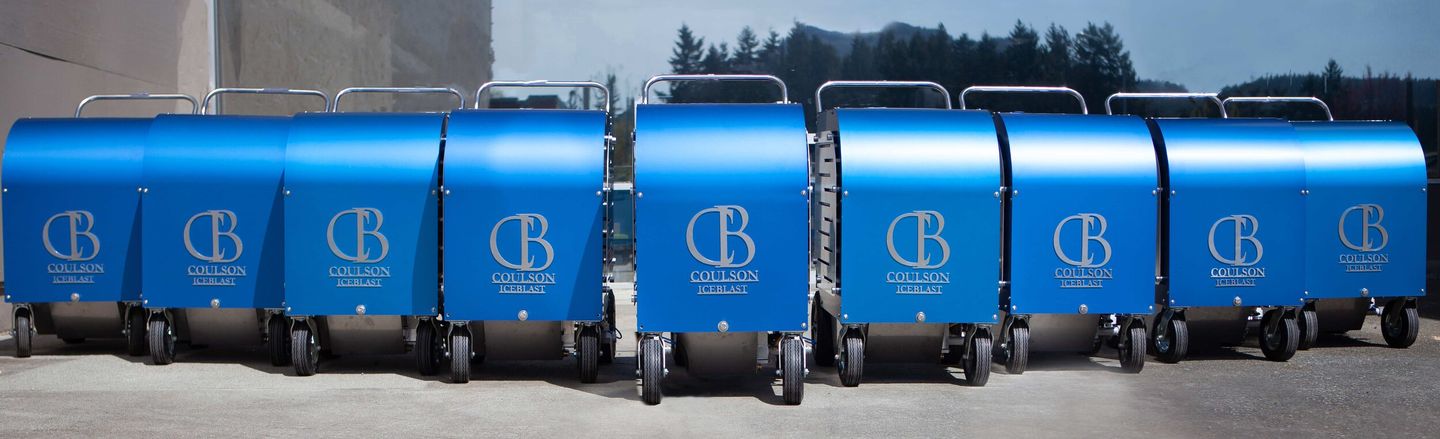
With wet ice blasting machines (invented by Coulson Ice Blast in 2012) such as the IceStorm 90 and IceStorm 45, operators can use everyday ice cubes for media. Ice cubes cost far less that dry ice pellets or dry ice blocks. Read this article that breaks down the cost difference between dry ice media and wet ice media.
-
Because dry ice isn`t always readily available, deburring and deflashing work can be interrupted leading to downtime. There is often a shortage of dry ice in the supply line and there is nothing an operator can do when this happens.
2) Superior Cleaning Power:
Ice has a superior cleaning power to any other media and is the only medium to use all three states of matter during blasting; solid state to hit with maximum impact, liquid state to trap and contain airborne contaminants, and gaseous state to minimize waste streams.
3) Unique Cleaning Mechanism:
Ice is the only medium with three cleaning mechanisms (bulk removal, detail clean, and final rinse). You can decontaminate and clean in one step rather than two steps for traditional dry ice blasting.
4) Environmentally Friendly:
Ice is environmentally friendly with minimal levels of airborne contaminants (0.003 MG/m3), less water requirement (up to 95%), and minimal residual water waste. It releases no greenhouse gases (compared to 259,200 lbs for dry ice blasting) and only needs minimal ground containment (compared to full containment). This will help you to meet the more stringent environmental regulations enacted since the development of traditional blasting.
DEBURRING AND DEFLASHING WITH ICE + AUTOMATIONIn our recent post on industrial robotics and ice blasting we covered how Coulson Ice Blast technology is being used in the automated manufacturing and fabrication industry. These videos below show two examples of robots carrying out deburring and deflashing armed with our wet ice blasting technology.
The IceStorm45 Machine Uses Wet or Dry IceWe`re happy to inform you that our IceStorm45 technology gives you the unique ability to use wet ice OR dry ice blasting media in the same portable, lightweight machine. Wet and/or dry ice blasting may be the perfect solution for your company`s deflashing and deburring needs.