

Drum Mix Asphalt Plant Approval Depends on Supplier Environmental Support
When planning a drum mix asphalt plant, the environmental support provided by asphalt plant suppliers determines how smoothly site approval proceeds and how reliably the plant operates long term. Buyers should evaluate suppliers’ emissions data, noise mitigation strategies, dust management solutions, and documentation for permitting. High-quality environmental support reduces approval delays, lowers compliance costs, and limits operational interruptions from regulatory actions. This article focuses strictly on how supplier-delivered environmental measures and paperwork influence both initial permitting and the plant’s sustained, lawful operation.
Emissions data and compliance documentation
First, assess the completeness and credibility of emissions documentation supplied by asphalt plant suppliers. Authorities commonly require source-specific emissions inventories, stack test reports, and guaranteed particulate and gaseous limits. Suppliers who provide detailed test reports from similar drum mix asphalt plant installations, backed by measurement methodologies and instrument calibrations, shorten review cycles. Conversely, vague or generic emissions claims provoke additional sampling requirements that delay permits and increase costs.
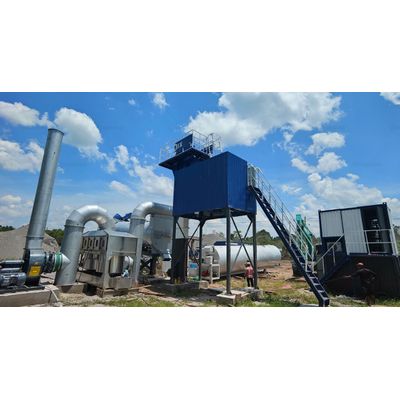
Second, verify whether suppliers supply design features that reduce emissions—effective dust collectors, properly sized baghouses and well-designed transfer points—and whether performance guarantees are contractual. Guarantees tied to measurable limits give regulators confidence and provide buyers legal recourse if limits are exceeded. Suppliers should also include predicted emission dispersion modeling and contingency plans for exceedances to aid the approval process.
Third, ensure all emissions-related instruments come with calibration certificates and maintenance schedules. Continuous emissions monitoring requirements are increasingly common; asphalt plant suppliers that integrate compatible monitoring interfaces and provide procedure documents enable operators to meet reporting obligations without extensive third-party modifications.
Noise control, odor management and community impact mitigation
Noise and odor are frequent causes of permit refusal or community complaints. Evaluate the noise attenuation measures offered by asphalt plant suppliers—enclosed pumps, acoustic enclosures for fans and generators, and low-noise conveyor designs. Suppliers that provide measured sound-power data and predicted site-specific noise contours help planners choose siting and mitigation strategies that meet local criteria.
Odor control near binder storage and transfer points is another supplier-dependent factor. Vendors who supply closed transfer systems, venting with activated carbon or thermal oxidation options, and documented control efficiencies reduce the likelihood of nuisance complaints that can trigger inspections or operational restrictions. Request technical descriptions and performance data to validate claims.
Finally, community engagement materials supplied by vendors—plain-language operating descriptions, typical emission profiles, and mitigation plans—assist applicants in addressing public consultation phases. When asphalt plant suppliers provide such materials proactively, permitting authorities and stakeholders receive the context needed to approve operations with fewer conditions that could constrain long-term throughput.
Operational readiness, monitoring and adaptive support
Long-term lawful operation depends on ongoing compliance, not just initial approvals. Asphalt plant suppliers who offer packaged monitoring solutions, spare parts for emission-control devices, and training for environmental monitoring reduce the risk of noncompliance from equipment failure or operator error. Buyers should ask suppliers for spare-parts lists with lead times for critical components like filter bags and fan motors.
Adaptive support is also crucial: suppliers that commit to post-installation tuning visits, remote diagnostics, or rapid-response service contracts help operators maintain emission control performance over changing feedstocks and operating conditions. Such commitments limit unplanned shutdowns that can arise from failed inspections.
Lastly, require suppliers to provide documentation templates for regulatory reporting and incident response plans. Ready-to-use logs and response procedures simplify audits and ensure that corrective actions are timely and traceable, protecting both site authorization and production continuity.
Conclusion
Environmental support from asphalt plant suppliers—robust emissions data, noise and odor mitigation, and ongoing monitoring and service—directly affects the speed of site approval and the durability of permitted operations for a drum mix asphalt plant. Prioritizing suppliers that deliver verifiable environmental performance and operational support mitigates approval risk and sustains lawful production over the plant’s lifecycle.