


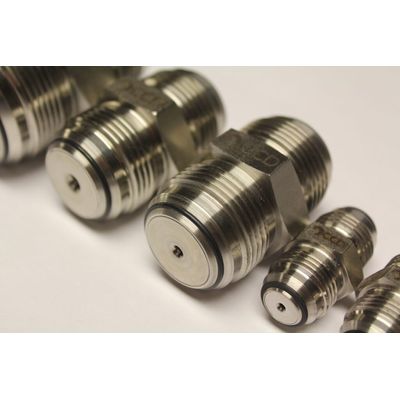
Dynamic Precision: Why Active MFCs are Outpacing Static Sonic Nozzles
In the high-stakes world of modern metrology, the debate between using Sonic Nozzles (critical orifices) and Mass Flow Controllers (MFCs) is no longer just about accuracy—it is about agility. While the sonic nozzle has long been a staple of gas flow measurement, its reliance on fixed physical geometry is increasingly becoming a bottleneck for high-throughput, automated laboratories.
Here is why the industry is shifting toward the active regulation of the MFC.
1. Hardwired Steps vs. Digital Fluidity
The core difference lies in how flow is generated. A sonic nozzle is a "fixed-geometry" device. To change a dilution ratio, you often have to physically swap hardware or manifold different nozzles together. It is a mechanical solution to a digital problem.
In contrast, an MFC uses a high-speed proportional valve governed by a closed-loop electronic system. Instead of being locked into hardware "steps," the user can dial in any setpoint—such as a 12.45% concentration—and the device adjusts instantly. This transforms gas flow from a static constraint into a software-defined variable.
2. Proactive vs. Reactive Environment Defense
A common industry myth suggests that because sonic nozzles are "mechanical," they are more stable. In reality, physics dictates that flow through an orifice is hypersensitive to upstream pressure and temperature.
- The Nozzle Approach: These systems are reactive. They use external sensors to calculate environmental drift and then try to "fix" it by adjusting an external pressure regulator. It is a chain of mathematical assumptions.
- The MFC Approach: These systems are proactive. Because the sensor and valve are integrated into a single millisecond-speed loop, the MFC neutralizes "noise" (like temperature spikes or pressure drops) before it ever impacts the output. It doesn't just calculate a fix; it physically enforces the setpoint in real-time.
3. Overcoming the "Pressure Gap"
Integration is where the sonic nozzle faces its steepest climb. To maintain the "choked flow" required for accuracy, a nozzle typically requires a strict 2:1 pressure ratio (upstream vs. downstream). This makes it difficult to deliver gas into pressurized reaction chambers or systems with fluctuating back-pressure.
MFCs act as an active buffer. Their ability to maintain precise mass flow against significant back-pressure allows for much greater versatility in system design. Whether you are venting to atmosphere or injecting into a pressurized line, the MFC remains indifferent to the downstream environment.
4. Maintenance: Transparency vs. Mystery
All metrological instruments drift over time, but how they handle that drift defines their operational cost:
- Nozzle Dependency: If the external pressure transducer or the upstream regulator drifts, the nozzle’s accuracy dies with it. Even worse, microscopic erosion or clogging in the orifice can cause "silent errors" that are impossible to fix without replacing the hardware.
- MFC Transparency: Because an MFC is a self-contained smart system, performance shifts are digitally observable. If a routine check shows a slight deviation, the device can often be realigned extending its service life without requiring a hardware overhaul.
The Verdict: Future-Proofing the Lab
The sonic nozzle is a respected piece of metrological history, but the modern laboratory demands more than just a "fixed" measurement. The move toward MFC technology represents a shift toward active, closed-loop regulation. By offering infinite resolution, superior pressure tolerance, and digital diagnostics, the MFC provides a level of operational freedom that static orifices simply cannot match. For those looking to automate and scale, the choice is clear: the future of flow is active.