


- Home
- Companies
- PlugCo - a brand by ArGesim Makina
- Articles
- Effective Pipeline Leakage Testing: ...
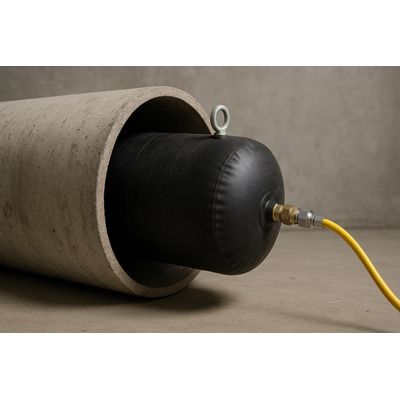
Effective Pipeline Leakage Testing: Plug Selection, Placement, and Procedures
Plugs are used for temporary blocking, closing gravity pipelines, or for leakage tests of newly constructed pipelines. Correct plug selection in testing and temporary blocking operations is essential for test integrity and safety.
1. Pipe Diameter and Plug Sizing
- If the plug will be used in multiple pipe diameters, a multi-size plug should be preferred.
- If the plug will be used in a single pipe diameter, a single-size plug should be selected.
- Care should be taken to ensure that the internal diameter of the pipe where the plug will be used is within the usable diameter range of the plug.
- Note: In cases where the plug will be used in critical applications, a higher model of the suitable plug should be preferred to stay on the safe side.
Example: Internal Pipe Diameter: 400-500–600 mm; Working Pressure: 0.5 bar; Suitable Plug Model: PP300600 (1.5 bar model). If the application is critical and difficult, instead of the PP300600/1.5 bar plug, the PP300600/2.5 bar or PP375800/1.5 plug model should be used to stay on the safer side.
2. Back Pressure / Test Pressure
Back Pressure refers to the maximum water head that the plug can withstand, i.e., the pressure generated by the water accumulating behind the plug. Test Pressure is the pressure value applied during the leakage tests of newly constructed pipelines. This value is specified in the EN 1610 standard or defined in project specifications. For plug selection, back pressure and test pressure refer to the same information and are indicated on the plug’s label or data sheet.
For more detailed information: the back pressure and test pressure specifications are associated with the plug model and its data sheet.
3. Media Resistance
- For non-chemical fluids, plugs produced from standard flow materials such as SBR+NR rubber with reinforced cord fabrics can be used.
- For chemical fluids such as gas or oil, plugs manufactured from Nitrile (NBR) rubber with high chemical resistance must be preferred.
- For potable (drinking) water lines, the plug should be manufactured with rubber that is not harmful to health.
- For applications involving high temperatures, the raw material should be selected from heat-resistant options.
- Plugs can be manufactured to meet specific application requirements.
4. Application-Specific Requirements
Inflatable plugs are generally used for the following applications:
- Repairing broken or faulty pipelines by temporarily blocking them: during repair, a by-pass plug enables transfer of actively flowing fluid to another location.
- Use of by-pass plugs: by-pass plugs are required to facilitate flow transfer.
- Water discharge: to enable faster transfer or to prevent the pressure behind the plug from exceeding the back-pressure limit, water should be discharged with the help of a pump.
In leakage tests of newly constructed pipelines, if there is an opening such as a manhole to add water, a non-bypass inflatable plug can be used with both ends blocked by PP model plugs, and the test water filled through the manhole.
In leakage tests without openings or manholes, if there is no access point, two PTP plugs or a combination of one PP plug and one PTP plug are used to fill the line with water or air. Testing with PTP (By-pass) plugs involves filling the test area with water or air through the bypass line of the PTP model plug.
For repairs involving a manhole, temporary blocking is performed with a PTP model plug, and dewatering is accomplished via the bypass line using a motor pump. If the manhole diameter is smaller than the pipe diameter, the deflated diameter of the plug must be smaller than the manhole diameter. Example: a 500 mm manhole and a 1200 mm pipe require a plug whose deflated diameter is less than 500 mm; the PP6001200 has a deflated diameter of 586 mm, which would not fit the entrance. In such cases, a conical foldable plug is recommended, provided the condition D_manhole > D_pipe plug is met.
Frequently Asked Questions
- 1. What are the basic criteria for plug selection? The pipe diameter, back pressure (or test pressure), fluid type, and project-specific requirements.
- 2. What is the difference between a multi-size plug and a single-size plug? Multi-size plugs accommodate multiple diameters; single-size plugs fit a single fixed diameter.
- 3. What does “Back Pressure” mean? The maximum water head the plug can withstand behind it.
- 4. What rubber should be used in lines exposed to chemical fluids or oil? Nitrile (NBR) rubber with high chemical resistance.
- 5. What are the characteristics of plugs used in potable water lines? Rubber should be non-harmful to health and suitable for drinking water.
- 6. In which cases is a by-pass (PTP) plug necessary? To transfer flow via a bypass, discharge accumulated water, or fill test water/air in lines without manholes.
- 7. What solution is used if the manhole entrance is narrower than the pipe diameter? Conical, foldable plugs are preferred.
- 8. How should plug selection be made for critical and difficult applications? To stay on the safe side, select a higher model within the appropriate diameter range.
- 9. According to which standards are pipeline leakage tests performed? Generally according to EN 1610 or project specifications.
- 10. For which fluids are standard SBR+NR rubber plugs suitable? Non-chemical fluids such as domestic wastewater or rainwater.