

Festival music never sounded so good
Jochen Schaal, Managing Director at SoundPLAN GmbH – a market leader in sound and air pollution mapping software – looks at the developments in understanding and mitigating nuisance noise at open air events.
Introduction
Music festivals have been popular for decades, with millions of attendees across the globe at events such as Lollapalooza in Argentina and Chile, Glastonbury in England or Coachella in the United States, to name but a few. Part of the attraction of festivals is the loud music but this can damage hearing and also be nuisance to those in the surrounding area. Jochen Schaal, Managing Director at SoundPLAN GmbH – a market leader in sound and air pollution mapping software – looks at the developments in understanding and mitigating nuisance noise at open air events.
Concern about excessive noise at concerts and festivals is not new. The US National Library of Medicine - National Institutes of Health reports that in 2001 during the Paleo Festival in Nyon, Switzerland, a number of volunteers were given small sound level meters to monitor their sound exposure while they took in the sights and sounds of the festival. Sound levels at the mixing console and in front of the speakers – where people are most heavily exposed – were also measured.
To get greater insight into the audience experience, a sample were also interviewed over the course of the festival and asked about sound level and quality, where in the arena they preferred to listen to the music; whether they used ear plugs, and if they had experienced any tinnitus following exposure to loud noise.
The results showed that: “The individual sound exposure during a typical evening was on average 95 dB(A) although 8% of the volunteers were exposed to sound levels higher than 100 dB(A). Only 5% of the audience wore ear plugs throughout the concert while 34% used them occasionally. While some 36% of the people interviewed reported that they had experienced tinnitus after listening to loud music, the majority found both the music quality and the sound level good.”
There was a sound level limit of 100 dB(A) at the place where the people were most heavily exposed. This was judged to be a good compromise between public health demands, artists and organisers’ plans, and audience expectations. However, considering the average sound levels to which the public are exposed during a single evening, the US National Library of Medicine - National Institutes of Health recommends that ear plugs are used when concert-goers attend more than one day of a festival. This is because it is generally agreed that the danger of hearing loss is a given if people are exposed to a noise level of more than 85 dB(A) for a sustained period.
It is clear that noise from outdoor entertainment events is also a serious topic for the surrounding neighbourhood, particularly as the number of events in populated urban environments is increasing. As well as considering the health and safety of those in attendance, neighbourhoods in affected areas are quite rightly concerned about their exposure to nuisance noise from festivals and other events. To get permission to stage an event, the organiser now usually requires an official statement with a prediction of the noise impact on the surrounding areas.
New solution
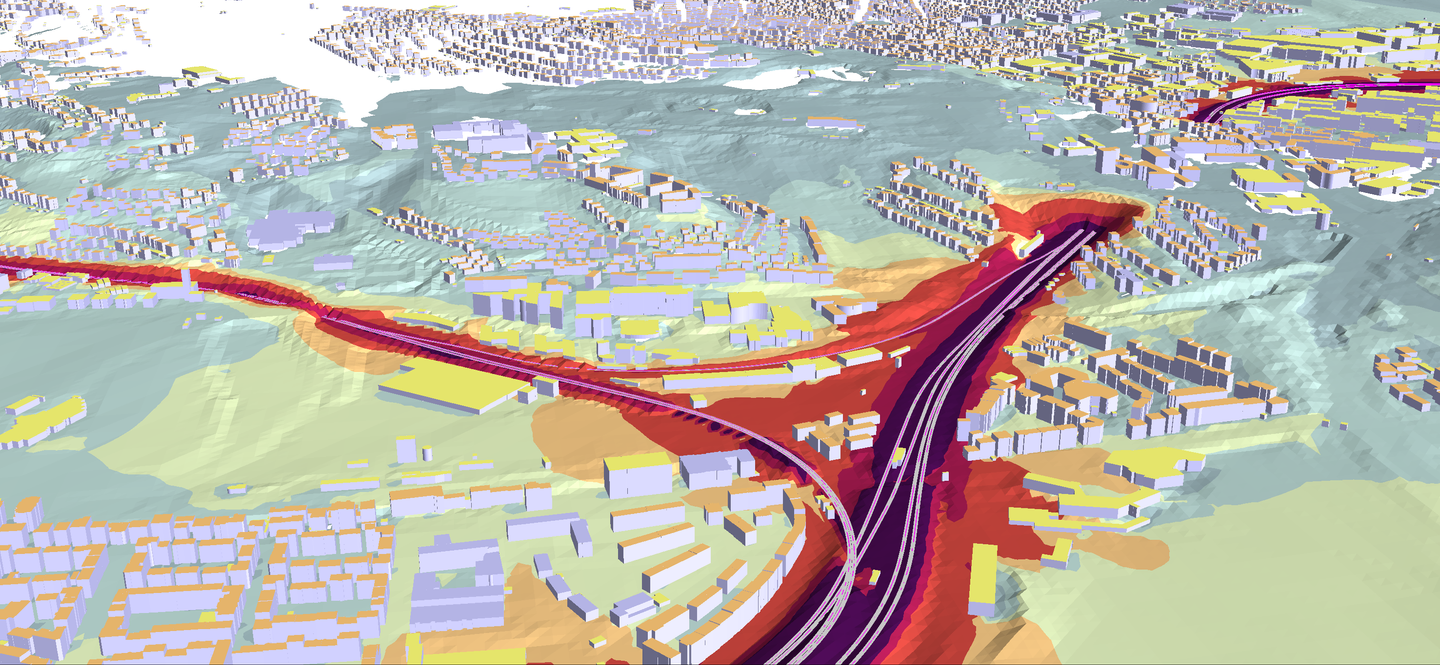
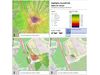
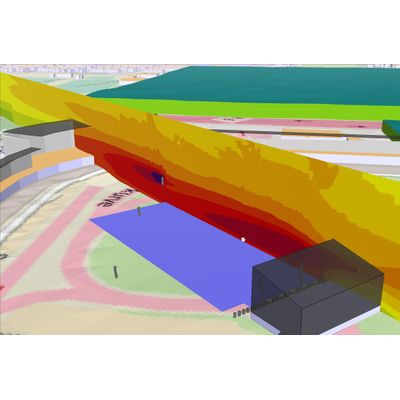
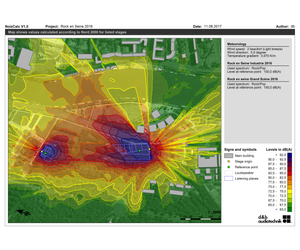
NoizCalc, is a revolutionary free to use software tool, which can be used to predict the far field noise emission of open air events, giving a graphical overview already during the planning of the stage setup. It is the result of a close collaboration between audio technology manufacturers d&b audiotechnik and noise control and software development experts from SoundPLAN GmbH. Their simulation software SoundPLANnoise uses multiple extensive reporting capabilities to create an official statement about the expected noise levels based on a wide range of international propagation standards. The next version of SoundPLANnoise will also be able to import d&b system setups from ArrayCalc (a simulation tool for planning system configurations from d&b audiotechnik). Both software tools NoizCalc and SoundPLANnoise, are able to import those project files from d&b ArrayCalc, with all the complex data of the interaction of all the sources. Based on this, the software, predicts the sound propagation of multiple coherently emitting sources such as line arrays and subwoofer arrays. Using 3D terrain data the software accurately predicts the far field noise emission across the terrain according to ISO 9613-2 and Nord2000 standards. This allows system designers to predict any potential noise issues during the event planning stage, including consideration of specific meteorological conditions. Once they have been identified organisers can model mitigation methods, such as sound barriers to ensure disturbance is limited.
Sabina Berloffa, Chief Marketing Officer at d&b audiotechnik described NoizCalc as: “a straightforward solution for sound system designers who are now able to investigate how their loudspeaker systems will impact on a wider area. With SoundPLAN, our software development partner, we have found a counterpart who shares our vision to develop an easy to use noise prediction tool.”
We are delighted to have teamed up with audio experts d&b to use our joint expertise to find a safer way for music lovers to enjoy outdoor events with less disturbance for the neighbours, meaning the music has never sounded so good!