Guidelines for offshore in situ testing and interpretation in deepwater soft clays
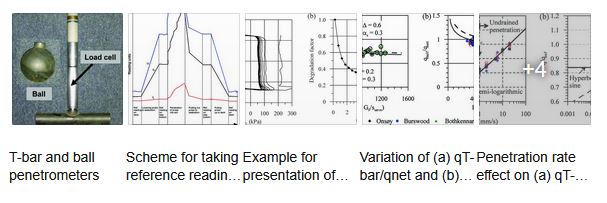
Offshore developments for hydrocarbon resources have now progressed to water depths approaching 3000 m, with geotechnical design increasingly focused on soft sediments in the upper 30 m or so of the seabed. Due to the difficulties and high cost in recovering high-quality samples from deepwater sites, there is increasing dependence on in situ testing techniques for determining the geotechnical design parameters. This paper summarizes the findings from a joint industry project, undertaken by the Norwegian Geotechnical Institute and the Centre for Offshore Foundation Systems at The University of Western Australia, on the use of in situ testing for the characterization of deepwater soft soils. The project focused on theoretical and empirical studies for the interpretation of piezocone, T-bar, and ball penetration test data, linking the penetration resistance to shear strengths determined from in situ vane tests and laboratory tests on high-quality samples. Guidelines are summarized for interpreting in situ test data, particularly for estimating intact and remoulded undrained shear strengths from the penetration resistance measured by each type of penetrometer. Suggestions are also given for future development of in situ testing techniques to maximize the potential of in situ testing in characterization of deepwater soft soils.