


- Home
- Companies
- Ocean Global Non Wovens Pvt Ltd
- Articles
- HDPE Liner for RCC Project in ...
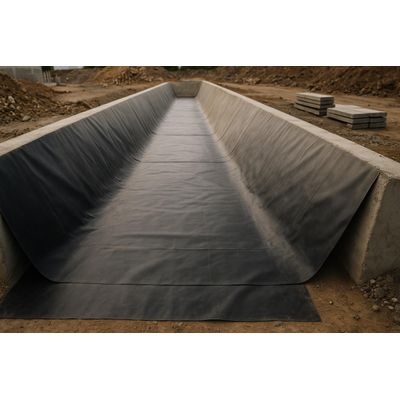
HDPE Liner for RCC Project in Chhatrapati Sambhaji Nagar
Reinforced Cement Concrete projects in Maharashtra increasingly rely on barrier and lining systems to mitigate moisture ingress and subgrade interaction. This case study documents the deployment of Ocean HDPE Liner (300 micron) for a RCC-related infrastructure project in Chhatrapati Sambhaji Nagar, Maharashtra. The scope covered 2,857 square meters of liner installation as part of protective and separation layers within RCC works.
HDPE liners in RCC infrastructure HDPE liners provide a moisture barrier, seepage control, chemical protection, and subgrade separation to enhance long-term performance of RCC elements exposed to moisture, aggressive soils, and dynamic loads.
Key functional roles include:
- Moisture barrier: prevents ingress to concrete substructures, reducing reinforcement corrosion risk.
- Seepage control: provides an impermeable layer under channels, tanks, and drains.
- Chemical protection: blocks aggressive soils or effluents from contacting concrete surfaces.
- Subgrade separation: minimizes contamination between subgrade soils and RCC elements, supporting durability.
Regulatory context: national guidelines on industrial wastewater containment recognize polymeric liners like HDPE for containment and seepage control in lined channels and holding structures due to low permeability and chemical resistance.
Role of composite mats in related civil engineering projects
While this project employed HDPE liners, geosynthetic cementitious composite mats (GCCM) are increasingly used in RCC works as thin, hardening concrete-on-a-roll layers.
- Lining drainage channels and canals to reduce erosion and seepage
- Protection of slopes and embankments from surface runoff
- Rapid lining of culverts and stormwater channels
- Erosion protection beneath and around RCC structures
Industry studies indicate lined channels can reduce water losses due to seepage by 30–60% compared with unlined earthen channels, improving hydraulic efficiency and longevity. The dual-layer approach of HDPE liner plus composite mat enhances performance against seepage and subgrade moisture intrusion.
Broader geosynthetics in infrastructure
- Pavement reinforcement: geogrids and geotextiles beneath concrete pavements distribute loads and reduce cracking, with evidence suggesting pavement life extension of 20–40% when properly designed and installed.
- Soil stabilization: geotextile separation maintains load-bearing capacity in weak subgrades.
- Erosion control: mats, composite mats, and geotextiles protect slopes and embankments.
- Drainage improvement: geocomposites facilitate lateral drainage under RCC slabs, mitigating hydrostatic pressure in high water table scenarios.
- Environmental protection: HDPE liners support containment structures and utility corridors to prevent soil and groundwater contamination.
Site challenges under Indian conditions
- Variable subgrade soils from silty clays to loose alluvium affect liner bedding and settlement behavior.
- Monsoon-driven installation schedules; wet subgrades can trap moisture under liners, impacting adhesion and potential uplift if hydrostatic pressure is present.
- Urban or constrained sites limit subgrade preparation; protective cushioning layers such as non-woven geotextiles may be required to preserve liner integrity.
Installation complexities and quality control
- Surface preparation: subgrade must be free of sharp objects and protrusions to avoid puncture.
- Seaming and joint integrity: even at 300 micron thickness, overlaps and seals must be inspected and tested to prevent seepage paths.
- Anchorage and edge detailing: proper anchorage prevents liner slippage during concrete pours.
- Protection during concreting: avoid direct damage from reinforcement and equipment; use protective layers and sequencing to minimize punctures.
Long-term performance and environmental exposure
- UV resistance: prolonged exposure degrades HDPE; minimize during construction.
- Thermal movement: HDPE expands/contracts with temperature; design should accommodate movement to prevent wrinkling and stress.
- Chemical exposure: HDPE resists most industrial effluents, salts, and mild acids.
- Mechanical stress: repeated loading requires cushioning and proper design to mitigate fatigue over decades.
Laboratory ageing studies indicate HDPE geomembranes retain functional performance for decades when protected from UV exposure and installed under controlled conditions. This is supported by standard geosynthetics design references.
Maintenance, durability, and lifecycle considerations
- Lifecycle cost implications: while liners add initial cost, they reduce long-term maintenance by minimizing moisture ingress, subgrade weakening, repairs in lined channels, and extending RCC service life. Assessments indicate maintenance cost reductions of roughly 25–40% over a 20-year horizon for lined versus unlined drainage systems.
Conclusion: The RCC project in Chhatrapati Sambhaji Nagar demonstrates the role of HDPE liners in mitigating moisture ingress, subgrade interaction, and long-term deterioration, reinforcing the value of geosynthetics in durable, environmentally safe infrastructure for India.
Final note: Ocean Non Wovens supplied the Ocean HDPE Liner (300 micron) for the project and maintains capability for large-scale deployment and technical support across Indian sites.
Original: https://oceangeosynthetics.com/hdpe-liner-rcc-project-chhatrapati-sambhaji-nagar/