

How does a fully automatic tripod turnstile work?
How does a fully automatic tripod turnstile work?
In practice, semi-automatic tripod turnstile suffers from the drawback that once the condition that has resulted in disengagement of the mechanisms maintaining the arms in the operational state has been eliminated and regular operation is to be resumed, the arms must be shifted back manually into their usual and operational state. Because the access turnstile will require more time to return to service, the fully automatic tripod turnstile is a solution to this issue.
Unlike a semi-automatic tripod barrier turnstile, the fully automatic barrier gate operates with an incremental-advance motor. Once the condition resulting in disengagement of the mechanisms that maintain at least the tripod gate barrier means currently in the thoroughfare-obstructing position in the operational state has been eliminated, the force that shifts the thoroughfare-obstructing means out of their non-operational state and back into their usual and operational state are exerted on the thoroughfare- obstructing means in the non-operational state by advancing the thoroughfare-obstructing means at least one increment.
The fully automatic tripod turnstile gate accordingly addresses reinstating thoroughfare-obstructing means in the non-operational state by exerting the force that shifts the thoroughfare-obstructing means out of their non-operational state and back into their usual and operational state by the advance of the thoroughfare-obstructing structure.
The axis of the thoroughfare-obstructing structure in the electric tripod barrier is at an angle to the horizontal. Its thoroughfare-obstructing means are arms. When the arms are in their thoroughfare-unobstructing position they are at least approximately horizontal. When a condition resulting in disengagement of the mechanisms that maintain at least the thoroughfare-obstructing means currently in the thoroughfare-obstructing position in the operational state occurs, the arms will fold down into a non-operational state subject to gravity and the force that shifts the arms out of their non-operational state to their usual and operational state will also be gravity. Gravity will become effective once the arm’s articulation to the thoroughfare-obstructing structure has revolved through the nadir of its orbit as the structure rotates around its axis. At the nadir, accordingly, the weight of the thoroughfare- obstructing means as concentrated at their center of gravity that shifts them out of their non-operational state and back into their usual and operational state.
A thorougMare-obstructing arm that has folded down into a non-operational state can be shifted back to its usual and operational state with particular reliability in a turnstile access control system with three thorougfare-obstructing arms that extend out trigonally from the axis of the thoroughfare-obstructing structure by advancing the thoroughfare-obstructing structure at least two adjacent increments. In this event, the articulation of the folded-down arm to the thoroughfare-obstructing structure revolves through the nadir of its orbit.
The thoroughfare-obstructing means are shifted out of their non-operational state and back into their usual and operational state by centrifugal force that occurs as the thoroughfare-obstructing structure resumes rotation once the condition resulting in disengagement of the mechanisms that maintain at least the thoroughfare-obstructing means currently in the no-thoroughfare position in the operational state has been eliminated.
The force that shifts the thoroughfare-obstructing means out of their non-operational state and back into their usual and operational state is gravity and becomes effective as the thoroughfare-obstructing structure rotates. The reinstating force is centrifugal. All these forces act on the center of gravity of the folded-down arms and radially away from the axis of rotation. They also have components acting straight down from the arms’ articulation to the thoroughfare-obstructing structure and accordingly tending toward reinstatement, however.
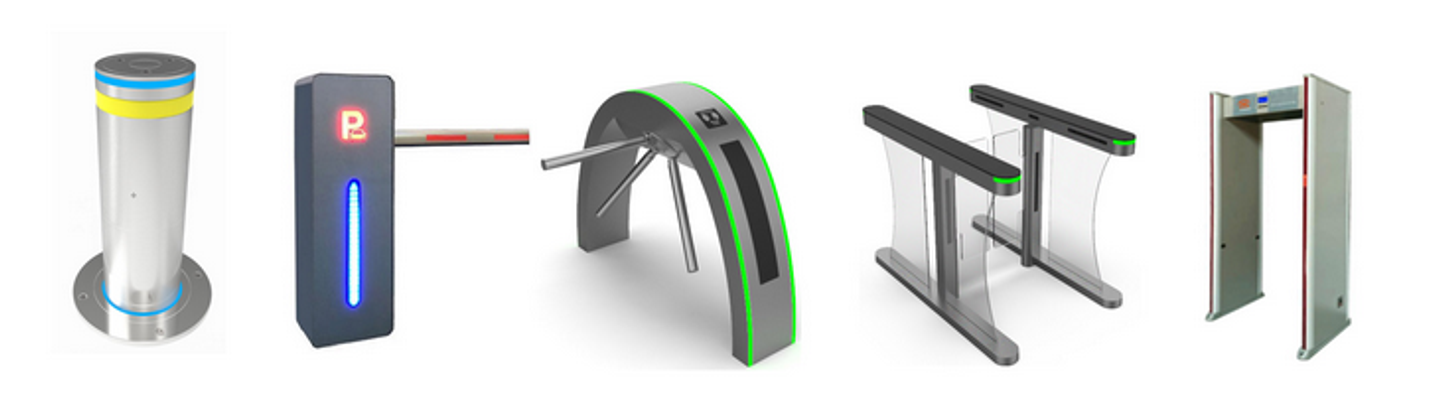
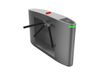
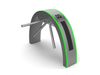
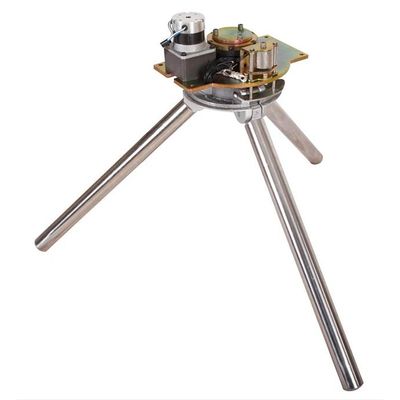
A fully automatic waist-height turnstile includes a turnstile in the form of three thoroughfare-obstructing arms extending at angles of 120° to one another out of a transmission housing mounted on a column. The turnstile rotates on housing around an axis at an angle of approximately 45° to the horizontal. Arms can be folded down out of their usual operational state and into a non-operational state around axes of articulation on a hub that extends at a right angle to the axis of rotation. Hub is mounted tight on a shaft and coupled to an incremental-advance motor accommodated in housing by way of shaft and cogwheels. The motor advances the hub in increments around the axis of rotation. Arms extend out of the hub separated by angles of 120° along the surface of an imaginary cone that tapers out and away from the hub. In their usual and operational state, one arm is always in a horizontal position that obstructs thoroughfare, and the other two slopes down and out of the way as will be particular. When someone arrives at the gate, the horizontal arm is shifted out of its thoroughfare-obstructing position due to his actuation as the motor rotates the hub. Hence, the turnstile, and the thoroughfare become unobstructed. The next upstream arm in the sense of rotation simultaneously assumes the thoroughfare-obstructing position once the gate has been passed.
A fully automatic Tripod gate turnstile with its arms separated by angles of 120° will rotate at increments of 120°. One arm will in the usual and operational state always be in the thoroughfare-obstructing position. The arms that fold down around an axis of articulation on the hub will be maintained in the usual and operational state by electromagnetic mechanisms that can be disengaged . When the electromagnetic mechanisms are disengaged due to power failure or interruption, whichever arm happens to be in the essentially horizontal thoroughfare obstructing position will fold down subject to gravity out of that position, the position always assumed while the arms are in their usual and operational state, into the thoroughfare-unobstructed position. Since, due to the structure of the entry access control system, the other arms are already in a thoroughfare-unobstructed position, it will be possible for anyone to pass by the gate once the arm originally in the thoroughfare-obstructed position has folded down.
Once the problem resulting in disengagement of the mechanisms that maintain at least the thoroughfare-obstructing means currently in the no-thoroughfare position in the operational state has been eliminated, the gate can be readied to resume regular service by motor incrementally rotating turnstile around the axis of rotation until the arm in the non-operational state pivots back into its usual and operational state around its axis of articulation to the hub and is once more maintained in that state. A folded-down arm can especially reliably be shifted back into its usual and operational state in a turnstile with three arms separated by angles of 120° once the problem resulting in disengagement of the mechanisms that maintain at least the thoroughfare-obstructing means currently in the no-thorougMare position in the operational state has been eliminated by rotating the turnstile at least two increments so that the axis of articulation to the hub of the arm that is to be shifted back into its usual and operational state from its non-operational state travels through the nadir of its orbit.
Please visit www.jaydagate.com or e-mail us at luke@jaydagate.com for more details on us and our products.