


How-to calculate the Acid Dew Point (ADP) of flue gas
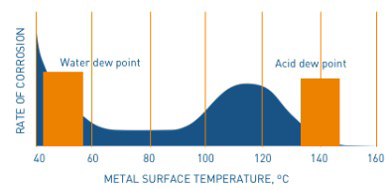
Acid Dew Point calculation formulas
There are multiple formulas available to accurately calculate the Acid Dew Point. Each formula takes the H2O and SO3 levels of your flue gas into consideration.
Okkes
The Acid Dew Point formula from Okkes:
TDEW (°C) = 203.25 + 27.6log10(pH2O) + 10.83.log10(pSO3) + 1.06.(log10(pSO3) + 8)2.19
Where:
pH2O = volume fraction H2O in m3/m3
pSO3 = volume fraction SO3 in m3/m3
Verhof
The Acid Dew Point formula from Verhof:
TDEW (K) = 1000/[2.276-0.0294.ln(pH2O) – 0.0858.ln(pSO3) + 0.0062.ln(pH2O.pSO3)]
Where:
pH2O = partial pressure H2O in mm Hg (= volume fraction * pressure in mm Hg)
pSO3 = partial pressure SO3 in mm Hg (= volume fraction * pressure in mm Hg)
ZareNezhad
The Acid Dew Point formula from ZareNezhad:
TDEW (°C) = 150 + 8.1328.ln(pH2O) + 11.664.ln(pSO3) – 0.38226.ln(pH2O).ln(pSO3)
Where:
pH2O = partial pressure H2O in mm Hg (= volume fraction * pressure in mm Hg)
pSO3 = partial pressure SO3 in mm Hg (= volume fraction * pressure in mm Hg)
Differences between Acid Dew Point calculation formulas
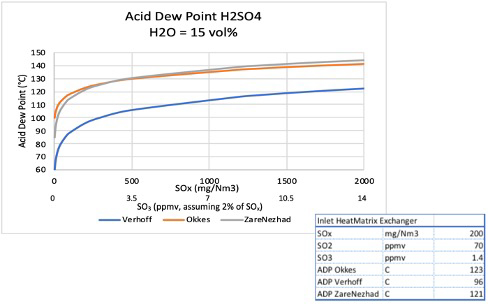
Verhoff’s equation results in a 20 to 40 ℃ lower Acid Dew Point. The ZareNezhad equation closely follows the Okkes equation at higher SO3 levels and calculates a slightly lower ADP at lower SO3 levels.
SO3 itself is hard to analyze for. Typical SO3 levels are assumed to be in the range of 2 – 4% of the SOx level measured. The corresponding graph for the acid dew point related to the SOx level (in mg/Nm3) in the gas, assuming a 2% SO3 content is as follows.
Which Acid Dew Point formula to choose?
Throughout the industry, the ADP correlations of Okkes and ZareNezhad are mainly used. If operation above ADP is desired, it is common to use an additional margin of >10 ℃ above the ADP. This approach provides an engineering basis for a corrosion free operation.
Cooling through the Acid Dew Point without heat exchanger corrosion
Heat recovery potential below the Acid Dew Point
Because of the acid dew point issue, flue gases are normally kept at relatively high temperatures and sent to the atmosphere. That is a pity because the heat from that flue gas can be recovered and reused.
Heat exchanger resistant to acid corrosion
Polymer heat exchangers of HeatMatrix have been designed to be resistant to acid corrosion. This is achieved through the application of Ultra Performance Polymers, specifically chosen for their excellent chemical resistance to corrosive flue – and exhaust gases.
The resistance to acidic solutions has been extensively tested. Chemical resistance tests have been conducted with 80% sulphuric acid at 140 ℃ (sulphuric acid dew point conditions). These tests confirmed the suitability of the polymer for the duty in question.