



How XRF Lets Us Reread History: From Meteoric Daggers to Ancient Glass
For most of human history, the materials behind great artifacts were a matter of educated guesswork. Was that dagger really made from a fallen star? How did a Roman glass cup change color from green to red? What alloys did ancient mints and silversmiths actually use?
X-ray fluorescence (XRF) has quietly become one of the main tools for answering these questions. It lets scientists determine what an object is made of—element by element—without taking samples or damaging the surface. In the last few decades, that combination of precision and gentleness has changed how we understand some very famous objects.
Below are a few real cases where XRF literally rewrote the story.
One of the most striking examples is the iron dagger found in the tomb of the Egyptian pharaoh Tutankhamun. Iron objects from the 14th century BCE are extremely rare, and this blade had puzzled researchers for decades: it hadn’t rusted, and its quality looked far ahead of known ironworking in Egypt at that time.
Photo: Olaf Tausch, source: Wikimedia Commons, license: CC BY 3.0.

In 2016, researchers used a portable XRF spectrometer directly on the dagger, right in the museum display. They found that the blade is mostly iron, but with about 10–11 wt% nickel and ~0.6 wt% cobalt.
That specific Fe–Ni–Co ratio is characteristic of iron meteorites, not terrestrial ore. The conclusion was hard to escape: the dagger was forged from meteoritic iron. XRF didn’t just “measure a metal” here—it confirmed that a royal weapon really was made from material that fell from the sky thousands of years ago.
Crucially, this was done non-destructively. The team didn’t have to cut, drill, or remove any material; the blade stayed exactly where it has lain since the tomb was opened in 1922.
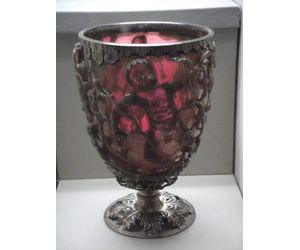
Another famous case is the Lycurgus Cup, a late Roman glass cup from the 4th century CE. When lit from the front, it appears greenish; when lit from behind, it turns a deep red. This dramatic “dichroism” looks like a special-effects trick, but it was achieved with materials technology the Romans probably understood only empirically.
Analytical work combining XRF and electron microscopy showed that the glass contains tiny nanoparticles of gold and silver dispersed in the matrix. These metal nanoparticles interact with light in different ways depending on whether it’s reflected or transmitted, which produces the color shift from green/yellow to red.
XRF’s role here is to identify and quantify those precious metals in the glass without taking large fragments. It confirms that we’re not just looking at colored glass, but at a deliberately doped nanocomposite: a 1,600-year-old “engineered material” that still fascinates optical physicists today.
Coins are small, common, and perfect for XRF. They’re also loaded with historical information.
Rhodian bronze and silver coins
A 2023 study used micro-XRF (µ-XRF) to analyze 111 copper-based and 11 silver-alloy coins minted in Rhodes from the mid-4th century BCE to the 2nd century CE.
The results showed that:
- The bronze coins could be grouped into three main alloy families, with different levels of tin and lead as key alloying components.
- Changes in composition over time reflect shifts in metal supply, minting practices, and possibly economic or political events.
None of this required sampling; each coin was measured intact, and XRF data were used to build a detailed picture of Rhodian mint metallurgy over several centuries.
Roman and Sasanian silver
Earlier work on late Roman and Sasanian silver plate—around 200 objects in total—used energy-dispersive XRF to show that the silver was generally of very high fineness, averaging about 95 % Ag. Differences in copper and lead content helped distinguish Roman from Sasanian workmanship and illuminated their refining technologies.
Smaller numismatic studies have applied XRF to Roman silver coins, using ratios of Ag, Cu, Pb and other elements to group coins by ore source and refining method. Again, the key point is that XRF can do this while leaving every coin fully intact.
XRF plus 3D imaging
More recent research combines handheld XRF with X-ray micro-CT. For example, a 2023 study used this combination to determine the composition and reveal hidden inscriptions on Roman coins. XRF delivers elemental data from the surface; micro-CT reveals internal structure and hidden markings. Together, they help numismatists date coins, identify mints, and spot forgeries.
XRF has also become routine in the conservation of larger, high-value objects.
The Seuso Treasure
The Seuso Treasure—a famous late Roman hoard of 4th–5th-century silver vessels—has been studied with handheld XRF to determine alloy compositions, classify objects, track chemical inhomogeneity, and characterize gilding and joining techniques. This helps answer questions like:
- Were all vessels made in the same workshop?
- Were some reworked or repaired later?
- What refining level did the silversmiths achieve?
Again, the advantage is that these massive, unique pieces do not need sampling. XRF “reads” the metal where it is.
Bronze statuary and decorative arts
Similar work has been done on bronze sculptures—both ancient and modern—using XRF to identify alloy types (for example, copper–tin bronze vs. brass) and to relate them to specific workshops or periods. Non-destructive elemental analysis helps distinguish original parts from later repairs or additions, which is crucial for authenticity and restoration decisions.
All of these case studies rely on the same core capability: energy-dispersive XRF, often in portable form. The instruments used in major museum and field studies belong to the same class as today’s advanced handheld analyzers—compact devices with silicon drift detectors (SDDs), powerful X-ray tubes, and sophisticated software for semi-quantitative analysis.
Modern handheld systems such as Elvatech’s ProSpector 3 are designed with exactly these tasks in mind:
- They can detect elements from light metals like magnesium and aluminum up to heavy metals such as silver, gold and lead, depending on configuration.
- They work non-destructively, directly on the artifact surface.
- Measurement times are typically seconds to tens of seconds, which is fast enough for field surveys and on-site campaigns.
The same features that make handheld XRF indispensable for scrap sorting or process control in metallurgy—speed, portability, and multi-element capability—are what make it so powerful in archaeology, numismatics, and art conservation as well.
To be clear, specific famous objects like Tutankhamun’s dagger or the Lycurgus Cup have been studied with various academic instruments, not necessarily Elvatech analyzers. But the underlying method and performance class are the same as those available today to museums, labs, and private collections.
These examples show XRF doing much more than producing numbers on a screen:
- It confirms that a pharaoh’s dagger really was forged from meteorite metal.
- It explains the “magic” color-changing glass of a Roman cup in terms of gold–silver nanoparticles.
- It reveals how Greek and Roman mints adjusted their alloys over centuries.
- It helps conservators document and protect unique silver treasures and bronze sculptures.
For research companies, these stories are a reminder that the same physics used every day in industry can also shed light on questions of culture and history.
And for anyone working with cultural heritage—museums, archaeologists, private collectors—XRF has become a quiet revolution: a way to ask very direct questions of ancient objects (“What are you made of?”) and get precise answers, without leaving a mark.