


- Home
- Companies
- Ixom Watercare
- Articles
- Improved Processing Performance in a ...
Improved Processing Performance in a Facultative Pond System- USINWW-LOC110.001 (ID32) - Case Study
Topics: wastewater, sludge reduction, ammonia, MLSS/TSS, BOD, odor control, short-circuiting
Overview: This is a facultative pond for the wastewater treatment plant (WWTP) serving a town of about 2,000. The WWTP is a continuous flow system with a design flow of 0.16 MG/day, but does receive up to 0.9 MG/day during rainy periods. The facultative treatment pond is 16 acres in surface area, and has a mean depth of 5.5 feet deep with an average slurry/sludge depth of about 9 inches. The pond has a curtain dividing the 7-acre primary side (Cell 1) from the 9-acre secondary side (Cell 2). Cell 1 has an operating volume of 7.7 MG and an average detention time of 51 days; Cell 2 has an operating volume of 11.7 MG and an average detention time of 78 days.
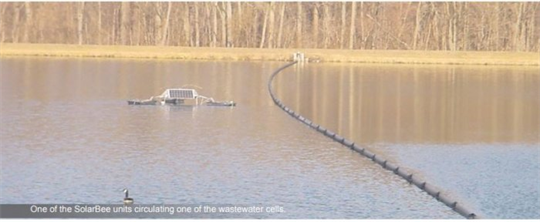
Conditions / Objectives: This pond had history of shortcircuiting, and difficulty meeting the current ammonia permit limit of 9.3 mg/L (as a monthly average). There was also a need to keep sludge from building further.
Solution: Two (2) SB10000v12-DM (Dual Mix) units in the treatment pond, with one unit deployed in each treatment cell. Deployment Date: Jan 2007
Results: The WWTP reported noticeable improvements in effluent water quality after the SolarBees were deployed. Average monthly percent removal since the SolarBees were deployed are 69.5% for ammonia, 91.8% for TSS, and 91.2% for BOD5. The table to below compares 2005 and 2006 annual averages without SolarBee circulation to 2007-09 averages with circulation. During periods of wet weather and substantial excess flow in 2007, the system was able to remain below ammonia permit levels while providing significantly improved BOD5 and TSS reductions. The SolarBees have also reduced short-circuiting in the cells. The operators are very pleased with the results, as well as with the ease of operation and low maintenance of the SolarBees.