


- Home
- Companies
- PEAK Scientific Instruments Ltd
- Articles
- Know the Difference between Analytical ...
Know the Difference between Analytical and Precision Balance
Measurement of samples or items in a laboratory is a very significant operation. However, there are several types of laboratory balances available to choose from. Each with different features and recommendation for use. How do you know which one to use and in what circumstances? Before buying a balance, here are a few questions to consider; – the application that will be measured, the maximum capacity needed, and the accuracy needed. Nesvax Innovations’ Biochemist Eric Mbai shares with us the differences between two most commonly used balances – an analytical balance and a precision balance
Analytical balances have been designed to measure small mass at great precision. They are highly sensitive lab instruments designed to accurately measure mass. Their readability has a range between 0.1mg – 0.01mg (can measure four decimal places to the right of the decimal point) and are capable of measuring samples up to 320g. They have a draft shield or weighing chamber to prevent the very small samples from being affected by air currents. They’re meant to detect very fine increments, so the slightest vibrations or breeze can impact the results.
Analytical balances are usually used in quantitative chemical analysis. An analytical balance is so sensitive air currents can affect the measurement. A draft shield is provided to prevent inaccurate readings. A dedicated space should be designated to prevent environmental interference. Analytical balances require frequent calibration and need to be monitored carefully. Most balances include an automatic internal motorized calibration weight. External weights can also be used for calibration. These balances are used in chemistry and pharmaceutical applications.

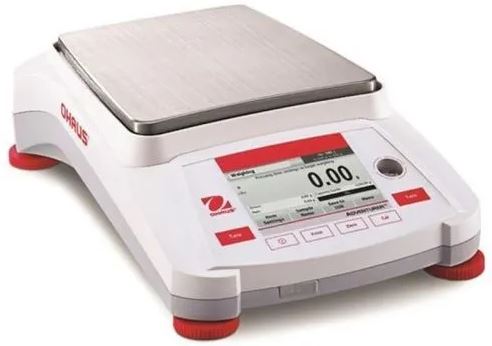
Precision balances are also called top-loading balances and considered semi-analytical balances because they are less accurate than a standard analytical balance. Their meaning lies in the name and fact that they are used to weigh the mass to its exact number. Its capacity varies from grams to kilograms. They usually have a higher capacity than analytical balances do and typically deliver results of 0.1g, 0.01g or 1mg. They do not offer readabilities greater than three decimal places and cost less than analytical balances.
They are more robust, hence not affected by environmental conditions and give a readout within seconds. The weighing pan is usually larger than in analytical balances with smaller pans to accommodate only small samples. They have multiple weighting functions, such as dynamic weighting, part counting, percentage weighting and so on.
If you’re looking to purchase a balance for extreme accuracy, then an analytical balance is a better choice for your laboratory. It will measure the accuracy of 0.0001 to 0.00001g. However, such accuracy is not important, a top-loading balance will work just fine in measuring the accuracy of 0.001g. It’s also a budget friendly balance and has a higher measurement capacity.