

- Home
- Companies
- SoundPLAN GmbH
- Articles
- Making improvements to noise control in ...
Making improvements to noise control in production plants
Jochen Schaal, managing director of SoundPLAN GmbH and Michel Rosmolen, director of SoundPLAN Asia, outline opportunities for the sector to soundly improve our environment
Manufacturing is one of the high growth sectors in India. The India Brand Equity Foundation (IBEF) reports that the country’s ranking, in terms of most sought after manufacturing destination in the world, has climbed to the third spot, up from its fourth position the previous year.[i] With the help of the ‘Make in India’ initiative[ii], devised to transform the nation into a global design and production hub, it is on a path to becoming a focal point for hi-tech companies too.
The economic benefits are clear, however, the machinery and processes used in India’s diverse manufacturing sectors, including automotive, metals, and chemicals can generate huge amounts of clamour.
The noise emissions come from a wide variety of sources and have a range of impacts. Take, for example, a chemical production plant. The commotion generated from compressors and vacuum pumps can be deafening and disorientating. However, these emissions cannot be categorized easily, as every situation is different and their sources can vary widely in sound power, emitted frequency spectra, directivity and in their timings. This makes evaluation and mitigation much more difficult compared to other types of noise, such as traffic.
Mapping noise levels
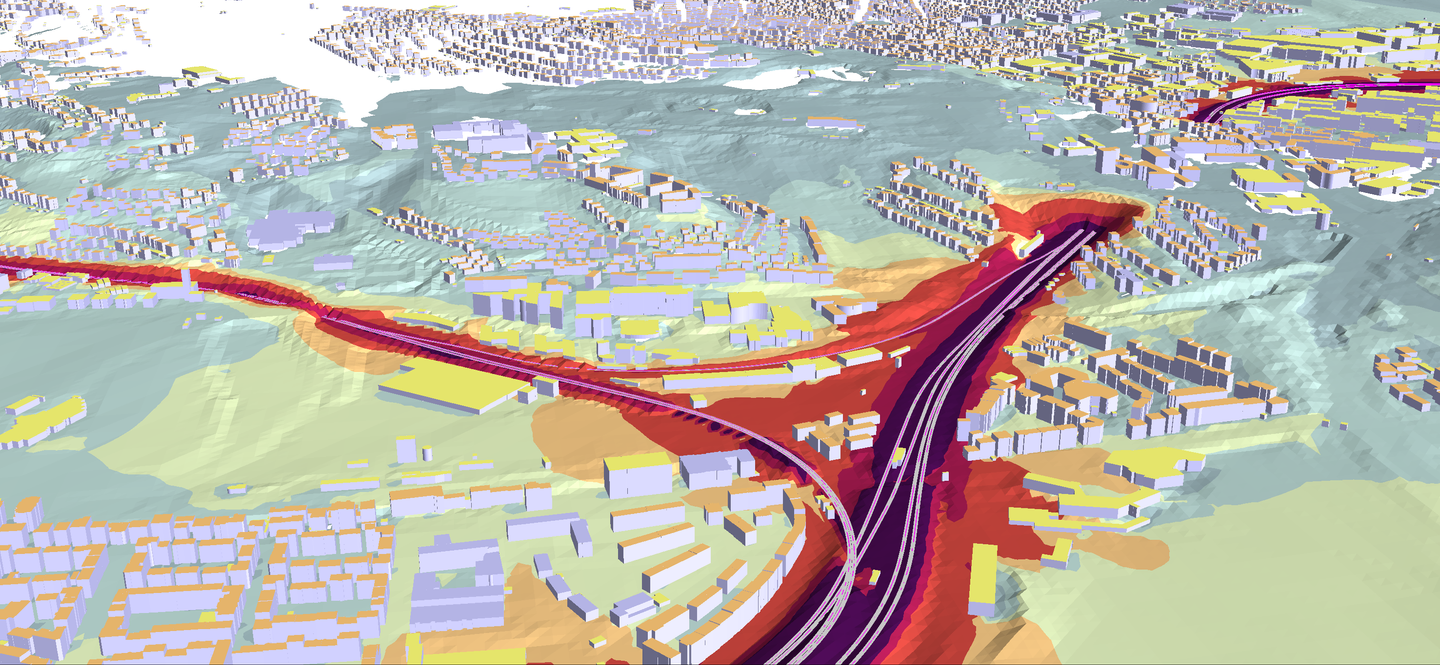
A noise map is a key step towards making the working environment safer, whether planning a new processing or manufacturing facility, or looking to improve an existing one. Simulation software allows you to assess the areas where you need to introduce controls to defend workers against hazardous noise. Using the software, you are able to produce a noise map of the production plant in question, and produce a visual display of how it will propagate and at what volumes it will be, helping you isolate and address problem areas.
The din from manufacturing processes can cause significant health issues for workers and has the potential for litigation against any company that does not take the necessary steps to protect their staff. As it spreads, it can also impact on environmental noise levels in public places. To control this, the Government enacted the India Noise Pollution (Regulation and Control) Rules, 2000[iii], in exercise of its powers conferred under the Environment (Protection) Act, 1986.[iv]
Data from the Central Pollution Control Board (CPCB), which tracks noise-levels through monitoring stations, found that almost every part of India’s six metro cities, violates noise pollution standards.[v] Not surprisingly, the study, conducted in 2018 (the latest year for which data was available), found that the loudest parts of the cities studied are in commercial and industrial areas.
In its 2021 ‘World Report on Hearing’, The World Health Organization indicates that there are currently 401 million people in the South-East Asia region living with hearing loss. This costs the region US $108 billion annually. By 2050, it estimates that 666 million people are projected to have problems with their hearing.[vi]
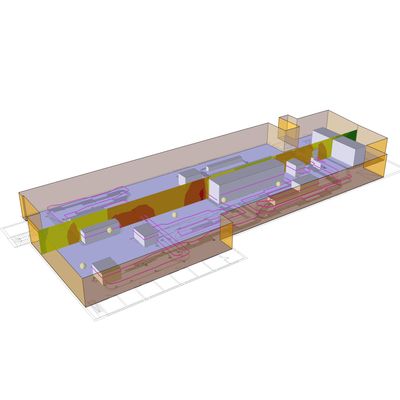
If a workplace has areas that may be close to or above 85 dB, then a noise study should be carried out to define all areas where hearing protection is required. Mapping software enables realistic noise simulations to be developed. These can show the loudest sources and the propagation across the site, including industrial halls and across production plants, to show how noise levels propagate across the landscape.
Predicting and analysing noise
Advances in technology mean that, not only can existing noise be calculated and moderated, but by using mapping software, future levels can be predicted and assessed before projects have even begun. Using and inputting available data, this simulation software creates a visual demonstration of where the noise comes from and how it spreads across the site, breaking down different components.
The software also supports the assessment of different methods to mitigate noise, for example specifying quieter equipment and introducing noise control fixtures such as barriers and enclosures, and the rearrangement and careful planning of buildings and equipment. Different options can be trialled and costed on the computer, rather than having to retrofit noise mitigation measures.
The SoundPLAN library within the software contains an extensive database of noise-reduction solutions, and their sound attenuation and absorption spectra can be compared. The technology can help with the optimisation and positioning of these noise protection structures and concepts for complex manufacturing plants. Various evaluations (such as the number of affected workers) or the best cost-benefit ratio can be made. These variants can be assessed before investment in any solution. The equations help to better represent the complex nature of noise propagation in the environment.
The data can come from multiple sources, including graphical information systems or other mapping services, counts of traffic mix to and from the plant, manufacturers’ source specifications, software libraries or any other source.
Going further
Noise mapping software goes much further than measurements, which only record the overall level of noise as it occurs at a specific geographic point. A noise map shows the position of sources including all geometrical data and the levels inside and outside a building. Future levels can be predicted, and pre-emptive steps taken to control it. With this approach, mitigation measures can be targeted in the most cost-efficient way.
Each noise map is unique, according to project size, geography, objectives, the relevant noise sources, but most of all, the data that is available and which can be readily acquired to be imported and used.
The mapping software produces graphical representations of the noise using colours to depict the different levels, which can be in 3D and animated formats, if required. This colour coding means the information can be easily understood, giving a very visual demonstration of where noise comes from and how it propagates. After creating a noise map, you can introduce controls to start defending the environment and people against unwanted noise.
The software incorporates available noise calculation and assessments to national and international standards, including industry specific guidelines.
Rebuilding better
As we rebuild from the impact of COVID-19, and look to build a better future, mechanisms need to be in place to ensure compliance with the tightening up of green policies and procedures. The consequences of not reducing our environmental footprint include increased noise and air pollution with the associated health, safety, and financial impacts.
Mapping software is one way to make significant improvements in a variety of plant operations by clearly identifying problem issues and the effectiveness of possible mitigation measures.
https://www.soundplan.eu
E: info@soundplan.de /info@soundplan.asia
Biographies
Jochen Schaal is managing director of SoundPLAN GmbH, an innovative software company and engineering firm and market leader in the fields of noise control, noise mapping, occupational health and safety and room acoustics. He is responsible for overall business strategy, markets and product development, key partner relationships, and brand development. Jochen’s professional expertise in the field of noise control also means he often supports guideline work in ISO and DIN Standards committees in Germany and across Europe and at international level.
Academic degrees: Dipl. Ing. (FH)
Michel Rosmolen is director of SoundPLAN Asia. Michel is an active committee member at IIAV (International Institute for Acoustics and Vibration), where he is currently Director from 2020 – 2024, having previously held this role the 2014 – 2018. He also holds the role of Chair Sponsor & Exhibitions at IIAV since 2012. Michel is also a board-member of
SAS (Society of Acoustics (Singapore) as Honorary General Secretary as well as Vice President (Communications). At the IYS2020 (International Year of Sound) he is a Steering Committee member for SE Asia.
[i] India Brand Equity Foundation infographic https://www.ibef.org/industry/manufacturing-sector-india/infographic
[ii] www.makeinindia.com/about
[iii] https://hspcb.gov.in/content/laws/noise/Noise_Rules.pdf
[iv] https://www.indiacode.nic.in/bitstream/123456789/4316/1/ep_act_1986.pdf
[v] National Herald: https://www.nationalheraldindia.com/videos/indian-cities-rank-high-on-noise-pollution
[vi] World Health Organization ‘World Report on Hearing’ infographic for WHO South-East Asia region: https://www.who.int/images/default-source/health-topics/deafness-and-hearing-loss/world-report-on-hearing/world-report-on-hearing---infographic-searo.jpg?sfvrsn=ccb90120_7