

Metal Detection Systems for Battery Recycling Operations
The battery recycling industry processes complex material streams including multi-chemistry cell formats, mixed metal alloys, and composite electrodes. Undetected metallic contamination remains one of the most costly and disruptive risks a facility can face. Metal detection systems are mission-critical infrastructure that determine product purity, downstream equipment integrity, and regulatory compliance across the processing line.
GME Recycling supplies advanced metal detection solutions engineered for signal interference challenges in battery processing where the material itself is electrically conductive. This overview outlines detection technologies, application strategies, and the measurable return on investment from precision metal detection in battery recycling operations.
Why Metal Detection Matters in Battery Recycling
Material Purity and Output Value
Purity requirements for outputs such as black mass, refined cathode precursors, copper foil, and aluminum foil tie directly to contract specifications. Contaminants such as a steel bolt or aluminum fragment can cause batch rejection with substantial economic impact. Metal detectors provide continuous screening to ensure each tonne meets purity thresholds demanded by downstream smelters and refinery operators.
Equipment Protection
Shredders, granulators, hammer mills, and ball mills represent substantial capital investments. Hard tramp metal such as tool steel fragments, bolts, and bearing components entering equipment at speed causes rotor damage, bearing failure, and unplanned downtime. Installing scrap metal detection upstream of size reduction provides a defense with automatic rejection of suspect material before it reaches cutting chambers. The cost of a single avoided repair often exceeds the cost of a high-specification detection system.
Quality Control Standards
Operators increasingly operate under certified quality management frameworks such as ISO 9001 and IATF 16949 for automotive-grade outputs, which require documented contamination controls. Metal detection checkpoints with automated data logging provide the audit trail needed to demonstrate conformance. With EU Battery Regulation traceability, metal detection records become part of responsible sourcing verification for downstream customers.
Metal Detection Technologies
Electromagnetic Induction Detectors
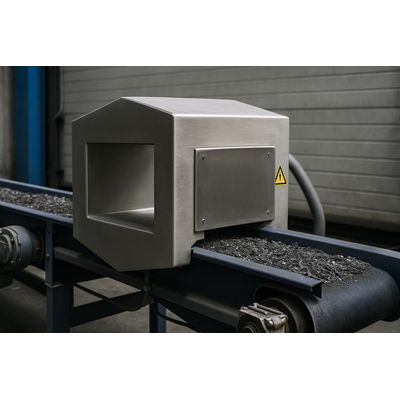
Electromagnetic induction detectors are widely deployed on conveyors. A transmitter coil generates an alternating field; metallic objects passing through induce eddy currents detected by receiver coils. Modern EMI systems achieve detection sensitivities below 1 mm diameter for ferrous spheres and below 2 mm for non-ferrous metals in standard configurations. In battery processing, where the bulk material is electrochemically active, specialized suppression algorithms distinguish product-induced signals from genuine contaminant signatures.
X-Ray Detection Systems
X-ray transmission detection provides material-independent contamination analysis based on density contrast. This makes X-ray systems effective in battery recycling where the product stream contains conductive carbon black, metallic electrode powders, and electrolyte residues that challenge electromagnetic detection. X-ray systems identify metallic inclusions by attenuation and can detect non-metallic dense contaminants such as ceramic fragments. Dual-energy configurations enable material classification by atomic number to support automated material sorting decisions.
Pulse Induction Technology
Pulse induction detectors offer superior ground-balancing capability in mineralized or electrochemically active product streams. They emit short electromagnetic pulses and analyze the decay characteristics of induced magnetic fields. The technology excels at detecting large metallic objects at depth within a material bed and is less sensitive to fine metallic particles than EMI systems but provides more reliable performance in electrically noisy environments.
Multi-Frequency Detection
Multi-frequency systems transmit and receive at several simultaneous frequencies, enabling real-time analysis across the full spectrum of metallic conductivities. This approach improves detection of low-conductivity non-ferrous metals such as titanium, certain aluminum alloys, and lead, which are challenging for single-frequency systems. For battery recycling with diverse chemistries and mixed streams, multi-frequency systems provide broad coverage in a single installation, reducing the need for multiple detector stages.
Ferrous vs Non-Ferrous Metal Detection
Identifying Lead Components
Lead-acid battery processing introduces dense lead plate fragments and oxide paste into the stream. Lead is a relatively poor conductor compared to copper or aluminum, requiring calibrated detector sensitivity profiles. Lead-optimized X-ray thresholds must account for attenuation due to lead oxide in bulk material. Detector configurations for lead-acid lines incorporate dedicated lead-optimized frequency profiles and density-calibrated X-ray thresholds.
Detecting Steel Casings
Steel battery casings are highly detectable due to ferromagnetic permeability. Ferrous metal detection using electromagnetic induction and magnet-based separators achieves reliable removal of steel components from mixed fractions. However, when steel fragments are embedded within compacted black mass or mixed with aluminum foil, multi-modal detection combining electromagnetic and density analysis yields superior detection rates.
Copper and Brass Identification
Copper current collectors and brass terminal components are high-value non-ferrous materials that must be detected and correctly sorted. Copper’s high electrical conductivity makes it easy to detect electromagnetically, but distinguishing copper from aluminum by conductivity alone is challenging. Complementary eddy current separation technology enables material-specific diversion after detection.
GME’s Metal Detection Solutions
Real-Time Detection Accuracy
GME metal detection systems combine high-sensitivity EMI aperture detectors with multi-frequency signal processing tailored for electrically conductive bulk materials. Detection thresholds are validated against reference standards at commissioning, with sensitivity curves for ferrous, non-ferrous, and stainless targets across the full range of material depths encountered in battery processing. Real-time detection events are timestamped and logged to the plant control system, providing documented process control records required by quality management certifications.
Integration with Conveyor Systems
Detector frames are dimensioned to match standard conveyor widths to ensure consistent aperture geometry and avoid edge-effect blind zones. Electrical interfaces follow standard industrial protocols, enabling direct integration with PLCs for synchronized detection and rejection sequences.
Automated Rejection Mechanisms
Rejection mechanisms include air-blast ejectors for high-speed lines and pneumatically actuated flap gates for slower, heavier lines. For independently verifiable rejection, dual-detection confirmation requires two independent detector signals within a defined time window to eliminate false-positive shutdowns.
Applications in Battery Recycling Lines
Pre-Shredding Inspection
The highest-stakes detection point is upstream of primary size reduction. Pre-shredding detects non-battery metallic objects such as pallet nails, strapping clips, and tool components. Sensitivity settings prioritize reliable large-tramp rejection over fine-particle detection.
Post-Processing Quality Control
After shredding, granulation, and initial separation, detectors transition to product quality assurance by targeting fine metallic fragments such as wire ends, foil slivers, and bearing fragments. Automated sorting uses higher sensitivity, often multi-frequency or X-ray, to identify sub-millimetre inclusions. Rejection targets defined belt sections rather than production stops.
Final Product Verification
Before refined materials exit the plant, a final verification checkpoint provides the QA required by off-take agreements. Detectors are calibrated to stringent product chemistry settings, with events logged against batch records. Final verification records support First Article Inspection documentation for downstream customers.
Benefits of Advanced Metal Detection
Reduced Contamination Rates
Facilities with multi-stage detection consistently achieve contamination levels well below refinery thresholds. Transitioning from single-point to multi-stage detection has yielded substantial reductions in contamination incidents in documented cases.
Improved Output Quality
Cleaner feed streams improve downstream recovery by reducing impurities that affect leaching and processing costs, thereby improving overall metal recovery yields.
Enhanced Equipment Lifespan
Comprehensive detection coverage correlates with lower wear on rotors, liners, and screening media. Five-year cost savings from improved equipment longevity often exceed the capital and operating costs of a well-specified metal detection system.
Regulatory Compliance
EU Battery Regulation and national waste legislation require documented quality controls. Automated data logging and reporting support compliance, with traceability and purity documentation becoming integral to responsible sourcing declarations in the battery supply chain.
Installation and Calibration
Optimal Placement Strategies
Detectors should be placed on horizontal conveyor sections with consistent bed depth, downstream of transfer points where material is settled and belt speed is stable. Inclined conveyors reduce detection uniformity. If necessary, adjust aperture geometry and sensitivity zoning for inclined sections.
Sensitivity Settings
Calibration balances detection completeness and false rejection. Commissioning uses actual material as a background and defines minimum detectable sizes against certified test pieces. Baseline documentation supports periodic verification.
Regular Testing Protocols
Performance degrades over time due to drift and wear. Recommended testing includes daily performance verification with certified test pieces, monthly sensitivity reviews, and annual third-party calibration audits for QMS systems. Test results are logged for inspections and audits.
ROI of Metal Detection Investment
ROI analysis accounts for direct and indirect value. Direct benefits include avoided repair costs, avoided batch rejections, and reduced reprocessing costs, with payback typically six to eighteen months on high-throughput lines.
Indirect benefits include reductions in annual maintenance on size-reduction equipment, enhanced access to premium automotive-grade contracts, and the value of automated records under regulatory compliance. GME provides facility-specific ROI models during technical consultations.
GME’s engineering and commercial teams provide facility-specific ROI models as part of the technical consultation process.
Contact the engineering team to discuss how advanced metal detection systems can be integrated into your battery recycling operation to deliver measurable returns from day one.
Original: https://www.gme-recycling.com/metal-detection-systems-for-battery-recycling-operations/