

- Home
- Companies
- SoundPLAN GmbH
- Articles
- Noise control in building design ...


Noise control in building design planning is a sound investment
Jochen Schaal, managing director of SoundPLAN GmbH and Michel Rosmolen, director of SoundPLAN Asia, outline developments in room acoustics to improve our environment
Demand for architectural services in India is increasing, with government initiatives like the Smart Cities Mission[i], encouraging development in the sector. This project aims to harness technology to improve urban development, with a plan to build one hundred smart cities. Another key trend is increasing demand for green buildings, with sustainable design and construction driven by climate policies to curb greenhouse gases.
Architects and interior designers have a lot to consider when designing a building, such as the client’s brief, ensuring the building is fit for purpose, sustainability, structural issues, technology and, of course aesthetics. There is however one invisible factor that can sometimes be overlooked - noise.
Modern architecture is often based upon new and innovative technologies and is characterised by exposed concrete and glass facades and open room concepts. This poses a great challenge to achieving pleasant acoustics, suitable for the intended use of the room, and failure to do so often results in annoyance, stress, and poor work performance. Whether working on a commercial or residential project, it is important that architects factor acoustics into their plans to help protect the future users of their buildings. The noise levels from, and within, a building can strongly influence whether it is judged as a success or failure, as it has a strong impact on the user experience.
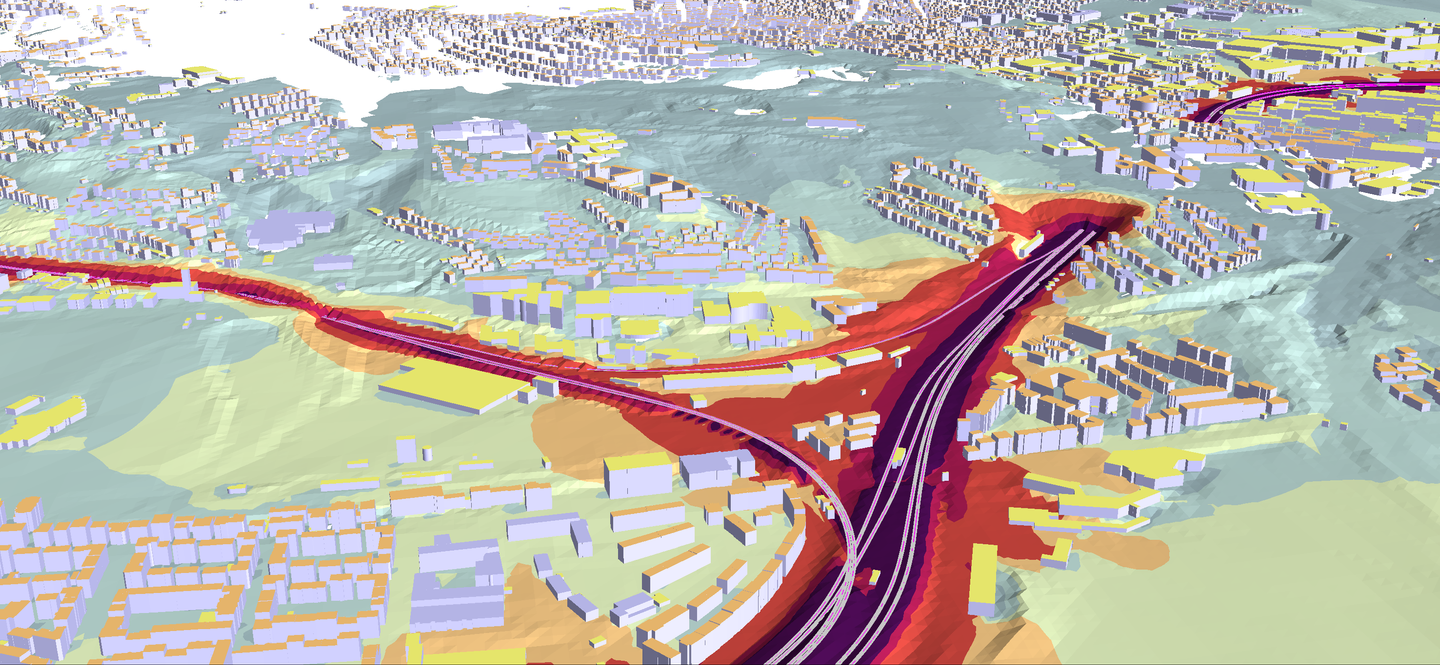
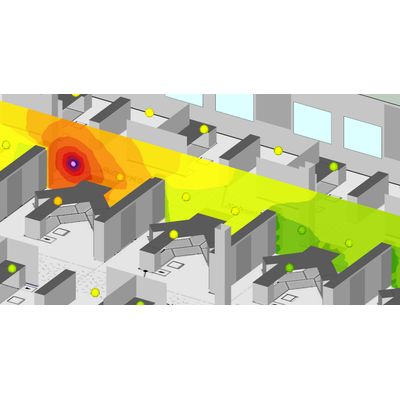
Specialist noise modeling software can help architects and planners in the design process to optimize the room layout, so that excessive noise is reduced, and good acoustic conditions are achieved. The software creates maps which are very visual demonstrations of where noise comes from and how it spreads. The maps are color coded so can be understood easily. This can be useful, especially when dealing with other planners or non-building professionals involved in the project.
Mapping software can break down different noise components rather than just giving an overall figure as a measurement does. Secondly, if we are relying on measurements, the building or room must already have been built in order for the acoustic situation to be measured, whereas modelling can be used in the design planning stage.
Greater scope for improving room acoustics
Until recently, effectively mapping and modelling indoor workplace noise and room acoustics has proved problematic. Multiple floors and walls in between the sound source and the receiver of the noise can interrupt the signal. It’s even worse when you take corners into account, which make modelling , and mapping even harder as sound doesn’t travel in a uniform pattern around them.
Room acoustics software is designed for use across a range of room types, where the demands on the acoustic quality may vary greatly. This includes open plan offices, conference and lecture theatres, concert halls, restaurants and doctors’ practices.
These simulations are now an established tool in the day-to-day planning work of acousticians. One of these processes being the sound particle simulation method[ii], which is an extension of the well-known, and frequently used, ray-tracing approach. In the last decade, it has been possible to extend the application range of this method to calculate sophisticated acoustic scenarios with complex, arbitrary geometries. It allows the user to analyze and evaluate the acoustic properties of a room and any room acoustic optimization measures extensively and in detail.
In addition to the frequency-dependent sound pressure level values, all commonly used room acoustic parameters according to ISO 3382, such as reverberation time, Definition - D50 and speech decay rate can be calculated. It is also possible to calculate the increasingly popular speech transmission index (STI) and listen to how recordings sound in a room (auralisation). By storing the corresponding evaluation criteria according to VDI 2569 and DIN 18041, the user can quickly check whether the room acoustics meet the selected requirements.
Our room acoustics software program includes features to help accommodate electro-acoustics. In addition to frequency-dependent directivities, all sources have a delay setting, and the Source Library within the software contains a selection of official specifications and loudspeakers.
How does it work?
For the interior calculation, in addition to the geometry, the user simply enters the essential acoustic properties (absorption coefficients, scattering coefficients if available, and transmission coefficients) of the boundary surfaces and furnishings. An intuitive room editor tool leads to easy and fast model creation.
A detailed overview of the results, and the possibility to produce meaningful graphics such as color coded maps of all room acoustic parameters, simplifies the comparison and evaluation of the measures, and also makes it easier to communicate results with customers.
A better future
Using noise modelling software, architects are also able to see how noise from the surrounding area will affect occupants of their building, along with how, in turn, the building use will affect the local environment. Different design options can be trialled and costed on the computer, rather than having to expensively retrofit mitigation measures.
The software can also help show how well mitigation factors might work. This includes use of sound-absorbing acoustic products, different placement and height of noise screens, or seeing the result of moving a new hotel or office block to a different area where natural features may shield it.
Future noise levels can be predicted, and pre-emptive steps taken to control it. With this approach, noise mitigation can be targeted in the most cost-efficient way. In fact, if noise is not properly assessed at the planning and design phase, problems and additional costs to manage it can arise further down the line.
https://www.soundplan.eu
E: info@soundplan.de /info@soundplan.asia
[i] Smart Cities Mission: https://smartcities.gov.in/
[ii] Uwe M. Stephenson, ‘Introducing Higher Order Diffraction into Beam Tracing Based on the Uncertainty Relation,’ Building Acoustics, vol. 18, 1-2: pp. 59-81. March 1, 2011.
https://journals.sagepub.com/doi/pdf/10.1260/1351-010X.18.1-2.59