

- Home
- Companies
- SoundPLAN GmbH
- Articles
- Noisy sites setting alarm bells ...

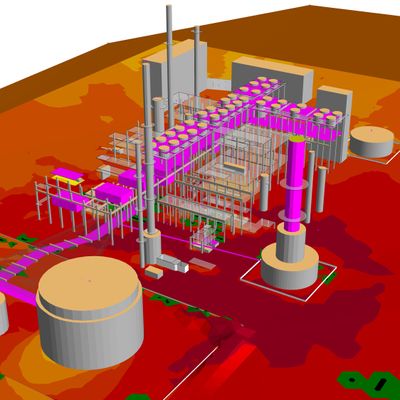
Noisy sites setting alarm bells ringing?
Industrial sites such as refineries and factories will always be noisy, but with millions of people across the world occupationally exposed to hazardous noise, and noise-related hearing loss listed as one of the most prevalent occupational health concerns, what can be done about it? Arne Berndt, owner / adviser at SoundPLAN GmbH and SoundPLAN International LLC – a market leader in sound and air pollution mapping software – explains how properly planning and mitigating noise emissions can protect both workers’ health and businesses’ reputations and legal positions.
Noisy workplaces
Industrial noise is not just an environmental problem. It also causes significant health issues for workers and the potential for litigation against any company not taking the necessary steps to protect those workers.
Industrial noise emissions come from a wide variety of sources. However, they cannot be categorized easily as every industrial situation is different. This makes evaluation and mitigation much more difficult compared to other noise sources, such as traffic.
Industrial sources vary widely in sound power, emitted frequency spectra, directivity and also in their time dependency. The characteristics of the emitted noise of industrial plant varies between irregularly distributed noise impulses (for example in a hammer mill) and almost continuous noise levels from a steel plant.
Today we assume that the danger of hearing loss is a given if people are exposed to a noise level of more than 85 decibels (dB). The risk of hearing loss increases with the magnitude and exposure time and the frequency of the noise; with higher frequencies doing more damage. Hearing loss makes up between 30% and 40% of occupation-related illnesses.
The main problem in noisy plants is finding and documenting where the noise reaches 85 dB, known as the ‘noise contour line’. In areas where noise levels exceed 85 dB, workers must wear hearing protection. If the 85 dB line is not clearly marked companies may be liable to fines. Signs must make it clear to employees that hearing protection is required. It is irrelevant whether the high noise levels are inside or outside a building; all that matters is that the 85 dB contour line is enforced.
If a plant has areas that may be close to or above 85 dB, it is wise to invest in a noise study to define all areas where hearing protection is required. An alternative solution is to provide workers with noise dosimeters that keep track of their daily dosage of noise. A well-studied and documented noise policy is better than paying for lawsuits from workers with hearing problems and paying for disability because of tinnitus and hearing loss.
The effects of excess noise
High levels of noise can result in hearing loss, sleep disturbance, cardiovascular disease and other physical disturbances in workers.
Loss of hearing has an enormously negative impact on the affected person and those around them. They are only able to hear if the sound levels are high enough and the difference between the levels of what they are trying to listen to and the background noise is significant. In many cases this leads to the affected person suffering from social isolation, because a proper acoustical communication is no longer possible.
There is also a risk that people cannot localize a noise source or cannot hear it at all. This can put them in greater danger than people with regular hearing, for example in urban traffic situations or when smoke alarms are activated.
Psychological impact of noise
The psychological noise impact is mainly related to the ability to work and concentrate and to psychological well-being. This describes the relationship between the personally experienced disturbance and the perceived noise level. Direct consequences of the noise impact in this content are:
• Disturbance of communication
• Reduced reactions
• Reduction of the psychological well-being (resulting in nervousness)
Impact of noise on human interaction
High noise loads result in considerable social problems as people fail to interact normally. In workplaces where undisturbed communication is not possible people can become isolated and not take into account the environment around them. Affected people become more aggressive, their willingness to help others is reduced and the sociability is reduced.
Ear protection and other mitigation factors could also have the unintended consequence of workers not being able to hear emergency alarms. For this reason loudspeakers at any given point in a plant must be at least 10 dB above the ambient noise. For verbal messages the requirements are even more stringent. Both of these requirements can be studied with a noise map.
Measuring noise
Before computers were fast enough to do effective simulations and simulation software had reached its current level of proficiency, noise control engineers had to measure noise levels and then use their best judgment to control it.
Today using simulations has distinct advantages over measurements. A measurement yields only one noise level and it is impossible to find how much noise came from which source. Measurements cannot occur when you are planning a building; the problem must physically be there to measure. Simulations, however, allow one to work with ‘what-if scenarios’ prior to building.
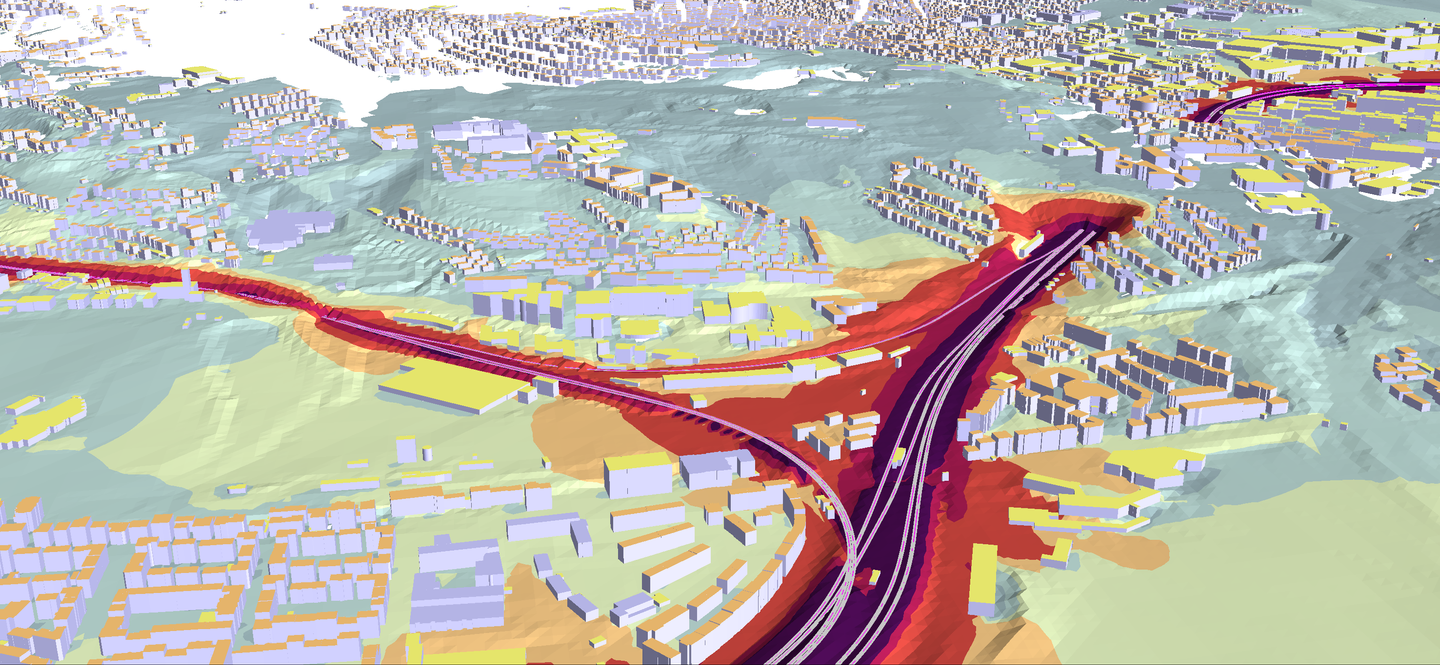
By using noise simulation software, it is possible to create a noise map. Noise mapping is mostly an exercise of tapping into existing data sources and compiling a simulation model from the data representing the infrastructure and the buildings involved. Each noise map is unique according to project size, the geography, the objective, but most of all, on what data is available and can be readily acquired to be imported and used for the noise map.
The noise levels can be measured or calculated, opening up the possibility of introducing theoretical noise reduction measures and evaluating possible improvements.
SoundPLAN is versatile software for engineers responsible for developing and testing noise and air pollution reduction strategies for road, rail and industry projects around the globe. Whether for land use or air purity planning, environmental impact studies or public enquiries. SoundPLAN has been a market leader for over 25 years and it has over 5,000 users, in more than 60 countries, including governments, consultants and researchers.
SoundPLAN places the power of a comprehensive noise calculation and air pollution investigation system in your hands. It is fast, meets all major international standards and provides users with an accurate calculation package with superb graphics supporting all levels of customer presentation. It’s available in English, European and Asian languages, and our worldwide distributorship means expert local support.
Controlling noise
Once you’ve created a noise map you can introduce controls to defend workers against noise. Just a few decibels difference means the risk of hearing loss and its many consequences is lessened. The most common way to help safeguard workers hearing is to modify or replace the noisiest equipment or to adapt the environment around them. Using low noise and well maintained equipment or placing a barrier between the worker and noise source are relatively simple steps, but they can have a huge impact on people’s lives.
Whether it’s planning a new industrial facility or looking to improve an existing one, workers need to be protected from noise and simulation software helps solve noise issues.