

- Home
- Companies
- SWAN Forum
- Articles
- Overcoming Pollution with Data & ...
Overcoming Pollution with Data & Collaboration
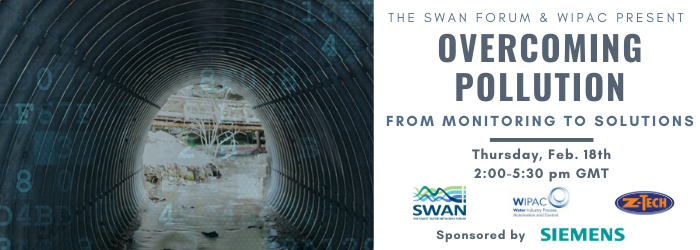
On Feb. 18th, 2021, over 400 participants tuned in to a virtual SWAN-WIPAC Workshop sponsored by Siemens to discuss “Overcoming Pollution - From Monitoring to Solutions.” The event opened with a keynote address by UK Member of Parliament Philip Dunne, who recently introduced a Private Member’s Bill to address sewage river pollution and water quality issues in the UK. Mr Dunne felt there was a timely opportunity to leverage political legislation to improve water quality and make a sustainable, environmental and public health impact.
Although Parliament has not yet convened to pass this bill, currently, 135 MPs support the bill and it has widespread support from the NGO community, water companies, and regulators. Mr Dunne pointed out that available technologies can now provide accurate pollution data and should be accessible to the public.
Throughout the Workshop, two key themes emerged from the diverse global perspectives:
The role of educating the public on the causes and impacts of pollution, leveraging citizen science and pollution data, to promote accountability and transparency to reduce pollution at the source.
During the first panel, Helen Wakeham, Deputy Director at the UK Environment Agency (EA) highlighted the importance of understanding the systems that need to work. She stated, what worked 30 years ago does not necessarily work today, and we can assume will not work in 30 years. The panel emphasised that the challenge is not only finding the right technology but understanding the cultural perceptions and implications on water pollution. Pernille Ingildsen, Project Manager at Hillerød Forsyning (Denmark) who is also the author of Water Stewardship, claimed that water is a “personal matter,” but is often cloaked by technical jargon making it more difficult to resonate with the public. She shared that her water company recently completed a cost analysis to achieve zero sewage overflow which would cost 300 Million Euros over the next five years, and they have already pledged 70 Million Euros to demonstrate this isn’t an eternity issue and could be resolved in our lifetime.
Nick Mills, Head of Pollution & Flood Resilience at Southern Water (UK), agreed there has been a general improvement in targeting regional investments, but that there also needs to be an improvement in analysing and interpreting data for effective decision-making. Reese Johnson, the Superintendent at the Metropolitan Sewer District of Greater Cincinnati, suggested that water companies should meet the public where they are in terms of their connection to water, (e.g., communities where children play in streams or families fish). Helen added that without proactive public discourse, regulations will be led by single-interest groups which might divert away from source control. Despite all the investments in technology, the public needs to play a larger role in the issue, which could be resolved at the source.
Maximising the use of data (and ensuring data quality and validity) through collaborative processes to make the case for holistic investments and innovations.
The second Workshop panel, led by David Butler from the University of Exeter focused on data-driven solutions to the pollution problem. Rob Whittaker from the EA suggested that by processing overflow data, the EA can provide increased awareness, transparency and accountability for high spill frequencies and encourage more insightful regulations. Neeraj Shah, a Data Scientist at Siemens, discussed the process of developing a new innovation. In collaboration with the University of Sheffield, Siemens was able to gather insights and build confidence in a new sewage overflow monitoring solution but noted that innovation does not end there, the collaboration must continue with the water company and their stakeholders. Dr Emma Harris, Head of the Smart Hub at Welsh Water also emphasised the importance of continued collaboration to achieve tangible results. Due to its climate, Welsh Water receives more rainfall than other areas of the UK which affects its assets. As a result, Welsh Water started a significant risk analysis programme and improvements to data governance (e.g., integrating OT with datasets), also referring to the SWAN 5-Layer Model to predict and identify risks early on. Lastly, Arun Mahadevan, a Senior Engineer at the Public Utilities Board (PUB), Singapore’s National Water Agency shared that working with a technology vendor, PUB has created an innovative dashboard to account for flow, rain, and operations to understand real-time catchment data and develop a Digital Twin to increase efficiency. The panel unanimously agreed that data quality is fundamental for a solution to scale and achieve the best results.
This Workshop strengthened our view that while data-driven insights and innovative technologies are improving the water companies’ capacity to monitor pollution challenges, to truly address this problem the focus should be on prevention by leveraging data transparency and promoting stakeholder education at the source. Taking a collaborative and integrated approach is critical to achieving cleaner and resilient smart stormwater systems.