- Home
- Companies
- FIBERSCOPE.net
- Articles
- Pipe Cameras: Explained
Pipe Cameras: Explained
In the inspection market, there is a wide array of different inspection cameras available, each with its own features and benefits. It's sometimes tough for a small-scale plumber or even for a big municipality department to buy the correct camera unit that would work for them and fit their application because, with the play of wording in the features and price, people can get tracked off instead of looking at the rating and specification of the camera. Its important to ask direct questions when speaking to a sales rep to buy a camera that you need, but we will cover that in other articles. Right now, we will move to meeting the types of sewer cameras available in the pipe inspection market. First, we will divide the types of sewer cameras according to the camera head.
Pipe Camera Heads
There are two main categories that can be split further they are the rotatable camera heads and the straight-view camera heads.
Rotatable Camera Heads:
The rotatable camera heads or pan and tilt camera heads have small motors installed into the camera head that rotate or tilt it. These camera heads tend to be big, starting from 1.3"(see example), and can be as big as 2.3"(see example). The primary cause of that is the mechanical part that enables the rotation since it is hard to make the motors and gears small after some point. This restriction makes the pan and tilt camera unit best for bigger-diameter pipes from 3" and up. The pan and tilt camera units are expensive compared to other pipe cameras but deliver valuable footage with the rotating function by inspecting the sidewalls, looking into laterals and assisting in leak detection. Some pan and tilt camera heads use a simpler technology, while others implement manual focus, which increases the inspectional output value even more.
Straight-view Camera Heads:
The most widely used and manufactured camera heads are the straight-view cameras. The straight-view models are simple camera cylinders with a straight-looking camera chip integrated into the tip. Not having the restricting motorized technology of the pan and tilt heads, the straight-view camera heads can be as small as 0.27" and up to 1.68" in diameter and cover pipe inspections roughly from 0.5" to 12". Generally, the straight-view cameras are sufficient for pipe inspections that do not require a sidewall examination and are more affordable than the pan and tilt units. Additional technology, like the self-leveling function, is available to keep the image upright.
Push Cable Reels
There are many styles and sizes of reels for the push cable, but I would like to focus on two types: standalone reels, handheld reels, and fused reels.
Standalone Reels:
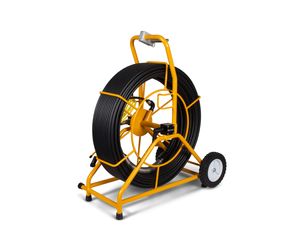
The standalone reels tend to be bigger in diameter and, therefore, house longer push cables, sometimes up to 500ft in length(for lengths longer than that, a robotic pipe camera is preferred). These reels are set alone from the monitor or are connected to the monitor with a holding bracket and connection cable. Some bigger reels have wheels installed into the frame for easier transportation, while others only have supporting feet. In some cases, the standalone reels, such as Hathorn Durascope Cameras, can be used horizontally or vertically. Generally speaking, the standalone reels are larger and heavier and have longer push cable lengths, but there are exceptions.
Handheld Reels:
The next reel configuration is the handheld reels, which are a miniature version of the bigger standalone reels. These reels(see example) are small and carry push cable lengths up to 130 ft. They usually fit into a handy carrying case that holds all the camera components. The handheld reels are easy to replace with a new one since they are not fused together to the sewer inspection system and only connect to it with a connection cable.
Fused Reels:
A fused reel(see example) is an integrated push cable reel connected to the control box and all the other parts of the pipe camera. Generally speaking, the fused reel design is used in shorter, compact pipe inspection cameras that inspect smaller-diameter pipes. These cameras are excellent solutions, with everything located in a handy and portable design.
Camera Monitors:
There are two main types of monitors: a monitor display that connects to the sewer camera by a connection cable and a tablet or mobile device that displays the image using a Wifi connection.
Monitor Display:
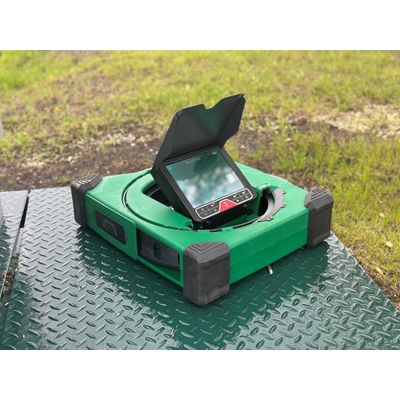
One type of monitor (see example) is coupled to the pipe camera reel or is integrated into the system and comes as a part of a pipe camera. In some cases, the monitor display houses a battery that powers the whole system and is integrated into the monitor body. The monitor usually has a way to record and replay the footage on the screen, but there are exceptions. Additional upgraded features like internal memory or text overlaying are available with these monitors for comfort and higher-quality inspection.
Wifi Displays:
The other option available for displaying the footage of the pipe camera is using a tablet or a mobile device that connects to the sewer camera's wifi module and transports the image. The wifi pipe cameras that connect to mobile devices may or may not have its own monitor display for viewing. For example, the Wifi Hathorn Cameras transfers the images onto the mobile device through wifi and displays the picture using an app. The footage counter is seen on the screen and the pictures and images are quickly captured using the interface buttons
If you are looking for a pipe camera solution and need assistance - don't hesitate to reach out to us.
Fiberscope.net | 1-877-613-2210 | sales@fiberscope.net
Check out our Youtube Channel!