


Pre-Engineered Solutions for Low-Flow Municipal Installations - Case Study
BACKGROUND
Ultraviolet (UV) technology has been used in the treatment of municipal wastewater for decades to ensure that discharge to local lakes and rivers is compliant with discharge permits, and local regulations. UV acts by inactivating microorganisms and reduces the various coliform, E. coli, or heterogenous plate counts used to evaluate discharge.
Chemical-based technologies such as free chlorine are known to form treatment by-products which are harmful to the environment1,2 and as a result, free chlorine levels are often capped in discharge permits, requiring operators to consistently monitor chlorine use and possibly apply additional dechlorinating chemicals to stay compliant. UV avoids these inconveniences.
THE TROJAN SOLUTION
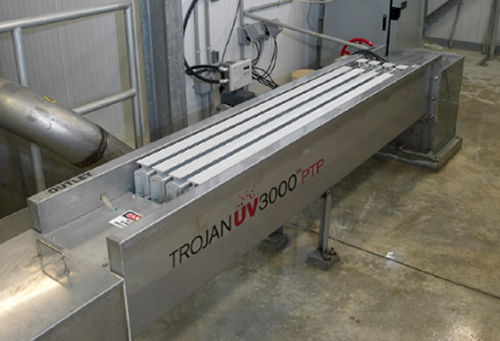
For wastewater treatment plants servicing small communities, the TrojanUV3000®PTP (Packaged Treatment Plant) is a viable solution. Over a dozen different models are available to treat flow rates from as low as 37,000 gallons per day to almost 3 million gallons per day. These systems are manufactured and delivered to your site as a single unit that can be efficiently and timely installed and commissioned.
Customers have multiple installation options for these systems such as:
- Poured concrete channels (by others)
- Stainless steel channels (provided by TrojanUV)
With stainless steel channels, customers have the option to install their TrojanUV3000 PTP in an open arrangement or, if needed, transition from a pressurized pipe arrangement to an open channel and back using flanged transition boxes (Figure 1).
ADD ADDITIONAL MODULE BANKS FOR MORE CHALLENGING WATER
For higher quality wastewater such as water pre-treated with clarification and biological treatment, installation ot a single TrojanUV3000 PTP bank may be satisfactory to meet discharge permits (specific permits will set forth the applicable requirements). More challenging wastewater, including unclarif ied primary wastewater or lagoon discharge, will likely require higher UV intensity to achieve similar treatment targets. Each TrojanUV3000 PTP model can be provided as a double banked system where two banks of UV lamps are included and connected to a provided "Turnbox" that minimizes the footprint of the double-banked system making it easier to integrate into small treatment facilities. This can be effective in such situations where higher UV intensity is required.
CASE STUDY - SMITHVILLE, GEORGIA
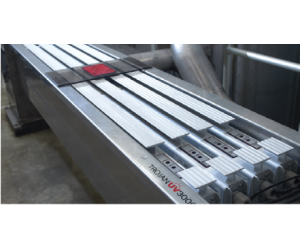
Located in South-West Georgia this municipality of only a few hundred people treats wastewater immediately before discharging it into an engineered lagoon. Without clarification or biological treatment, the water entering the UV has a very low UV transmittance with about 35% of UV-light being able to travel one centimeter through the water, in addition to higher levels of solids (-30 mg/L TSS). In order to achieve the fecal coliform targets, three (3) TrojanUV3000 PTP 3200 systems were installed in a single channel (in series) to combine the UV intensity of all three systems together and achieve a higher UV dose delivery that suits the conditions. The Smithville site has successfully overcome the challenges of treating low quality water with their system for over 15 years.
CASE STUDY - SILETZ, OREGON
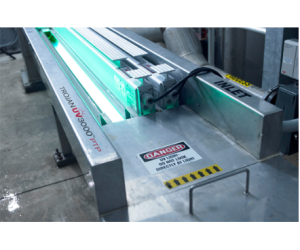
A town of just over 1,200 people, Siletz first installed a UV system in 1994 and twenty years later replaced its original system with a TrojanUV3000 PTP 3700 system. This system is designed to manage a higher flow rate through the stainless steel channel and a single system can manage a maximum 600,000 gallons of water a day. The application of biological treatment before the UV system improved the quality of the water allowing for the higher flow rate to still be treated with less UV intensity and fewer lamps.
CONCLUSIONS
TrojanUV3000 PTP systems can be designed to manage many treatment challenges making them an effective solution for highly diverse low-flow small community wastewater treatment plants. With pre-engineered connections and channels these turnkey systems can be efficiently installed and commissioned to serve your community`s needs.
REFERENCES
- Office of Water. (1999, September). Wastewater Technology Fact Sheet Chlorine Disinfection (EPA 832-F-99—062). United States Environmental Protection Agency, https://www3.epa.gov/npdes/pubs/chlo.pdf
- Watson, L, Shaw, G„ Leusch, F.D.L, and Knight, N.L (2012). Chlorine disinfection by-products in wastewater effluent: Bioassay-based assessment of toxicological impact. Water Research. 46,6069-6083.