


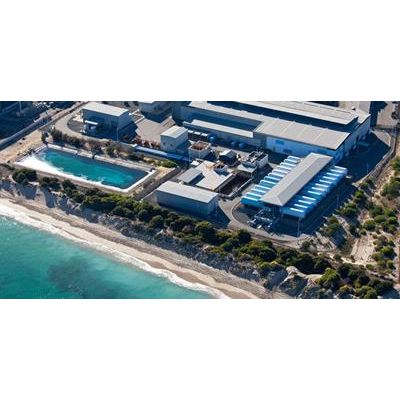
Pros and Cons of Seawater Desalination using Reverse Osmosis for Drinking Water
Seawater desalination will undeniably be the future of drinking water production for coastal communities and island nations in current times of water scarcity. It is already used quite heavily in a few countries. Saudi Arabia, the United Arab Emirates, and the United States are the top three desalination producers of drinking water by capacity in the world followed by Australia, China, and Kuwait.
These countries benefit from desalination systems because they have particulary dry climates with few freshwater sources or they require additional water resource capacity above their current water supply sources.
These sea water desalination systems are typically utilized by coastal communities, providing a practically limitless supply of feed water. Knowing some details about the applications of this seawater desalination technology, let’s talk about reverse osmosis desalination of seawater and how it works.
Some SWRO basics
The end goal of a desalination process is the removal of the salts present in seawater which are concentrated at about 3-3.5%. There are also other constituents in seawater that would need to be handled as well, like color, silica, and microorganisms. To do this, the process begins by drawing ocean water via an intake pump from a beach well or from an intake pipe buried on the seafloor into an equalization tank or basin.
From this process, the water undergoes pretreatment. The pretreatment consists of usually one or more filtration units that remove particles larger than 1 nanometer. This pretreatment process is very important, to reduce the risk of the RO membrane fouling or clogging.
In RO operation, pressure is applied to overcome osmotic pressure so that the water flows through the membrane to an area with a lower salt concentration, leaving the salts to flow through into a concentrated solution (brine). The resulting clean water is put through a post treatment process which includes remineralization and residual disinfection. Finally, the brine concentrate produced is carefully discharged back into the ocean in a dispersive way that will not negatively impact the local marine ecosystem.
Using seawater desalination RO treatment systems, coastal communities and island nations can achieve clean and safe water with a typical 97.5% salt rejection rate. So why do some countries utilize this advanced treatment technology while others do not?
Let’s look at some of the pros and cons of reverse osmosis sea water desalination for drinking water.
Pros
Modular systems
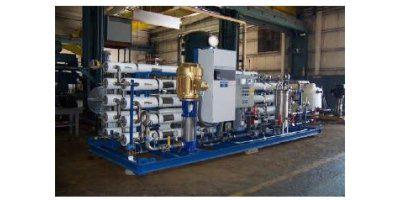
Modular systems are designed to be compact and easy to move and install in order to reduce capital costs. They are great for municipal or commercial drinking water applications (such as hotels) where space may be limited, but they need to provide for a large number of people.
Expansion of drinking water sources
The driving force behind desalination. Being more sustainably minded about the state of our current water sources is important, but alternatives are also essential when they are available. The ocean just so happens to be a very big alternative. With the world`s oceans as a viable source for drinking water, that would expand humanity’s most valuable resource by an exponential margin. Keep in mind that the oceans account for about 95+% of all the water on Earth.
Higher yield
The only other currently used desalination treatment is of the thermal variety. It works the same way as the water cycle, evaporating water into steam and when it is condensed it provides clean water. This approach is very effective at removing unwanted particles, but collecting and condensing steam is inefficient and produces much lower yields of pure water than RO. For the same output volume of water, thermal processes would require nearly three times as much seawater.
Pure water
After reverse osmosis, the water is so pure we actually have to put minerals back into it. The process unselectively removes the components of water that humans need as well as the tastes we are familiar with. Therefore, the post remineralization takes care of this process and regulates pH.
Cons
Lots of pretreatment needed
Reverse osmosis membranes are very sensitive. So, unless some more resistant membrane material is developed, pretreatment is an important requirement. Without it, the membrane can become practically useless, decreasing yield or producing impure water. Improperly pretreated seawater can deposit particulate matter on the membrane, preventing proper flow and affecting the pressure difference which increases operating cost.
High energy use
Reverse osmosis systems are constant flow processes so fluids are constantly being pumped and pressure is continually being applied to the cylindrical membrane vessels. The pressure required can approach up to 1000 psi (69 bar) in some systems. However, the osmotic pressure energy stored in the concentrate solution can actually be recovered to reduce the overall energy costs. A commonly used technology is the rotary pressure exchanger. Influent seawater is pressurized by pistons within channels inside the exchanger that are depressed by the high-pressure concentrate reject stream from the RO unit. This reuse of kinetic energy from the brine water can reduce the energy cost efficiently.
Costly for developing nations
Regardless of any energy saving, many nations of the world don’t have the capability or resources to construct and operate desalination projects. The drinking water produced from the sea water desalination process can be more expensive than treated ground water, brackish water or surface water sources.
Do you want to learn more about the pros and cons of seawater desalination by reverse osmosis, and how it may be a beneficial source of drinking water? Contact the water treatment experts at Genesis Water Technologies, Inc. at 1-877-267-3699 or email us at customersupport@genesiswatertech.com to discuss your drinking water application.