

- Home
- Companies
- SoundPLAN GmbH
- Articles
- Smart environmental solutions for a ...
Smart environmental solutions for a changing chemical landscape
Jochen Schaal, managing director of SoundPLAN GmbH and Michel Rosmolen, director of SoundPLAN Asia outline opportunities for the sector to soundly improve our environment
Like many sectors, the chemical industry within India and globally, is adapting to a number of challenges. The COVID-19 pandemic, and resulting shortages in materials and economic turbulence, has hit industries hard. There is growing impetus to tackle pollution from hazardous wastes, including chemical fertilisers and pesticides, reduce noise emissions, and combat climate change.
Positive progress
Despite these challenges, India is the sixth largest producer of chemicals in the world[i], and is attracting increased foreign investment. The industry has advanced in terms of innovation, with chemical plants becoming increasingly complex, using large numbers of processing machinery including generators, compressors, pumps and much more. However, this activity generates substantially high levels of noise, impacting both on the environment and on quality of life.
Industrial noise can cause significant health issues for workers and the potential for litigation against any company not taking the necessary steps to protect their staff. It can also impact on environmental noise levels in public places. To control this noise, the Government enacted the India Noise Pollution (Regulation and Control) Rules, 2000[ii], in exercise of its powers conferred under the Environment (Protection) Act, 1986.[iii]
Data from the Central Pollution Control Board (CPCB) which tracks noise-levels through monitoring stations, found that almost every part of India’s six metro cities, violates noise pollution standards.[iv] Not surprisingly, the study, conducted in 2018 (the latest year for which data was available), found that the noisiest parts of the cities studied are in commercial and industrial areas.
In its 2021 ‘World Report on Hearing’, The World Health Organization indicates that there are currently 401 million people in the South-East Asia region living with hearing loss. This costs the region US$ 108 billion annually. By 2050, it estimates that 666 million people are projected to have problems with their hearing.[v]
Before the pandemic, many of us may have tolerated environmental noise from industrial and other sources, as an inevitable part of city living. Now we have started to see some positive steps towards a greener and healthier future.
Building back better is a common theme across the world on the road to recovery from this pandemic. Climate change remains one of the most pressing issues which needs to be addressed on a global and local scale. India made a number of pledges at last year’s international climate summit, COP26, including getting 50% of its energy from renewable resources by 2030 and to achieve net zero carbon emissions by 2070.[vi].
As restrictions are eased, government and businesses must work hard to continue to protect people and places by combatting air and noise pollution and encouraging clean energy solutions. Targeted programs need to be in place to minimise carbon emissions and improve energy efficiency; and minimise liquid waste from the chemical industry. Greater efforts will need to be made to ensure compliance with existing and new legislation and the higher environmental standards and pledges being set.
Data driven development
Statistics from Invest India indicate there are over two million people working in the chemical industry, covering more than 80,000 types of commercial products.[vii] These are broadly classified into bulk chemicals, specialty chemicals, agrochemicals, petrochemicals, polymers and fertilisers. No two plant installations are the same and industrial noise emissions come from a wide variety of sources, so identifying the exact source and field of noise propagation can be a complex matter. If you are going to reduce it and mitigate its harmful effects, then you need to know as much about it as possible.
Smart solutions bring together infrastructure and technology to improve and connect urban development.[viii] The Indian government has recognised the importance of this through initiatives such as its ‘Smart Cities Mission,’[ix] which aims to drive economic growth and improve the quality of people’s lives, by enabling local area improvements and harnessing technology, especially options that lead to Smart outcomes.
One example is Internet of Things (IoT) technology, which enables objects (devices, buildings, and other items embedded with electronics, software, sensors, and network connectivity) to communicate with each other through the internet. This includes noise sensors, online noise monitoring platforms, and noise mapping software.
Predicting and analysing noise
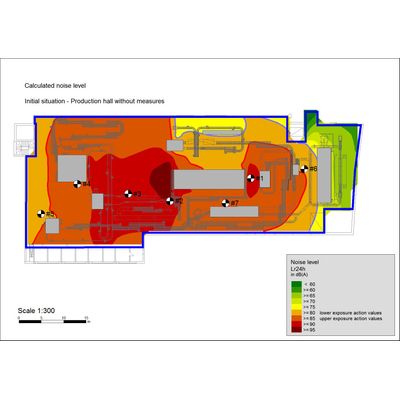
Advances in technology mean that, not only can existing noise be calculated and moderated, but by using mapping software, future levels can be predicted and assessed before projects have even begun. Using this simulation software, a visual demonstration of where the noise comes from, and how it propagates, can be produced.
Using and inputting available data, noise mapping software can break down different noise components and create realistic simulation models of how it will travel. This means that those developing chemical plant operations can assess the impact across different locations, show the sources of the loudest noise and assess the propagation across the site.
It can also help show how well mitigation factors, including specifying quieter equipment, introducing noise control fixtures such as barriers and enclosures, and the rearrangement and careful planning of buildings and equipment, may work. Different options can be trialled and costed on the computer, rather than having to retrofit noise mitigation measures.
The data can come from multiple sources, including graphical information systems or other mapping services, counts of traffic mix to and from the plant, manufacturers’ source specifications, software libraries or any other source.
Going further
Noise mapping software goes much further than measurements, which only record the overall level of noise as it occurs at a specific geographic point. A noise map shows the position of sources including all geometrical data and the levels inside and outside a building. Future levels can be predicted, and pre-emptive steps taken to control it. With this approach, mitigation measures can be targeted in the most cost-efficient way.
Each noise map is unique, according to project size, geography, objectives, the relevant noise sources, but most of all, the data that is available and which can be readily acquired to be imported and used.
The mapping software produces graphical representations of the noise using colours to depict the different levels, which can be in 3D and animated formats, if required. This colour coding means the information can be easily understood, giving a very visual demonstration of where noise comes from and how it propagates. After creating a noise map, you can introduce controls to start defending the environment and people against unwanted noise.
Noise reduction measures
Protection is best achieved by controlling noise at the source. Using quieter and well-maintained equipment or placing a barrier between the worker and noise source are relatively simple steps, but they can have a significant impact on people’s lives.
Some practical examples include obtaining the noise data from the supplier when purchasing machinery or plant, to help inform your decision and source quieter options. Where noisy machinery/plant has to remain in the working area, enclose it within a sound-insulating screen or barrier. Anti-vibration machine mountings may also be required. Use of partition walls and berms, cladding and soundproofing of floors, walls, and ceilings also helps to reduce noise. Where noise levels exceed 85 decibels (dB), ensure workers wear hearing protection (earplugs or earmuffs) within the designated and clearly marked zones.
The SoundPLAN library contains an extensive database of noise-reduction solutions, and their sound attenuation and absorption spectra can be compared using the software. The technology can help with the optimisation and positioning of these noise protection structures and concepts for complex industrial plants. Various evaluations (such as the number of affected workers) or the best cost-benefit ratio can be made. These variants can be assessed before investment in any solution. The equations help to better represent the complex nature of noise propagation in the environment.
Ear protection and other mitigation factors could have the unintended consequence of workers not being able to hear emergency alarms[x]. For this reason loudspeakers at any given point in a plant must be at least 10 dB above the ambient noise. For verbal messages, the requirements are even more stringent. Both of these requirements can be studied with a noise map.
Cost effective testing
The majority of environmental noise simulations are small to medium projects tasked with checking the legal compliance of an expansion to an industrial facility, for example. These projects might not require the same complexity as is offered by the option of full-strength noise planning software.
Noise modelling software suited for these small to medium projects must be specially designed to quickly acquire the model data. Results must be obtainable quickly without much formatting, yet it must be customizable enough so the standards of your company can be represented, and you can be proud of your work.
As well as comprehensive noise mapping software, my organisation offers a version designed for users who only have an occasional requirement for a noise map. This helps them achieve reliable tabular and graphical results for a standard noise calculation with the investment of minimal time.
Noise within buildings
Until recently effectively mapping and modelling indoor workplace noise has proved problematic. Multiple floors and walls in between the sound source and the receiver of the noise can interrupt the signal. It’s even worse when you take corners into account, which make recording, mapping and modelling even harder as sound doesn’t travel in a uniform, predictable pattern around them.
Specialist noise mapping software is now available to calculate room acoustic parameters, for example reverberation time, STI (speech intelligibility index), or privacy distance. This is achieved according to a sound particle model with diffraction for the evaluation of buildings and rooms according to the standards ISO 3382-3, VDI 2569 and DIN 18041.
Looking to the future
Mechanisms need to be in place to ensure compliance with the tightening up of green policies and procedures. The consequences of not reducing our environmental footprint include increased noise and air pollution with the associated health, safety, and financial impacts.
Mapping software is one way to make significant improvements in a variety of plant operations by clearly identifying problem issues and the effectiveness of possible mitigation measures. It’s vital that this message isn’t drowned out as we work together to build a better future.
www.soundplan.eu
E: info@soundplan.de /info@soundplan.asia
Biographies
Jochen Schaal is managing director of SoundPLAN GmbH, an innovative software company and engineering firm and market leader in the fields of noise control, noise mapping, occupational health and safety and room acoustics. He is responsible for overall business strategy, markets and product development, key partner relationships, and brand development. Jochen’s professional expertise in the field of noise control also means he often supports guideline work in ISO and DIN Standards committees in Germany and across Europe and at international level.
Academic degrees: Dipl. Ing. (FH)
Michel Rosmolen is director of SoundPLAN Asia. Michel is an active committee member at IIAV (International Institute for Acoustics and Vibration), where he is currently Director from 2020 – 2024, having previously held this role the 2014 – 2018. He also holds the role of Chair Sponsor & Exhibitions at IIAV since 2012. Michel is also a board-member of
SAS (Society of Acoustics (Singapore) as Honorary General Secretary as well as Vice President (Communications). At the IYS2020 (International Year of Sound) he is a Steering Committee member for SE Asia.
References
[i] Invest India https://www.investindia.gov.in/sector/chemicals
[ii]http://www.indiaenvironmentportal.org.in/files/file/Noise%20Pollution%20(Regulation%20and%20Control)%20Rules,%202000.pdf
[iii] https://www.indiacode.nic.in/bitstream/123456789/4316/1/ep_act_1986.pdf
[iv] National Herald: https://www.nationalheraldindia.com/videos/indian-cities-rank-high-on-noise-pollution
[v] World Health Organization ‘World Report on Hearing’ infographic for WHO South-East Asia region: https://www.who.int/images/default-source/health-topics/deafness-and-hearing-loss/world-report-on-hearing/world-report-on-hearing---infographic-searo.jpg?sfvrsn=ccb90120_7
[vi] Official Portal of the Government of India. National Statement by Prime Minister Shri Narendra Modi at COP26 Summit, Glasgow, 1 November 2021 https://www.pib.gov.in/PressReleasePage.aspx?PRID=1768712
[vii] Invest India https://www.investindia.gov.in/sector/chemicals
[viii] Ellesmore, J. (2019) ‘Smart Cities: The Future Of Urban Development’ Forbes (https://www.forbes.com/sites/jamesellsmoor/2019/05/19/smart-cities-the-future-of-urban-development/#36f644492f90)
[ix] Smart Cities Mission https://smartcities.gov.in/
[x] Electrical Contractor magazine. Codes and Standards https://www.ecmag.com/section/codes-standards/sounds-crisis