


- Home
- Companies
- Perma Pure LLC - a Halma Company
- Articles
- Solving Water Vapor Challenges in Total ...
Solving Water Vapor Challenges in Total Organic Carbon Analysis with NDIR
A review and comparison of common methods to remove moisture from a gas for analysis.
Total Organic Carbon (TOC) analysis measures the amount of carbon present in organic compounds in a sample of water or liquid. It is a non-specific indicator of purity and quality, often detected as CO2 in fractional ppm to ppb ranges.
Total organic carbon analyzers yield results that provide information on the safety of drinking water and water systems, product quality and giveaway, process optimization, and environmental impact in a variety of applications, such as:
- Municipal wastewater and treatment
- Airport runoff
- Industrial runoff
- Food & beverage
- Ultra pure water applications
- Drinking water
- Pharmaceutical manufacturing
- Semiconductor manufacturing
- Chemical manufacturing
- Power generation
- Environmental monitoring
Carbon can water sample can be measured by a nondispersive infrared (NDIR) detector or by a conductivity detector. When NDIR detection is used, carbon is measured in the gas phase. When conductivity detection is used, carbon is measured in the liquid phase.
NDIR detection is the primary detection method used, but this method faces challenges with water vapor interfering with analysis and maintenance.
After a liquid sample is injected into the flow path of the analyzer it is oxidized one of three methods:
- UV persulfate oxidation
- Heated UV persulfate oxidation
- Combustion
Typically, combustion is used for dirtier samples with more contaminants and particulate. After the sample is oxidized to a gaseous state containing CO2, some water still remains in the sample. For the highest accuracy, sensitivity and reproducibility possible, both liquid water and water vapor need to be removed before the sample is carried to the NDIR detector by the carrier gas. This is because:
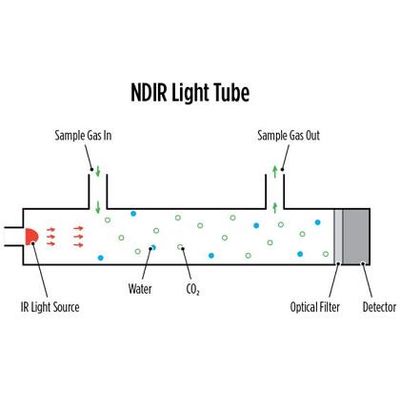
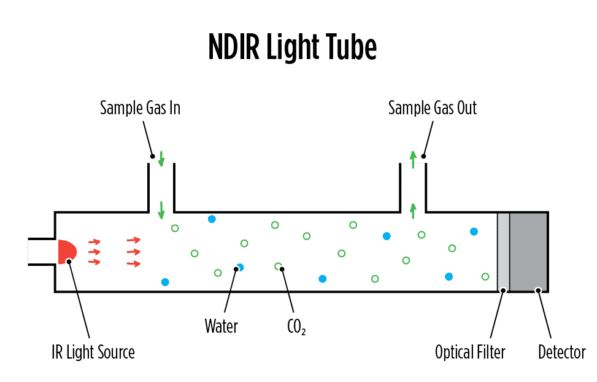
- Water causes spectral interference with CO2, affecting accuracy and sensitivity. The NDIR detector measures the amount of infrared light absorbed by CO2 flowing through the sample chamber or light tube. CO2 absorbs IR light at characteristic wavelengths. However, water absorbs IR light at some of the same wavelengths which affects the accuracy of the reading and analyzer sensitivity to CO2.
- Water condenses in the light tube, which is difficult to drain, resulting in challenges with reproducing results. It also can make the detector nonfunctional. End users in technical, manufacturing, or quality control roles need to run the analyzer with clean, dry air for up to 8 hours to remove this water buildup in the light tube, decreasing productivity.
Perma Pure offers MD-series and PD-series dryers that dry gas samples to humidity levels as low as –40°C dew point, outperforming water vapor removal achievable with other methods. This enables our customers to achieve leadership in TOC analyzer accuracy, sensitivity, and reproducibility, and eliminate condensation-caused maintenance for their end users.
In addition, when used with relatively clean water samples, Perma Pure dryers never require replacement.
Perma Pure gas dryers are powered by Nafion tubing, which selectively removes water vapor from a gas sample. Because of Nafion polymer’s selectivity for water vapor, a Nafion dryer removes more moisture than other gas drying solutions, such as water traps and thermoelectric coolers, while keeping CO2 in the gas sample.
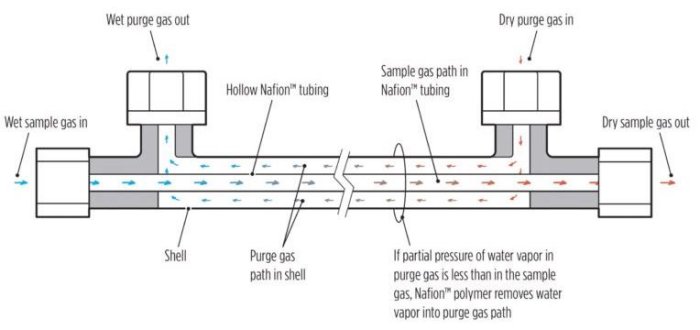
A Perma Pure dryer moves water vapor out of the sample gas stream and into a counterflowing purge gas using the partial pressure of water vapor to drive the exchange.
Purge gas should be instrument quality air (-40°C dew point) or nitrogen flowing at two to three times the sample flow rate. If no purge gas is available, there are other purge gas configurations that can be used, for example pulling vacuum through the purge path.
While the partial pressure of water in the purge gas is less than in the sample gas, Nafion polymer will selectively transfer water vapor from the sample gas across its membrane and into the purge gas flow to be swept away. At the sample gas outlet, water vapor has been removed from the sample to achieve humidity levels as low as –40 °C dewpoint.
Improve accuracy, sensitivity, and reproducibility of TOC analysis with NDIR by removing more water than all available gas drying solutions.
Eliminate condensation-caused maintenance for TOC analyzer end users.