- Home
- Companies
- Soundinsight BV
- Articles
- Sonocat - Finding Acoustic ...
Sonocat - Finding Acoustic Transfer-Paths Between 2 Rooms in a Concert Hall - Case Study
Introduction
For the purpose of determining sound transmission from concert room 2 to room 1, Sonocat measurements were taken close to various sound-radiating surfaces in room 1. In these measurements, the sound intensity of that sound-radiating surface was determined. A constant loud sound source was used in room 2 for this purpose.
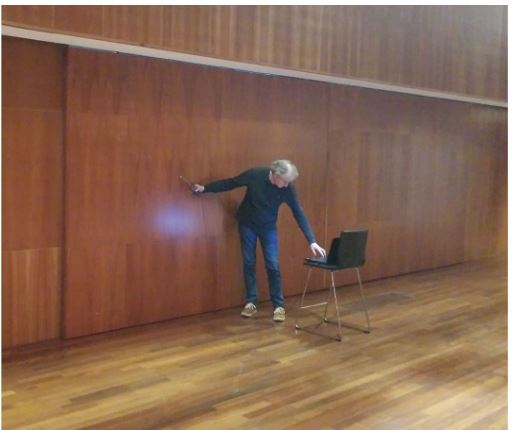
An example of such a measurement is shown below. The Sonocat is held in front of the sound-radiating surface. Due to time constraints, "point" measurements were made and an occasional "scan" measurement. A total of 62 measurements were taken.
In this measurement session, the radiated sound intensities were determined. The normal "active" intensities were also determined. The active intensity is the net intensity; i.e., the radiated intensity minus the intensity reflected back by the room. For a radiating surface, this means that if the value is positive, there is net sound being radiated; if the value is negative, then net energy is flowing into the surface (and thus there is absorption) and more sound is flowing out of the room through that surface than is flowing in. The same surface can radiate sound for one frequency (band) while absorbing sound for another frequency (band).
An example is shown in Figure 1. Here the wooden "sliding doors" in front of the windows are measured in room 1.