


- Home
- Companies
- Aimix Group Co., Ltd
- Articles
- Structural Design Factors Affecting ...
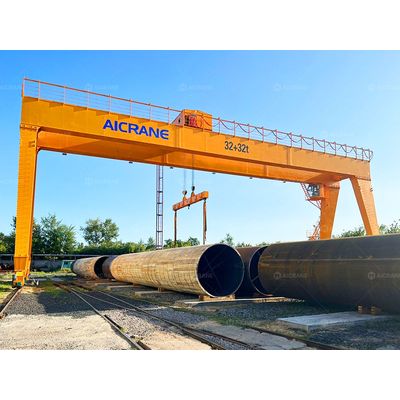
Structural Design Factors Affecting Double Girder Gantry Crane Capacity
Double girder gantry cranes are essential in industries where heavy lifting, long spans, and continuous operation are required. From steel mills to shipyards, these cranes enable the safe and efficient handling of heavy loads. While many factors influence crane performance, structural design plays a pivotal role in determining its lifting capacity, stability, and operational reliability. Understanding these factors can help engineers and operators optimize crane selection and performance for specific industrial applications.
1. Overview of Double Girder Gantry Cranes
A double girder gantry crane typically consists of two main girders supported by end carriages running on rails. The hoist mechanism travels along the girders to lift and move loads. Compared to single girder designs, double girder cranes offer:
- Higher lifting capacities, often exceeding 50 tons.
- Greater span lengths, sometimes over 40 meters.
- Reduced deflection and improved load distribution.
- Enhanced operational safety for heavy-duty applications.
The structural design of the crane—particularly the main girders, end carriages, bracing systems, and connections—directly affects the crane’s rated capacity and service life.
2. Main Girder Design and Material Selection
a. Girder Cross-Section and Profile
The main girders bear most of the crane’s load. Their cross-section must resist bending, torsion, and shear forces during operation. Common designs include:
- Box girders: Enclosed structure providing high torsional rigidity.
- I-beams: Economical and suitable for moderate capacities.
- Lattice girders: Lightweight design for very long spans with moderate loads.
A girder with insufficient stiffness may deflect excessively under load, reducing hoist stability and limiting rated capacity. For high-capacity cranes, box girders are preferred due to their superior strength-to-weight ratio and resistance to torsional twisting.
b. Material Strength
Crane girders are typically fabricated from high-strength structural steel, such as Q345 or Q355. Key considerations include:
- Yield strength: Determines the maximum stress before permanent deformation.
- Fatigue resistance: Important for cranes that operate continuously under cyclic loads.
- Weldability: Ensures structural integrity during fabrication.
The choice of steel and its treatment (e.g., heat treatment, corrosion-resistant coatings) directly influences the crane’s ability to handle higher loads safely.
3. End Carriage and Wheel Assembly
The end carriages support the main girders and transmit the crane’s load to the rails. The structural design of the carriage affects both capacity and stability:
- Wheelbase and number of wheels: Longer wheelbases distribute load more evenly, reducing rail stress. Multiple wheels per side improve stability and reduce point load on tracks.
- Wheel material and diameter: Wheels made of hardened steel with adequate diameter reduce wear and improve load-bearing capacity.
- Reinforcement and bracing: Carriages often include diagonal bracing and gusset plates to prevent twisting and lateral deformation.
A poorly designed carriage can reduce the crane’s effective lifting capacity even if the main girders are robust.
4. Bracing Systems and Load Distribution
Proper bracing ensures the crane structure can withstand:
- Vertical loads from lifting operations.
- Horizontal forces from acceleration, deceleration, and wind.
- Torsional forces from asymmetric loading.
Double girder gantry cranes often employ cross-bracing, end girder stiffeners, and inter-girder bracing. These elements stabilize the structure, prevent lateral deflection, and allow the hoist to operate safely at maximum rated capacity. Bracing is particularly critical for cranes with long spans, where girder bending moments are significant.
5. Hoist Location and Lifting Point Considerations
The position of the hoist along the girder affects the structural load distribution. Key factors include:
- Load eccentricity: If the hoist lifts loads away from the girder center, bending moments increase.
- Traveling loads: Hoists moving along the crane create dynamic forces, including impact loads during start/stop operations.
- Multiple hoists: Some cranes carry two or more hoists. Their positioning requires careful consideration of combined load effects on girders and end carriages.
Accurate structural analysis ensures that the crane can handle maximum loads across all hoist positions without compromising safety.
6. Crane Span and Lift Height
a. Span Length
The distance between end carriages (crane span) significantly impacts lifting capacity:
- Longer spans increase bending moments in the girders.
- Excessive deflection can lead to hoist misalignment, decreased precision, and structural fatigue.
- Engineers must balance span length with girder stiffness, material strength, and allowable deflection limits.
b. Lift Height
Higher lift heights increase the length of the rope and tension forces on the hoist. Structural factors include:
- Girder deflection: Higher lifting points amplify bending stresses.
- End carriage design: Must accommodate increased leverage from taller loads.
- Lateral stability: Taller cranes are more sensitive to wind and seismic forces.
Both span and lift height must be optimized to achieve the desired capacity safely.
7. Connection Design
The points where girders connect to end carriages, hoists, and bracing components are critical stress points:
- Welded vs. bolted connections: Welded joints provide higher strength but may be more susceptible to fatigue if not properly designed. High-strength bolts offer easier maintenance but require precise torque control.
- Gusset plates: Reinforce joints and distribute stress.
- End carriage brackets: Must resist torsion and maintain alignment under dynamic loads.
Improper connection design can create weak points, limiting safe lifting capacity and increasing maintenance requirements.
8. Safety Factors and Operational Duty Class
Cranes are designed with safety margins based on expected duty cycles and load variations. According to ISO 4301-1 standards:
- Duty classification (e.g., A3, A5, A7) determines load frequency and operational stress.
- Structural elements must withstand peak loads, fatigue, and environmental forces.
- A conservative safety factor ensures that even in worst-case scenarios, the crane structure remains stable.
Higher capacity 50 to 500 ton gantry cranes generally require higher-grade materials and more robust design to meet stringent safety factors.
9. Environmental and Dynamic Considerations
Structural design must account for environmental conditions:
- Wind loads: Especially important for cranes with large spans or in outdoor installations.
- Seismic activity: May require additional bracing and anchoring.
- Temperature variations: Can affect steel elasticity and expansion, impacting deflection.
- Dynamic loads: Acceleration, deceleration, and sudden stops create additional bending and torsion forces.
A crane designed without considering these factors may suffer premature fatigue or experience unsafe operating conditions.
10. Advances in Structural Design for Capacity Optimization
Modern double girder gantry cranes leverage advanced design techniques to maximize lifting capacity:
- Finite Element Analysis (FEA): Allows precise stress mapping and optimization of girder profiles, end carriages, and bracing.
- Lightweight high-strength steel: Reduces overall deadweight, allowing higher payload capacity.
- Modular construction: Facilitates custom spans and lifting heights without compromising strength.
- Anti-sway and load-limiting technology: Reduces dynamic forces and improves safety, allowing operation closer to rated capacity.
These innovations enhance the structural efficiency, operational safety, and long-term reliability of double girder gantry cranes.
11. Conclusion
The lifting capacity of a double girder gantry crane is heavily influenced by structural design factors. From girder profiles and material strength to end carriage design, bracing, connections, and environmental considerations, each element contributes to the crane’s ability to safely handle heavy loads. Modern engineering techniques, including FEA and high-strength steel, allow designers to push capacities higher while maintaining safety and reliability. For industrial operations, understanding these factors is essential when selecting or customizing a crane to meet specific lifting requirements. A crane’s rated capacity is not just a number—it reflects the meticulous structural design and engineering that ensures safe, efficient, and reliable performance for years of heavy-duty operation.