

- Home
- Companies
- Italian Exhibition Group S.p.A (IEG)
- Articles
- Textile waste and circular economy: ...
Textile waste and circular economy: prospects for the future
Textile products are among the most used in the world. The fashion industry has a huge footprint in this regard, particularly in the last few years when fast fashion has become increasingly widespread, leading to a sharp increase in the quantity of clothing produced, used and then quickly discarded. This clothing is mainly made of synthetic materials (60% of the textile fibres placed on the market - polyester being the most used fabric). Only 1% of textile waste in the world is recycled as new “clothing”(1), to the extent that the European Union has included it among its priorities on which to work for a circular economy future.
According to the European Union, the total use of primary raw materials in the supply chain for the consumption of clothing, footwear and household textiles in the EU is the fourth largest cause of environmental pressure after food, residential building and transport. Specifically, in 2017:
- approximately 1.3 tonnes of primary raw materials and 104 cm of water were used per person
- 85% of these raw materials and 92% of the water relating to the consumption of textile products in the EU were consumed in other regions of the world
- the production and handling of clothing, footwear and household textile products in the EU-28 generated emissions of 654 kg CO2 equivalent per person, of which only 25% took place within the EU
- production in the sector is responsible for about 20% of global clean water pollution
- washing synthetics releases 0.5 million tonnes of microfibres into the ocean a year, and accounts for 35% of primary microplastics released into the environment, which may end up in the global food chain (2).
According to the Ellen MacArthur Foundation, worldwide (1):
- 87% of textile waste is landfilled or incinerated
- 13% is recycled into lower value uses, often absorbent cleaning cloths and rags
- 1% is recycled into new clothing.
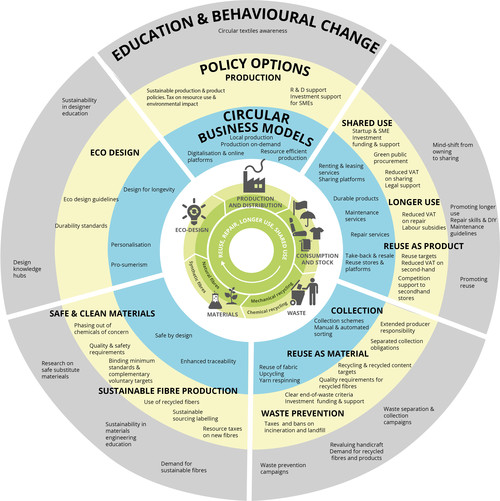
Effective business models and policies can guide us towards a circular textile economy.
Based on the waste directive approved by the European Parliament in 2018, EU member states will be obliged to set up separate collection for textiles by 2025. The Commission’s new strategy also includes measures to support circular materials and processes, to counter the presence of dangerous chemicals and to help consumers choose sustainable textile products.
Furthermore, private companies and public authorities are starting to see the potential economic, social, environmental and climate benefits of a switch to a circular textile system materialise. To optimise and disseminate these models, however, we need a change within the system driven and supported by regulations and specific taxation policies.
In its report The circular economy: a transformative Covid-19 recovery strategy, the Ellen MacArthur Foundation seeks to provide an overview of the topic, highlighting some of the main factors that can implement a circular economy model in this sector.
There are three circular economy drivers we need to pay attention to:
- the strengthening of collection, sorting and recycling systems
- investment in research to be able to recycle synthetic fibres and in technological tools to make the selection of fibres more efficient for recycling purposes
- design focused on recovery.
For the European Union, creating a circular economy for textiles means starting with decisions taken at the design stage. The use of safe and green materials may be supported by:
- introduction of regulation to increase quality and safety requirements
- greater “public” demand for sustainable fibres
- targeted policies for correct labelling
- specific taxes that could potentially increase the demand for recycled fibres.
The issue of textile waste management does not only concern the fashion sector, but also other goods. A number of European projects are focusing in particular on the large-scale recovery and recycling of textile fibres.
The RESYNTEX research project aims to create a new concept of the circular economy for the textile and chemicals industry. Using industrial symbiosis, it aims to produce secondary raw materials from non-wearable textile waste.
The objective of the ReHubs project is to put textile waste into dedicated hubs, process it where possible in order to put it back into the production cycle, possibly use it as thermal insulation, or dispose of it in the conventional manner when it cannot be processed.
The EU’s REACT project seeks to address the management of waste acrylic textiles coming from outdoor awnings and furnishings. The project seeks to find solutions to remove the chemical finishes from acrylic textiles coming from industrial waste or products at the end of their life.