

- Home
- Companies
- Inland Technology, Inc.
- Articles
- The Invincible Mortal in the Workplace.
The Invincible Mortal in the Workplace.
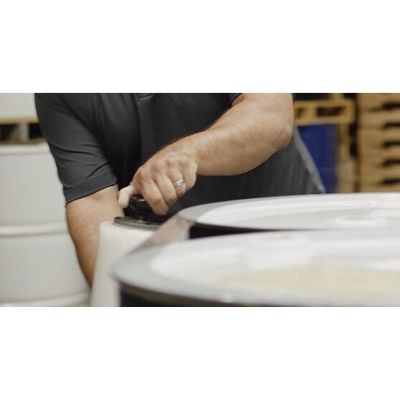
I have a superpower. I can breathe in radiation and spit out roses. Or at least, that's what many of us feel while working in industrial shops all over the country. In the typical industrial workplace there are tens, if not hundreds, of things you are exposed to throughout your work day, week and career. There are ergonomic related routinely made movements that affect the body over time, the noise exposure that causes too many older employees to require hearing aids and then there are the numerous chemicals exposures that can be adsorbed in through skin, breathed into the lungs and are a constant need to the shop technician to finish the job. We work blissfully in the notion that since I can't see the exposure and the effects aren't immediately felt, then I'm fine.
An aerosol can of some sort of degreaser or solvent is as likely to be in a tool box as a screwdriver for these hard working souls that are the backbone to the American workforce. Chemicals such as Heptane, Hexane, n-Propyl Bromide, Toluene, Trichloroethylene and other similar compounds are found in these cans and all are extremely volatile. A quick web search on any of these will haunt you, knowing that your father, your sister, your son and friends are breathing in these materials in order to make a living wage and provide you with that coveted iPhone, the new XBOX One or simply just to work on your car when it breaks down for you.
Some of these chemicals are regulated as Hazardous Air Pollutants (HAPs,) are part of a company's Volatile Organic Compound (VOC) reporting and all of them have known effects on the environment we live in. They are considerably toxic to the health of the technician spraying them, either through skin absorbing contact or breathing in the vapors, and often a likely identified by OSHA or US EPA as a likely human carcinogen. Users tend to have a superhero outlook though. Thinking that because they didn't fall over dead or ill immediately after using it, they must be fine and of stronger stock than the technician next to him that is alone in his safety measures: proper chemical resistant gloves, safety glasses with side shields, chemical apron, respirator (or similar option) and an appropriately ventilated area to work in.
The very nature of these materials creates a double edged sword for the worker using them. They just want to do their job, finish the day and get home to their family. Due to their extreme volatility (their fast evaporation), these materials are seen as a single use answer to the surface cleaning, degreasing and preparation activity they do on a regular basis. The propellant forces the chemical out in a manner that pushes off the grease and grime, while the solvent evaporates near instantaneously afterwards, and typically right past the technicians face as it does so. Acting as a drying agent. In their mind, it's an ideal work solution. No wipe, no fuss, no follow-up step. Now on to the next job, break time or checking Facebook on my phone.
The other side of the coin, is that the extreme evaporation allows for immediate exposure (and therefore over-exposure concerns) of the toxic material being used. A simple rule of thumb: If you can smell it, you're probably over exposed to it. The effects of exposure are typically not immediate, unless working in a confined space. However, the ongoing daily and weekly exposure adds up. The body can only filter out and dilute so much of the toxins we encounter. Genetics also play a great deal in this. One technician can work all his life and never have an issue even though he or she was exposed daily. Another can work a year, develop cancer and suffer from the exposure. There are countless stories of exposure related illness that have affected our workforce all throughout legal circles and in every home in America.
For the company providing these aerosol cans to the technicians, demanding that production be maintained or even increased, it is a cost seen as a necessary part of the business. One that is easier managed through pamphlets and signs posted around the work area to show that you should know better and work safer. Having the MSDS (Material Safety Data Sheet) placed in a book on the shop floor is typically better for a paper weight than an engaged way of educating the users. The employers, I would say, typically do not realize the liability concerns - or worse, do and just accept it as something they have limited control over.
The evaporation rate is never connected to the ongoing consumption costs associated with the chemical by these companies. Having witnessed a technician once using an entire 14oz can to clean and blow off a threaded shaft about the size of banana, I can attest to the wastefulness in the shop. The technician, who didn't have to foot the bill on the consumable costs, merely sprayed so much because he wanted to blow off all the grease, rather than take a rag and wipe it off. It's one less step, he felt. The company didn't blink at it, because to them, the cost was already established in doing business and accepted it from historical industrial habit.
I used to be a young man in the shop. I set my work ethic knee deep in chemical exposure at a normal, everyday small business concentrating on hydraulic equipment repair and service. I felt invincible then and never thought about it. Now, years later, and for full disclosure, I work in the industry of replacing many of these conventional and toxic chemicals in the same work place activities I worked in then. Not much has changed in fifteen years, though I've learned a great deal from my activities over the these years to now. The first thing I learned along the way is, I am not invincible. I was not born with a cape and a big giant 'S' on my chest. The second, there are easily adopted answers out there, if given the opportunity, shown the light of day and implemented by upper management effectively. The shops out there are more or less the same, the technicians work hard and put in their hours.
By establishing work practices involving low-volatile chemistry and a dry rag instead, or even a fan or air hose, a company can drastically reduce their impact on the environment and VOC reporting. Technicians would be exposed to one less toxic chemical and costs would be reduced by half or more, when considering the volatility difference between solvents. It seems simple enough. There is no measurable difference in labor hours associated with switching to a low-volatility solvent. But, until a company steps up and chooses to implement safer green chemistry to the shop floor and offers engaged instruction and education, the shop floor is going to continue to work in a habitual industrial manner they have for a century or more. I'm just happy my superpowers worked back then in my Clark Kent mode. It'd have been awkward to tear down and repair those hydraulic tools with a red cape protecting me!