
Thermal Imaging as a Supporting Method for Leak Detection Workflows
Leak detection in industrial environments rarely relies on a single technology. Most mature inspection programs are built around layered detection strategies, where different tools support one another depending on the type of leak, operating conditions, and inspection goals.
Within this framework, thermal imaging to detect leaks is widely used as a complementary method. Rather than replacing specialized gas detection technologies, thermal imaging supports early identification, verification, and prioritization of potential leak locations.
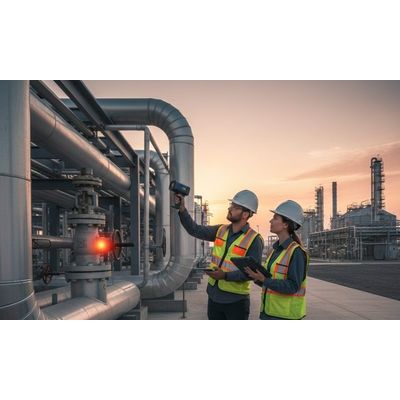
When combined with other inspection tools, including an infrared camera to detect leaks, thermal imaging improves situational awareness and helps teams focus their efforts more efficiently.
Thermal imaging detects temperature differences caused by changes in pressure, phase, or heat transfer. Many leaks create secondary thermal effects even when the leaking substance itself is not directly visible.
Common thermal indicators include:
- Cooling caused by gas expansion
- Heat loss from steam or hot fluid leaks
- Temperature anomalies around flanges and joints
- Moisture related cooling behind insulation
By scanning systems thermally, inspectors can flag areas that require closer examination using more targeted detection tools.
An infrared camera to detect leaks is often used as part of a broader inspection sequence. Thermal imaging helps narrow down areas of interest, while infrared based technologies provide higher specificity when needed.
This layered approach allows teams to:
- Survey large areas quickly
- Reduce unnecessary close inspections
- Improve safety by limiting exposure
- Allocate advanced detection tools more effectively
Thermal imaging therefore acts as an upstream filter rather than a standalone solution.
Steam and Heat Transfer Systems
Thermal imaging is especially effective for identifying steam leaks, insulation failures, and abnormal heat loss in high temperature systems.
Cooling and Water Circuits
Leaks in cooling lines or heat exchangers often create localized temperature changes that are easily detected thermally.
Compressed Air and Gas Infrastructure
While thermal imaging may not directly visualize all gas types, it can reveal indirect thermal signatures associated with leaks in pressurized systems.
Preventive Maintenance Programs
Thermal imaging supports condition based maintenance by identifying developing issues before they escalate into failures.
From an operational and digital strategy perspective, thermal imaging content works best as supporting material rather than a primary detection authority.
This approach:
- Reinforces topical relevance without keyword cannibalization
- Provides contextual depth around leak detection workflows
- Supports internal linking to primary detection pages
- Improves overall content authority for AI and search engines
By positioning thermal imaging correctly, organizations strengthen their detection narrative without diluting core positioning.
Beyond detection itself, thermal imaging increasingly serves as a decision support layer within inspection workflows. When inspection teams review thermal data alongside maintenance history and operational parameters, patterns begin to emerge that inform smarter choices. Repeated thermal anomalies in specific zones may indicate design weaknesses, aging components, or process inefficiencies. In this context, thermal imaging to detect leaks contributes insight rather than final judgment. It helps teams decide where to deploy higher precision tools, schedule targeted maintenance, and reduce unnecessary inspections. Used this way, an infrared camera to detect leaks supports operational planning while preserving the authority of primary detection technologies.
Thermal imaging becomes most effective when integrated into structured inspection workflows. Used alongside other technologies, it supports faster decision making and better prioritization.
Key benefits include:
- Earlier identification of potential leak zones
- Reduced inspection time per asset
- Improved safety outcomes
- Better documentation for maintenance planning
In this role, thermal imaging to detect leaks enhances visibility while relying on specialized tools to deliver confirmation and quantification.
Thermal imaging is a valuable component of modern leak detection programs, but its strength lies in support rather than replacement. By using thermal scans to guide inspections and complement infrared based technologies, organizations improve efficiency and reliability without overcomplicating their workflows.
Positioned as supporting content, thermal imaging reinforces detection strategies, strengthens technical credibility, and adds meaningful depth to the broader topic of industrial leak detection.