


- Home
- Companies
- Proco Products, Inc.
- Articles
- Understanding & Proper Installation of ...
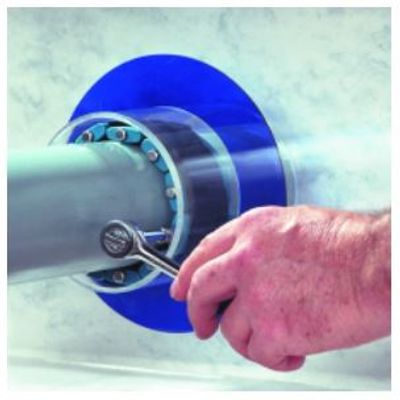
Understanding & Proper Installation of Pipe Penetration Seals
Why a gas and watertight seal is important for your operation
When designing a pumping system-or refurbishing, reconfiguring, or expanding one-users may be faced with sending a pipe through a wall, floor, tank, or vault. Sealing this pipe-through so that no substance-gas or liquid-leaks is of utmost concern. Not only could the failure to create a gas or watertight seal create loss of efficiency or product, but it could result in a safety issue for personnel.
The use of a pipe penetration seal is a reliable tool in such cases. A pipe penetration seal should be selected for the specifics of the application, considering available materials, temperature ranges, sizes, and the environment in which it will be installed.
A pipe penetration seal forms a mechanical rubber seal in the annular space between the pipe and the wall opening where the pipe penetrates the wall. It also forms a seal between inner pipe and outer pipe sleeves or pipeline casings. The seal should be able to achieve efficiency and work in a conjunction with any electrical conduit, concrete, cast iron, steel, copper or PVC/CPVC (polyvinyl chloride/chlorinated polyvinyl chloride) pipes passing through walls, floors, tanks, pipeline casings and vaults.
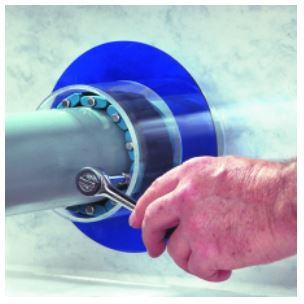
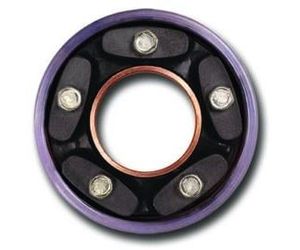
The Pen-Seal from Proco Products has been tested and will withstand a hydrostatic seal up to 20 pounds per square inch gauge (psig) or 40 feet of head pressure and temperatures up to 250 F (121 C) and -40 F (4 C). The Pen-Seal uses glass-reinforced plastic, and the hardware is made of steel zinc dichromate. To ensure corrosion resistance, 316 stainless steel is also available. Nitrile can also be used if the pipe penetration seal will come in contact with hydrocarbons, oil, gas, or miscellaneous solvents.
EPDM-or ethylene propylene diene monomer rubber-is the standard elastomer material for the Pen-Seal. This material is suitable for most water applications. The above ground and direct burial provides electrical insulation where cathodic protection is required. It is used to control corrosion of a metal surface by making it the cathode-the negatively charged electrode by which electrons enter an electrical device-of an electromechanical cell.
The alternatives to the use of pipe penetration seals-expandable foams and caulks-not only have 10 to 14 days of curing time, but they have to be reapplied to maintain the seal. A pipe penetration seal is a more permanent solution, saving time and cost on maintenance.
In the case of the Pen-Seal, it is resistant to sunlight and ozone and absorbs vibration, shocks, and sound waves. Insulating inner pipe from other structures including out pipe sleeves, pipeline casings, walls and tanks is also a feature. In additional, the nuts and bolts are plated with an anti-corrosive coating. Stainless steel nuts and bolts are also available.
Note: When a Pen-Seal is being used to seal a gap in electrical conduit lines, it acts as an incubator.
- Center the pipe in the sleeve or core opening-support the pipe at both ends. Warning: The Pen-Seal isn’t a support and pipe shouldn’t be able to be adjusted during seal installation.
- Wrap the belt over the pipe and make sure the bolt heads are facing the installer.
- Connect the ends by passing the bolt through the seal holes, thread the bolt into the last pressure plate and tighten the bolt head until snug.
- For larger sizes, insert the assembly at a 6 o’clock position and push the remaining seal on both sides as you move towards 12 o’clock. Use a light solution of soapy water as a lubricant as needed.
- Using a rachet wrench, tighten the bolt moving around the belt in a clockwise direction, starting at 12 o’clock. Tighten each bolt four turns at a time max until a slight bulge between each pressure plate is visible. This will need to be repeated at least three times around the seal.
Note: Make sure pipe and opening are clean and free of irregularities.
Warning: Use of high- speed power tools can lead to over torqueing.
- Wall sleeves
- Floor sleeves
- Interior piping
- Noise dampener
- Electrical contractors
- Valve pits
- Telecommunications
- Underground steel tank!
- Coal preparation plants
- Precast concrete
- Mining
- Marine
- Water and wastewater
- HVAC
- Offshore oil platforms
- Dual containment seal
- Pulp and paper
- Power generation
pipe penetration seal may seem tricky, but with the online Pen-Seal Sizing Calculator, the user can determine the right size needed for any application. This calculator helps determine the proper number of links needed and the correct size of those links. Simply type in the pipe`s outside diameter in inches and the penetration inside diameter in inches, and the Pen-Seal size and number of links needed will be calculated for the user, taking out any guesswork.
Product Offering: rubber expansion joints. PTFE pipe expansion joints, ducting expansion joints, braided flexible metal connectors, low torque gaskets, pipe penetration seals, rubber pipe connectors, rubber check valves
Industries: water & wastewater, chemical/ petrochemical. HVAC, industrial, marine, mining, oil & gas. power generation, pulp & paper, steel
Members of: Fluid Sealing Association (FSA), Water Environmental Federation (WEF), American Water Works Association (AWWA). Cooling Technology Institute (CTIJ, National Association for Hose and Accessories Distribution (NAHAD). Industrial Distributer Co-Op (IDCO) and American National Standards Institute (ANSI)