


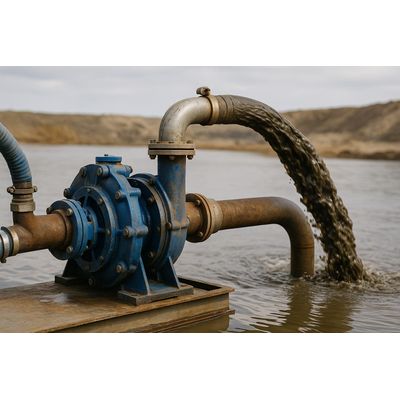
Understanding Pump Curves for Pontoon Dredging Applications
In pontoon dredging, the gap between test-based pump curves and field results is a common source of underperformance. The operating point is defined by the intersection of the pump curve and the system curve, which reflects the dredge layout, hose routing, elevations, and slurry characteristics—not brochure values alone.
What a Pump Curve Really Tells You (and What It Doesn’t)
A pump curve describes hydraulic capability under controlled test conditions. It shows flow versus head, efficiency bands and the Best Efficiency Point (BEP), and how power demand changes with flow, as well as Net Positive Suction Head required (NPSHr) and speed or impeller trims. It does not capture installation geometry, dredge operating conditions, or slurry properties once solids are present. When treated as a production guarantee, curves predictably underperform. Core elements include flow versus head, efficiency bands with the BEP, power demand across the operating range, NPSHr, and speed or trim settings. What they omit includes slurry density, wear, hose routing, and site variability. Therefore, using a pump curve in isolation yields suboptimal dredging results.
- Flow versus head and the basic operating range
- Efficiency bands and the BEP
- Power demand across the operating range
- NPSHr and suction requirements
- Limitations: geometry, hose routing, slurry density, wear, and site variability
The System Curve: Where Pontoon Dredging Becomes Real
A pump curve indicates what the pump can do; a system curve shows what the dredge must demand from that pump at different flow rates. The system curve represents the head required to move slurry through the complete setup and is driven by static head (ladder depth and discharge height), friction losses in suction and discharge hoses and pipelines, minor losses from fittings, and an operating margin for wear and slurry variability. As layout or conditions change, the system curve shifts, so the actual operating point is where the pump curve intersects the system curve.
- Static head from ladder depth, water level, and discharge height
- Friction losses in hoses and pipelines
- Minor losses from elbows, swivels, valves, and routing
- Operating margin for wear and slurry density variation
Field changes such as hose routing or ladder position cause the system curve to move, so the same pump can feel strong during setup and “weak” when dredging begins.
Why Dredging Performance Never Matches Clear-Water Curves
Curves are typically generated with clean water. Introducing solids lowers head at a given flow, reduces efficiency, and increases power demand due to particle interactions and additional losses. Consequently, dredging performance diverges from the brochure curve. Practical adjustment steps include:
- Start with the clear-water curve as a baseline
- Estimate slurry density and solids concentration
- Apply slurry derating or correction factors
- Reassess power demand and the usable operating range
NPSH on Pontoon Dredges: The Quiet Performance Killer
Suction conditions often govern cavitation onset. Pontoon dredges are susceptible due to long suction runs, fluctuating submergence, and potential air ingress. Field factors affecting NPSH available (NPSHa) include:
- Ladder depth and water level
- Suction hose length and condition
- Strainer cleanliness and fouling
- Air ingress at connections and leaks
When NPSHa is marginal relative to NPSHr, symptoms appear as vibration, increased wear, unstable flow, and reduced production. A practical rule is to maintain margin on the suction side across operating points.
Pipeline and Hose Losses: Why Your Operating Point Keeps Shifting
Friction losses increase with flow and scale with velocity, reshaping the system curve. In compact pontoon layouts, multiple bends, fittings, and flexible hoses compound losses. Factors that shift the operating point include:
- Added hose length and routing complexity
- Additional elbows or swivels
- Partially collapsed suction hose
- Worn or rough internal liners
Darcy-Weisbach is commonly used for general friction calculations in slurry systems; Hazen-Williams is less reliable when mixtures dominate. Small layout changes can move the operating point away from the BEP even if pump performance remains unchanged.
Wear and Erosion: How Pump Curves Drift Over Time
Abrasive dredging gradually shifts pump curves as impellers, liners, and wear rings erode. Head at a given speed declines, efficiency shifts, and internal leakage increases, so real performance degrades even if rpm remains the same. Operators may notice discharge pressure declines and reduced responsiveness before production falls. The remedy is ongoing monitoring of suction and discharge pressures with rpm to detect wear trends over time, rather than relying solely on daily output.
Using Pump Curves to Size and Run a Pontoon Dredge Correctly
A field-ready sizing and operating workflow should continue to emphasize real operating conditions. Core steps are as follows:
- Define production targets in volume and solids (e.g., cubic meters or tons per hour)
- Convert targets to slurry flow using realistic density and solids concentration
- Select a BEP-centered operating range to balance throughput, wear, and stability
- Build best-case and worst-case system curves considering hose runs, ladder depths, and discharge elevations
- Overlay curves across speeds and impeller trims to confirm viable operating points
- Verify NPSH margin across the range, not at a single flow
- Confirm driver power with wear allowance for slurry effects and future wear
During operation, apply simple checks to maintain stability: record suction and discharge pressures during steady runs, log rpm with ladder depth, review hose routing for obstructions before ramping speed, avoid extended operation far from the BEP, and compare data under similar conditions over time.
Turning Pump Curves Into Predictable Dredging Performance
Pump curves describe capability, not guaranteed output. Real dredging performance depends on the full system, including suction conditions, hose routing, slurry properties, and wear evolution. Small operational adjustments can shift the operating point sufficiently to affect production, efficiency, and wear. Treat curves as living references to improve predictability and facilitate diagnosis. For field guidance on applying pump curves to pontoon dredging conditions, rely on vendor-specific technical guidance and application expertise grounded in field performance rather than brochure data.
Original: https://www.daepumps.com/resources/understanding-pump-curves-pontoon-dredging/