


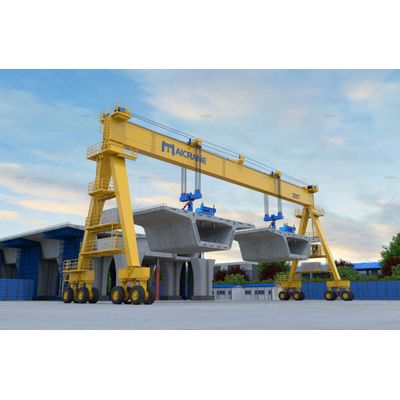
Unveiling the Control Dynamics of Mobile Gantry Cranes
In the realm of material handling, the mobile gantry crane stands as a symbol of versatility and adaptability. Unlike its stationary counterparts, the mobile gantry crane takes center stage with its ability to traverse the workspace with grace and precision. Behind this seamless movement lies a sophisticated control system that empowers operators to orchestrate the crane's every motion. In this article, we delve into the intricacies of how the movement of a mobile gantry crane is controlled, exploring the technology that makes this engineering marvel dance across the floor.
The Foundation: Wheels and Casters
At the heart of a mobile gantry crane's mobility lies a set of wheels or casters. These components enable the crane to move freely along the ground, providing the flexibility to navigate different areas within a facility. The design of these wheels or casters is crucial, as they must not only support the weight of the crane and its load but also allow for smooth and precise movement.
Mobile gantry cranes often feature swiveling casters at the base of each leg, allowing for multidirectional movement. Some advanced models may incorporate steerable wheels or drive systems that enhance maneuverability. These design elements are integral to the crane's ability to traverse the workspace efficiently.
Control Mechanisms: From Joysticks to Advanced Panels
The control of a movable gantry crane is typically facilitated through a dedicated control panel located on the crane or via a remote control device. The operator, stationed either on the crane itself or at a safe vantage point, interacts with the control system to dictate the crane's movements.
1. Joysticks and Levers: Traditional control panels often feature joysticks and levers that correspond to specific functions. These manual controls allow the operator to command the crane to move forward, backward, left, and right. The degree of movement is directly proportional to the displacement of the joystick or lever, offering a tactile and intuitive interface.
2. Remote Control: Many modern mobile gantry cranes come equipped with remote control capabilities. This advancement allows operators to control the crane's movements from a distance, providing enhanced visibility and safety. Remote control devices often mimic the layout of traditional joysticks, offering a familiar interface for operators.
3. Automated Control Systems: The evolution of technology has given rise to automated control systems that leverage sensors, cameras, and computerized algorithms. These systems enable automated navigation and positioning, allowing the crane to follow predefined paths or respond to specific inputs. Automated control is particularly useful in scenarios where repetitive tasks or precision movements are required.
Precision in Motion: Maneuvering the Workspace
The control of a mobile gantry crane extends beyond simple forward and backward movements. The ability to precisely position the crane, align it with the load, and navigate through confined spaces is a testament to the sophistication of its control system.
1. Speed Control: Operators have the ability to control the speed of the crane's movement. This feature is crucial for adapting to different work scenarios, allowing for slow and precise movements when needed and faster travel when repositioning is required.
2. Acceleration and Deceleration: Smooth acceleration and deceleration are essential for both safety and load stability. The control system governs the rate at which the crane starts and stops, ensuring that movements are gradual and controlled.
3. Turning Radius: The design of the wheels or casters plays a pivotal role in determining the turning radius of the mobile gantry crane. Some models are equipped with swiveling casters that allow for tight turns, making it possible to navigate through narrow aisles or around obstacles with ease.
4. Positioning Accuracy: Precision is paramount in material handling, and the control system of a mobile gantry crane ensures accurate positioning. Whether aligning with a loading dock, picking up a container, or placing a load with millimeter precision, the control system is finely tuned to execute these tasks flawlessly.
Safety at the Forefront: Emergency Measures and Collision Avoidance
Safety is a top priority in the design and operation of mobile gantry cranes, and the control systems incorporate various features to mitigate risks and ensure a secure working environment.
1. Emergency Stop Mechanisms: Emergency situations demand swift action. The control system includes emergency stop mechanisms that bring the crane to an immediate halt in case of a safety breach or unexpected circumstance. This rapid response is crucial in preventing accidents and minimizing potential damage.
2. Collision Avoidance Systems: Mobile gantry cranes operating in busy environments may be equipped with collision avoidance systems. These systems utilize sensors and advanced algorithms to detect obstacles in the crane's path. When a potential collision is detected, the control system triggers automatic adjustments, such as slowing down or altering the crane's course, to avoid accidents.
3. Load Monitoring and Overload Protection: To prevent overloading, a common cause of accidents in material handling, the control system often incorporates load monitoring and overload protection features. These systems provide real-time feedback on the load's weight and ensure that the crane operates within its specified capacity.
Adapting to the Future: Automation and Smart Technologies
The future of mobile gantry crane control is marked by the integration of automation and smart technologies. As industries embrace Industry 4.0 principles, mobile gantry cranes are evolving to become more intelligent and interconnected.
1. Automation for Repetitive Tasks: Automated control systems are becoming increasingly sophisticated, allowing mobile gantry cranes to execute repetitive tasks with minimal human intervention. This not only enhances efficiency but also reduces the risk of human error.
2. Connectivity and Data Analytics: Smart mobile gantry cranes are equipped with connectivity features that enable them to communicate with other machinery and systems. This interconnectedness facilitates data analytics, providing valuable insights into crane performance, maintenance needs, and operational efficiency.
3. Predictive Maintenance: The integration of sensors and data analytics enables predictive maintenance capabilities. The control system can analyze usage patterns, detect early signs of wear or potential issues, and prompt proactive maintenance interventions. This predictive approach minimizes downtime and extends the lifespan of the crane.
Conclusion: The Symphony of Control
In conclusion, the movement of a mobile gantry crane is a finely orchestrated symphony of control, guided by advanced technology and the skill of operators. From the responsive handling of joysticks to the precision of automated control systems, every aspect is designed to maximize efficiency, safety, and adaptability.
As we stand at the threshold of a new era in industrial automation, the control systems of mobile gantry cranes will continue to evolve. Embracing automation, connectivity, and smart technologies, these cranes are set to redefine the landscape of material handling, ushering in an era where mobility and intelligence harmonize seamlessly on the shop floor. The mobile gantry crane, with its ability to move with precision and purpose, is a testament to the relentless pursuit of innovation in the world of industrial machinery.