


- Home
- Companies
- Aimix Group Co., Ltd
- Articles
- Using Boat Travel Lifts to Support Boat ...
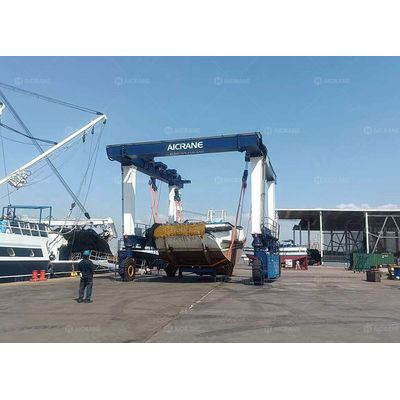
Using Boat Travel Lifts to Support Boat Maintenance and Repair Services
Boat maintenance and repair are essential services in the marine industry. Whether for recreational yachts, fishing vessels, patrol boats, or commercial workboats, routine inspection and repair ensure safety, efficiency, and longevity. One of the most important pieces of equipment that supports these services is the boat travel lift.
A boat travel lift—also known as a marine travel lift, boat hoist, or mobile boat gantry crane—is a specialized crane used in marinas, shipyards, and boatyards to lift boats out of the water and transport them to maintenance areas or storage yards.
By allowing vessels to be safely lifted, transported, and positioned on land, travel lifts make it possible for technicians to perform a wide range of repair and maintenance operations. From hull cleaning and painting to engine overhauls and structural repairs, these machines play a vital role in the daily operations of marine service facilities.
What Is a Boat Travel Lift?
A boat travel lift is a mobile lifting machine designed specifically for handling vessels in waterfront environments. It typically consists of two tall side frames connected by a beam, with multiple wheels that allow the machine to travel across marina yards. Boats are lifted using strong synthetic slings that pass under the hull and are connected to winches or hydraulic lifting systems.
Travel lifts can handle a wide range of vessels, including sailboats, motorboats, fishing boats, patrol boats, and yachts. Depending on the design, lifting capacities can range from around 10 tons to more than 1000 tons, making them suitable for both small marinas and large shipyards.
One of the key advantages of travel lifts is their mobility. Unlike fixed cranes, these machines can move boats from the water directly to repair zones, storage yards, or launching areas, allowing shipyards to manage multiple vessels efficiently.
Why Boat Maintenance Requires Travel Lifts
Boats spend most of their time in water, which exposes them to corrosion, marine growth, and mechanical wear. Regular maintenance is necessary to prevent damage and maintain performance. However, many maintenance tasks require full access to the hull and underwater components—something that can only be achieved when the vessel is lifted out of the water.
Travel lifts make this process simple and efficient.
Access to Hull and Underwater Components
A significant portion of boat maintenance involves the underwater hull structure. Tasks such as antifouling painting, propeller repair, rudder inspection, and through-hull fitting maintenance require technicians to access areas that are normally submerged.
Marine travel lifts allow a vessel to be lifted completely out of the water and placed on supports or blocks. This provides technicians with safe and convenient access to the entire hull, improving inspection accuracy and repair efficiency.
Efficient Boat Handling
Without travel lifts, boatyards would rely on ramps, trailers, or rail systems to haul boats from the water. These methods can be time-consuming and limited in capacity. Travel lifts, by contrast, can quickly lift vessels directly from docks or lifting wells and move them to designated maintenance zones.
Because the lifting slings adjust automatically to different hull shapes, travel lifts can safely handle many types of boats—from sailboats with keels to wide catamarans.
Safe Positioning for Repairs
Once a boat is lifted, the travel lift can move it precisely to a repair area and lower it onto maintenance blocks or stands. This ensures the vessel remains stable throughout the repair process. Stable positioning is particularly important for large vessels where structural work, engine replacement, or heavy component removal may be required.
Key Maintenance and Repair Services Supported by Travel Lifts
Boat travel lifts support a wide range of maintenance operations. These services are essential for keeping vessels in good condition and ensuring safe operation at sea.
Hull Cleaning and Antifouling
Marine growth such as algae, barnacles, and mussels can accumulate on hull surfaces over time. This increases drag and reduces fuel efficiency.
When a boat is lifted with a travel lift, technicians can perform:
High-pressure hull washing
Removal of marine growth
Sanding and surface preparation
Application of antifouling coatings
Regular hull maintenance improves vessel performance and reduces long-term maintenance costs.
Structural Repairs
Boats may experience structural issues such as fiberglass cracks, steel corrosion, or hull deformation. Lifting the vessel allows technicians to perform detailed inspections and structural repairs.
Typical tasks include:
Hull crack repair
Fiberglass lamination work
Steel plate welding
Reinforcement of structural frames
Without a travel lift, such work would be extremely difficult or impossible to perform safely.
Propeller and Shaft Maintenance
The propulsion system is another critical component that requires periodic inspection. With the boat lifted, technicians can easily access:
Propellers
Propeller shafts
Rudders
Shaft seals and bearings
Repairs or replacements can be completed quickly when the vessel is positioned on land.
Engine and Mechanical Overhauls
Although engines are located inside the vessel, many mechanical repairs require the boat to remain stable on land. Travel lifts enable shipyards to safely position boats for engine replacement, gearbox servicing, and other mechanical work.
Electrical and Navigation Equipment Repair
Modern vessels rely heavily on electronic systems. During maintenance periods, technicians may upgrade or repair navigation equipment, communication systems, or onboard power systems.
Having the boat lifted and stabilized simplifies access to cable routing areas and equipment compartments.
Supporting Seasonal Boat Maintenance
In many regions, boating is seasonal. During winter months or storm seasons, vessels are often removed from the water and stored on land.
Travel lifts make seasonal haul-outs efficient and safe. They allow marina operators to:
Lift boats quickly during busy haul-out seasons
Transport vessels to storage yards
Organize boats efficiently in tight storage spaces
By enabling dry storage, travel lifts help protect vessels from environmental damage and reduce marina congestion.
Improving Shipyard Productivity
For shipyards and marine service companies, travel lifts are not just lifting machines—they are productivity tools.
Faster Vessel Turnaround
Travel lifts reduce the time required to move boats between the water and repair areas. Faster handling means shipyards can service more vessels within the same time period.
Reduced Equipment Requirements
Instead of using multiple cranes or trailers, a single travel lift or boat hoist can handle most boat movement tasks. This simplifies equipment management and lowers operational costs.
Flexibility in Operations
Because travel lifts are mobile, shipyards can reorganize their yard layout based on current workloads. Boats can be moved easily between maintenance bays, paint areas, and storage locations.
Safety Features in Modern Boat Travel Lifts
Modern marine travel lifts incorporate advanced safety features to protect both vessels and operators.
Many systems include:
- Load monitoring systems to ensure lifting loads remain within safe limits
- Overload protection mechanisms that automatically stop lifting if capacity is exceeded
- Emergency lowering devices in case of power failure
- Hydraulic or electric control systems with precise lifting synchronization
Some modern systems also provide real-time monitoring of parameters such as hydraulic pressure and load distribution, ensuring safer operations.
These features significantly reduce the risk of accidents and improve overall operational reliability.
Customization for Different Marine Facilities
Boat travel lifts can be customized to meet the specific requirements of different facilities. Important parameters include:
Lifting capacity (e.g., 30 ton, 50 ton, 100 ton, 300 ton)
Span width to accommodate wider boats or catamarans
Lifting height to handle tall vessels
Wheel configuration for different ground conditions
Modern travel lifts may also feature diesel-hydraulic or fully electric drive systems, depending on operational needs and environmental requirements.
Customization ensures that marinas and shipyards can select the most suitable equipment for their vessel types and service capacity.
Future Trends in Boat Handling Equipment
As the marine industry continues to evolve, travel lift technology is also improving. Some emerging trends include:
- Electric travel lifts for reduced emissions in marinas
- Smart monitoring systems for predictive maintenance
- Remote control and automation for improved safety
- Higher lifting capacities to accommodate larger yachts
These innovations will help shipyards and marinas improve operational efficiency while meeting environmental and safety standards.
Conclusion
Boat travel lifts are indispensable tools in modern marine maintenance and repair operations. By enabling vessels to be lifted safely from the water and transported around shipyards, they provide the access and stability required for a wide range of services—from hull cleaning and painting to major structural repairs.
Their mobility, high lifting capacity, and adaptability make them ideal for marinas, yacht clubs, and shipyards handling vessels of all sizes. In addition to supporting maintenance work, travel lifts also improve operational efficiency by streamlining boat handling, reducing turnaround times, and optimizing yard space.
As marine service industries continue to expand, the role of travel lifts will become even more important. With advancements in automation, safety systems, and electric drive technology, these machines will remain at the heart of boat maintenance and repair operations for years to come.