


UV Technologies for Chlorine Removal from Water
Chlorine is widely used in water treatment as a disinfection and oxidizing agent. However, the reaction of free chlorine in water leads to the generation of undesirable by-products and have harmful effects on industrial processes.
In high purity water systems, the presence of free chlorine in water may result in the deterioration of treatment units such as ion exchange beds and RO membranes.
Traditional treatment methods for the removal of residual free chlorine include adsorption by Granular Activated Carbon (GAC) or by addition of chemicals such as sodium metabisulfite.
Activated carbon beds are susceptible to microbial growth and vulnerable to break-through, which can lead to serious system contamination and costly downtime on manufacturing processes.
Sodium metabisulfite generates undesirable reaction by-products in process water which can create perfect conditions for microbial growth in RO membranes and adds critical load on downstream treatment units such as deionizers. This can result in a significant increase in operating, service and maintenance costs for ion-exchange, DI and RO systems used for clean water production and manufacturing processes.
However, UV technology is becoming increasingly popular for the destruction of residual chlorine in industrial applications. This is mainly due to the increased overall costs associated with traditional methods and on the improved performance of UV lamp technologies and UV reactors design.
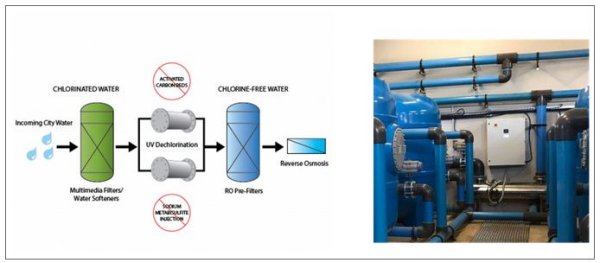
Positioning UV systems before GAC and RO systems has been proven to reduce overall operating, service and maintenance costs without generation of undesirable by-products or affecting taste and odor. The use of the correct UV dechlorination design can significantly increase the time between cleaning cycles and extend the useful life of both the activated carbon and the RO membranes.
ESCO International provides a comprehensive selection of advanced treatment technologies and solutions which include high output amalgam and medium pressure UV systems and engineered ozone & advanced oxidation processes (AOP).