

- Home
- Companies
- Earth Shield Environmental Co., Ltd.
- Articles
- What is the difference between Textured ...
What is the difference between Textured geomembrane and smooth geomembrane?
Textured HDPE Geomembrane is a new type of anti-seepage material made from high-density polyethylene. It boasts a high anti-seepage coefficient (up to 1×10?¹³ cm/s) and excellent chemical stability, maintaining a service life of 30 years in environments ranging from -60°C to 60°C. Its unique surface roughening or studded structure increases the coefficient of friction, making it suitable for slope projects such as embankments and landfills. During construction, care must be taken to protect the geomembrane from direct impact with rocks, and an appropriate protective layer must be applied to prevent UV exposure and thermal deformation.
Smooth geomembrane is a polymer material used in anti-seepage projects, primarily made from high-density polyethylene (HDPE) or linear low-density polyethylene (LLDPE). Its smooth surface offers excellent anti-seepage properties, chemical resistance, and resistance to environmental stress cracking. Smooth-surface geomembranes are widely used in anti-seepage projects such as landfills, tailings ponds, slag dumps, fish ponds, oil depots, and leachate tanks, effectively preventing the leakage of liquids and gases. Both Textured and smooth geomembranes fall under the same category of geomembranes, but they differ significantly in structure, performance, and application scenarios. The specific differences are as follows:
Smooth Geomembrane
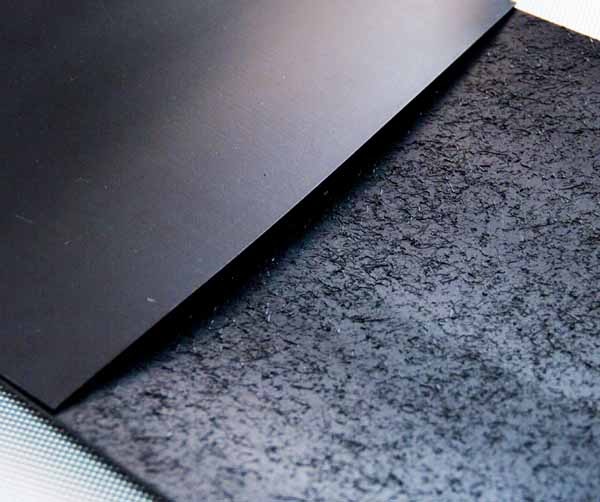
Structure: The surface is smooth and flat, without any additional texture. Both sides of the membrane are dense and smooth, resulting in a relatively low coefficient of friction with the contact material and low interfacial shear strength.
Appearance: Available in black, green, white, or custom colors, the surface is highly reflective, feels smooth to the touch, and has a uniform thickness (0.2-3.0mm).
Textured Geomembrane
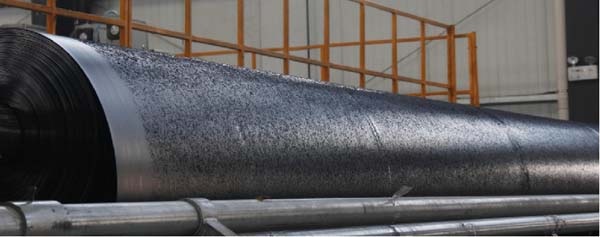
Structure: The geomembrane surface is uneven, with at least one side having a concave-convex texture (such as granular or streaky). A roughened layer (usually HDPE with roughening) is applied to the membrane surface through a co-extrusion process. The texture height is typically 0.3-1.0mm.
Appearance: Available in single-sided (textured on one side) or double-sided (textured on both sides). The roughened side feels Textured to the touch, with noticeable granular or streaky textures. The overall thickness is slightly greater than that of a smooth geomembrane of the same specification. A Textured surface significantly increases the coefficient of friction between it and contact materials (such as geotextiles, sand, and clay). This means it provides greater interfacial shear strength, resisting relative sliding between the two.
Friction Coefficient
Smooth geomembranes: Their smooth surface offers a low coefficient of friction (typically 0.2-0.3) with other materials (such as soil and geotextiles), making them susceptible to relative sliding and, in particular, less stable on slopes or in high-head environments.
Textured geomembranes: The Textured surface textured increases the friction coefficient (up to 0.4-0.6) by increasing the contact area. This significantly enhances interlocking with surrounding materials, reduces the risk of slip, and provides superior stability on slopes and steep slopes.
Impermeability
The core of both geomembranes relies on the density of the membrane itself. Their permeability coefficients are both ≤10?¹¹cm/s, and their basic anti-seepage capabilities are comparable. However, due to the texture of the Textured surface, if sediment is trapped between the grains during construction, this may partially affect the fit, requiring greater attention to compaction during installation. Mechanical Properties
Smooth Geomembrane: Its homogeneous structure offers more stable mechanical parameters such as tensile strength and elongation (e.g., HDPE smooth membranes have a tensile strength ≥16 MPa and an elongation ≥700%), making it suitable for applications requiring high material uniformity.
Textured Geomembrane: The lamination process between the Textured surface layer and the base membrane may slightly affect local mechanical properties. High-quality products ensure a strong bond between the Textured surface and the base membrane (peel strength ≥3 N/cm). Overall mechanical properties are comparable to smooth geomembranes of the same specification (tensile strength ≥15 MPa, elongation ≥600%).
Smooth Geomembrane
Advantageous Applications: Anti-seepage projects on flat or gently sloping surfaces (slope
Typical Applications: Agricultural irrigation ponds, small landscape ponds, and underground garage waterproofing. The low coefficient of friction can be compensated by laying a protective layer (e.g., fine soil, sand, or gravel). Textured Geomembrane
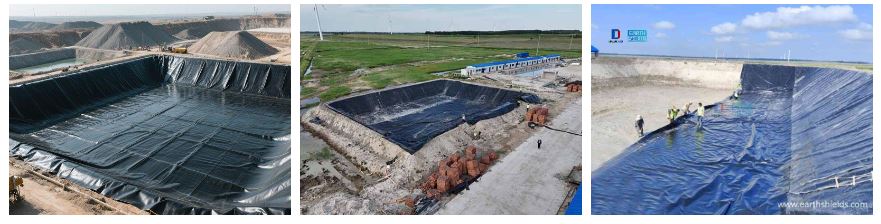
Advantages: Steep slopes (gradient ≥ 1:3), high water heads, or projects requiring anti-slip properties, such as tailings dam slopes, landfill slopes, and canal slopes. These geomembranes rely on their Textured surface to enhance friction with the slope and prevent slippage.
Typical Applications: Seepage control for embankments in water conservancy projects, seepage control for large landfill slopes, and steep-slope canal linings. Double-surface geomembranes can also be used where both upper and lower layers require anti-slip properties (such as the middle layer of a composite anti-seepage system).
Construction Requirements
Smooth Geomembrane: Care must be taken to prevent slippage on the slope during installation. For steep slopes, additional securing measures (such as sandbags) are required. Seam welding is simplified (smooth surfaces facilitate alignment).
Textured Geomembrane: The Textured surface should face the contact material (such as slope soil) to achieve its anti-slip properties. Welding should avoid the Textured surface texture, which requires more stringent equipment commissioning to prevent weld defects caused by the texture. Cost Differences
Smooth geomembranes: The production process is simple and the cost is low. The unit price of a geomembrane with the same thickness (e.g., 1.5mm) is typically 10%-20% lower than that of a Textured geomembrane.
Textured geomembranes: The roughening process increases production costs. Single-surface geomembranes are 10%-15% more expensive than smooth-surface geomembranes of the same specification, and double-surface geomembranes are 20%-30% more expensive. However, they reduce rework costs due to slippage and offer better long-term economic benefits.
The choice of geomembrane depends entirely on the specific requirements of the project, particularly the terrain slope and stability requirements.
Applications where Textured geomembranes are preferred:
All slopes: landfills, tailings ponds, and evaporation pond slopes.
Steep landscape revetments.
Any project with high requirements for interfacial friction performance.
Applications where smooth-surface geomembranes are preferred:
Flat bottom anti-seepage layers: such as the bottoms of landfills, sewage treatment ponds, and artificial lakes. As the base layer of a composite liner (geomembrane + geomembrane-based geomembrane): In this case, stability is determined by the friction between the geomembrane and the geomembrane-based geomembrane (bentonite blanket) or underlying foundation. If the foundation is flat and solid, a smooth geomembrane will meet the requirements.
For pools or channels where welding quality and anti-seepage performance are extremely demanding.
Textured geomembranes are used to address stability issues and are used on slopes.
Smooth geomembranes are used to address anti-seepage issues and are used on flat ground.
In large-scale projects (such as a standard landfill), a combination of geomembranes is often used:
Smooth geomembranes are used on the flat bottom area for optimal anti-seepage performance and cost-effectiveness.
Textured geomembranes are used on the surrounding sloped areas to ensure the overall stability and safety of the liner system. Therefore, when selecting a geomembrane, a comprehensive technical and economic comparison must be made based on factors such as the design drawings, geological conditions, slope, and project cost to determine the most appropriate option.
If you have an ongoing geomembrane project, please contact us. As a geomembrane manufacturer with over 20 years of experience, we can provide you with professional technical guidance on geomembrane projects, 24-hour online technical support, and free geomembrane samples for your testing!