


- Home
- Companies
- isoTracker Solutions Ltd.
- Articles
- Why and How to Perform a Risk-Based ...
Why and How to Perform a Risk-Based Internal Audit (RBIA)
In this article, we look at how risk-based thinking should affect internal auditing processes and how to perform a risk-based internal audit (RBIA).
Over recent years, there has been a move to risk-based thinking across quality standards, including ISO 9001: 2015.
Incorporating this approach in internal adits allows for more targeted, impactful audits that contribute to stronger governance and better decision-making.

Traditionally, internal audits have focused on compliance with external requirements, with little to no consideration of risk.
Audits are performed to satisfy a schedule, and internal audit resources are spread over all business activities. The focus is on finding deficiencies in controls and cases of non-compliance with policies and procedures.
Overall, this can lead to audit results that mean very little. Boxes may be ticked, without the most significant quality issues for the organization being addressed.
A risk-based internal audit (RBIA) focuses on identifying and addressing the most significant risks to an organization.
It links internal auditing to the organization’s overall risk framework. It also brings the auditing process in line with real business goals and priorities, and the key risks associated with these.
These are the main advantages of a risk-based internal audit:
- aligns the audit process with the organization’s strategic goals
- prioritizes critical areas, ensuring that audit resources are allocated strategically based on what poses the greatest risks
- enhances overall risk management strategies
- allows for early identification of potential issues, enabling proactive management rather than reactive problem-solving.
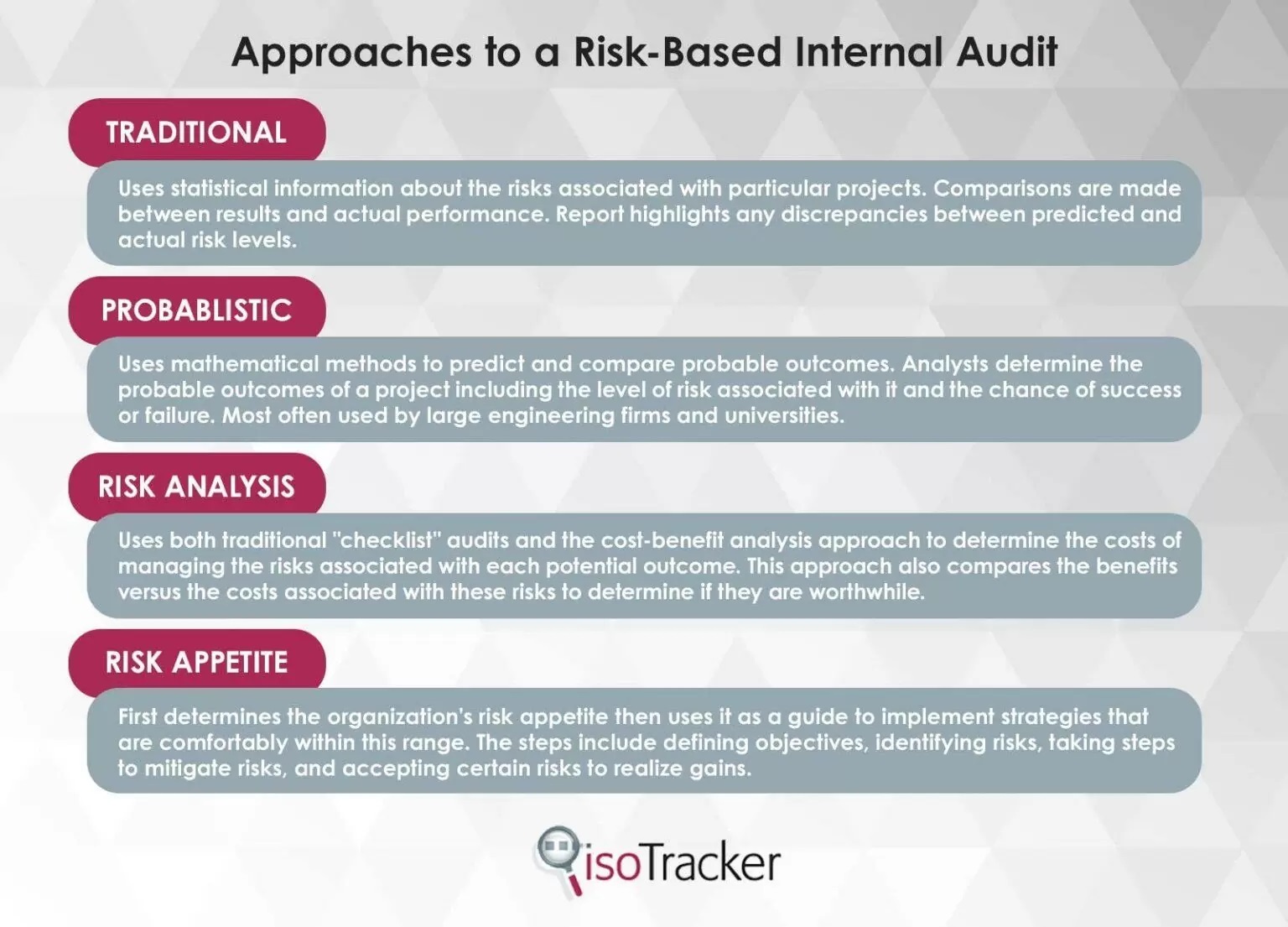
To conduct an effective RBIA, internal auditors must have a deep understanding of the organization’s strategies, goals, and objectives. This will help them focus on the organization’s most critical risk areas.
Management must work closely with auditors to align business strategy and risks.
The organization’s directors must ensure that the risk management framework includes:
- identification and evaluation of risks that threaten the organization’s goals
- an approved risk appetite so that risks can be easily identified as being above or below it
- development of an internal control system to reduce threats to below the risk appetite
- a system for recording, assessing, and classifying risks in order of threat
- defined responsibilities for risk management.
A risk-based internal audit involves systematically assessing and addressing the organization’s most significant risks. Here’s a step-by-step summary:
1. Understand the organization
Begin by understanding the organization’s objectives, processes, and risk environment. This includes reviewing strategic goals, industry regulations, and previous audit reports.
2. Identify and assess risks
Collaborate with management to identify key risks through risk assessments, interviews, and data analysis. Then prioritize these risks based on potential severity of impact and likelihood of occurring.
3. Develop an audit plan
Create a flexible audit plan focused on high-risk areas. Allocate resources and set audit priorities to ensure critical risks are thoroughly examined.
4. Conduct the audit
Evaluate controls and processes in the identified high-risk areas. Test their effectiveness in mitigating risks and ensure compliance with policies and standards.
5. Report findings and recommendations
Summarize findings clearly, highlighting key risks and control weaknesses. Provide actionable recommendations to mitigate risks and improve processes.
6. Follow up
Monitor the implementation of audit recommendations and assess their effectiveness in addressing identified risks.
This approach ensures internal audits are aligned with organizational priorities, proactively addressing potential threats and adding value through focused, strategic insights.
isoTracker offers both Risk Management and Audit Management software modules, and these can integrate seamlessly as part of our quality management system.
The software provides an integrated, centralized, cloud-based system for identifying, assessing, monitoring, and mitigating risks. It can dramatically simplify the process involved in performing a risk-based internal audit.
It uses automated notifications and workflows to assign and track risk mitigation tasks, and supports up-to-date risk analytics.
It also has built-in CAPA features for ensuring that audit and compliance issues are reliably resolved.
Sign up for a free 60-day trial of our full quality management software platform or contact us directly to discuss your organization’s needs.