


- Home
- Companies
- Chatoyer Environmental Pty Ltd
- Articles
- Why Use a Silt Curtain: Environmental ...



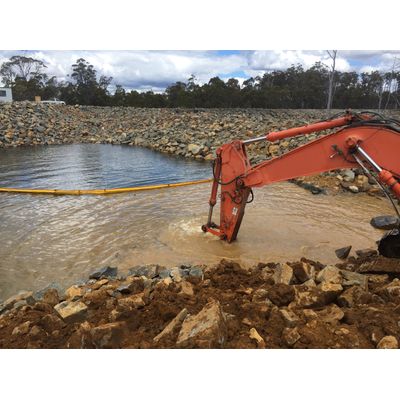
Why Use a Silt Curtain: Environmental Protection, Compliance and Cost Benefits
Why is a silt curtain important during in-water works?
In-water works such as dredging, piling and trenching stir up sediment that can:
- Smother benthic habitats
- Reduce water clarity, affecting photosynthesis in seagrass and other plants
- Transport attached contaminants further afield
A properly designed and installed silt curtain creates a controlled zone where turbidity is contained and allowed to settle, significantly reducing these impacts.
Why do regulators and EMPs call up silt curtains?
Environmental regulators and major clients often treat silt curtains as standard practice because they:
- Demonstrate active turbidity management, not passive reliance on natural settling
- Provide a visible, auditable control aligned with guidance on dredging and construction BMPs
- Can be designed and documented in silt curtain deployment plans and EMPs
Permits may define trigger levels for turbidity, with silt curtains as one of the main tools to keep levels inside the allowable band.
Why not just rely on natural settling or improvised barriers?
Natural settling alone is unpredictable: plumes can travel long distances depending on currents, wind and storms. Improvised barriers (e.g. rope and tarps) often:
Lack sufficient depth and ballast
- Fail under load or wave action
- Leave gaps and bypass paths
- Provide no tested performance or warranty
In contrast, engineered turbidity curtains are purpose-built with known behaviour in specified conditions, and are often referenced in technical and regulatory guidance.
Why does a silt curtain protect fish, seagrass and sensitive habitats?
By containing turbidity and limiting how far it spreads, silt curtains help: Maintain light penetration for seagrass and benthic plants
Reduce gill clogging and smothering effects on fish and invertebrates
Protect nearby reefs, wetlands and spawning areas from silt deposition
This is why silt curtains are often mandatory near seagrass meadows, shellfish beds or marine parks.
Why is selecting the right class and depth essential?
Using the wrong class or depth can be worse than having no curtain:
- Too shallow – plumes travel underneat
- Too deep – skirt drags on the bed, tears or causes scour
- Wrong class for energy conditions – curtain can fail or be overtopped
Selection guides and technical notes emphasise matching curtain type, depth and anchoring to flow, waves and depth so they perform as intended.
Why does high-quality design reduce non-compliance risk, fines and delays?
A robust, well-designed silt curtain system:
- Keeps turbidity more consistently within permitted limits
- Reduces the likelihood of regulatory exceedances, site shutdowns or stop-work orders
- Supports clear reporting and documentation that BMPs were in place This translates directly into lower risk of fines, reputational damage and schedule blowouts.
Why monitor performance instead of “set and forget”?
Field studies and guidance documents highlight that curtain effectiveness can vary with conditions, installation and maintenance.
Monitoring:
- Turbidity inside vs outside the curtain
- Curtain condition, alignment and anchoring
- Weather and tide-driven events
allows project teams to adjust configuration, repair damage or change operations before problems escalate.
Why is a silt curtain cost-effective compared to clean-up?
Preventing plumes from spreading is usually far cheaper than:
- Reactive remedial dredging or vacuuming
- Emergency habitat repair or restocking
- Managing complaints, investigations and legal processes When you factor in these avoided costs, well-chosen silt curtains are typically one of the most cost-effective turbidity controls available.
Why use a specialist supplier and invest in reusable systems?
Specialist silt curtain suppliers with marine and construction experience can:
- Recommend appropriate types, depths and layouts
- Provide installation and anchoring guidance tailored to your site
- Supply durable, reusable systems with robust connectors and fabrics
For contractors with ongoing marine projects, reusable systems:
- Reduce unit cost over multiple deployments
- Speed mobilisation and demobilisation
- Support consistent environmental performance and client confidence
Clients and stakeholders often view a well-designed and monitored silt curtain program as a visible sign of responsible environmental practice.
References
GEI Works 2025a, Turbidity curtains – DOT compliant silt barriers, GEI Works, viewed 18 November 2025, <https://erosionpollution.com/staging/9188/turbidity-curtains/\>. Erosion Pollution
GEI Works 2024, Turbidity curtains: what they are & how they work, GEI Works, viewed 18 November 2025, <https://geiworks.com/turbidity-curtains-what-they-are-how-they-work/\>. geiworks.com
HR Wallingford (Ogilvie, JC, Middlemiss, D, Lee, MW, Crossouard, N & Feates, N) 2012, Silt curtains – a review of their role in dredging projects, in CEDA Dredging Days 2012, HR Wallingford, Wallingford, viewed 18 November 2025, <https://eprints.hrwallingford.com/865/1/HRPP560_Silt_curtains_-_a_review_of_their_role_in_dredging_projects.pdf\>. EPrints
IADC (International Association of Dredging Companies) 2020, Assessing and evaluating environmental turbidity limits for dredging, Terra et Aqua, IADC, The Hague, viewed 18 November 2025, <https://www.iadc-dredging.com/article/turbidity-limits-for-dredging/\>. IADC Dredging
Layfield Group Ltd n.d., Turbidity curtains, Layfield Group Ltd, viewed 18 November 2025, <https://www.layfieldgroup.com/wp-content/uploads/2023/03/Turbidity-Curtains.pdf\>. Layfield Group Ltd.
Michigan Department of Environment, Great Lakes, and Energy (EGLE) n.d., Turbidity curtain (BMP fact sheet), State of Michigan, viewed 18 November 2025, <https://www.michigan.gov/-/media/Project/Websites/egle/Documents/Programs/WRD/NPS/Tech/BMP/bmp-turbidity-curtain.pdf\>. Michigan
NOAA National Marine Fisheries Service 2023, Control in dredging: efficacy of bubble screens on turbidity (technical report), NOAA Institutional Repository, viewed 18 November 2025, <https://repository.library.noaa.gov/view/noaa/48494\>. NOAA Institutional Repository
Parker Systems Inc. 2025a, Turbidity curtain – Siltmaster Type I, Parker Systems, viewed 18 November 2025, <https://www.parkersystemsinc.com/booms-barriers/siltmaster-type-i-turbidity-curtain/\>. parkersystemsinc.com
Parker Systems Inc. 2025b, Turbidity curtain info booklet, Parker Systems, viewed 18 November 2025, <https://www.parkersystemsinc.com/general-info/turbidity-curtain-info-booklet/\>. parkersystemsinc.com
Silt Barriers / GEI Works n.d., Silt barriers and turbidity curtains, GEI Works, viewed 18 November 2025, <https://www.silt-barriers.com/\>. silt-barriers.com+1
State of Michigan Department of Transportation (MDOT) 2021, 208 – soil erosion and sedimentation control (NPDES), MDOT, Lansing, viewed 18 November 2025, <https://mdotwiki.state.mi.us/construction/index.php/208_-_Soil_Erosion_and_Sedimentation_Control_%28NPDES%29\>. mdotwiki.state.mi.us
U.S. Army Engineer Research and Development Center (ERDC) 2023, An analysis of the functional capabilities and performance of silt curtains (technical report), ERDC Knowledge Core, Vicksburg, viewed 18 November 2025, <https://erdc-library.erdc.dren.mil/items/79d9091e-375b-4955-a8fe-2dfd79d243be\>. Knowledge Core Repository
US EPA 2005, Silt curtains as a dredging project management practice, U.S. Environmental Protection Agency, Washington, DC, viewed 18 November 2025, <https://semspub.epa.gov/work/01/466658.pdf\>. EPA Science Inventory
ERM 2021, Silt curtain deployment plan – Black Point Power Station subsea gas pipeline (BPPS), report for Castle Peak Power Company Limited, Hong Kong Offshore LNG Terminal Project, viewed 18 November 2025, <https://env.hkolng.com/ep_submissions/FEP03/SCDP-Mar2021/0505354_Silt%20Curtain%20Deployment%20Plan_BPPS_Rev_5.htm\>