


A F Howland Associates services
Site Investigation
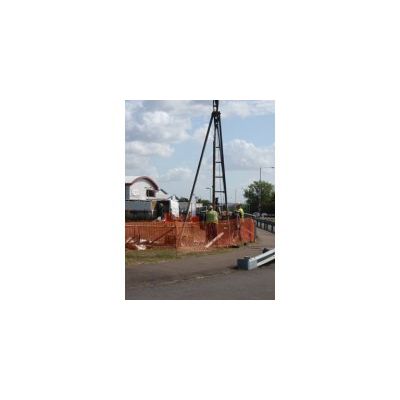
Cable Percussion Boring
Light-cable percussion is the most common drilling method used for geotechnical site or ground investigations. Depending upon access limitations and favourable ground conditions deep boreholes up to 50m depth can be formed. Light-cable percussion drilling uses a mobile rig with a winch of between one to two tonne capacity driven by a diesel engine and a tripod derrick of about 7m height. The derrick folds down so that the rig can be towed by a four-wheel drive vehicle. In areas where there is restricted headroom or access limitations a demountable or low-headroom drilling rig can be used. This rig is brought to site in sections on a trailer and the equipment is re-assembled on site.
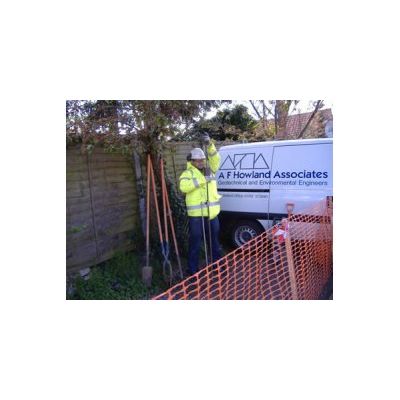
Dynamic Cone Penetrometer (DCP) Test
The California Bearing Ratio (CBR) test is a penetration test developed by the California State Highway Department and is used to determine the mechanical strength of a soil. The test can be carried out on site or in the laboratory. The VBR test is carried out using a cylindrical plunger which penetrates the soil at a given rate. The relationship between the force and penetration can then be used to calculate the CBR value of the soil being tested.
Dynamic Probing
Dynamic probing involves driving a cylindrical sacrificial or fixed cone into the ground using a high frequency percussive hammer. The diameter and angle of the cone will depend upon the chosen method. For example the heavy or super heavy dynamic probe has an angle of 90 degrees. The cone is attached to a 1m section steel rod with a nominal diameter of approximately 35mm and graduation markings set at 100mm intervals. Depending upon the chosen method, the drop height can be adjusted. The super heavy method is generally the preferred choice, with a drop weight of 63.5kg and a drop height of approximately 750mm.
Rotary Core Drilling
The rotary drilling technique is normally used for forming a deep observation borehole or for obtaining representative samples of rock which could not be recovered using conventional light cable percussion drilling methods. Powered rotary cutting tools use a cutter head on the end of a shaft, which is driven into the ground as it rotates. The system requires lubrication (air, water or drilling mud) to keep the cutting head cool and remove the soil or rock which has been cut through. The lubricant lifts the debris from the cutting head up the borehole and ejects the material at ground level.
Trial Pit Excavations
This technique is normally used for recovering near surface large bulk samples of granular soil or if close visual examination of the strata is required. The main advantage of this method when compared to percussion drilling is the relative speed with which the work can be carried out. The disadvantage is the level of surface disturbance suffered and the difficulty in carrying out the effective reinstatement of the excavations. Trial pits can be formed where the ground will be able to stand temporarily unsupported. Where there is water present in the excavation, problems may be presented due to instability of the sides and the difficulty of obtaining representative samples of the ground (finer material tends to wash out with the water as the sample is collected).
Plate Loading Test
Plate load tests are used to make a determination of the vertical deformation and strength characteristics of soil and can allow an estimate of ultimate bearing capacity, shear strength and modulus of sub-grade reaction to be made. The method involves applying a load through a rigid plate and assessing the amount of penetration with time. The test may be carried out at ground surface or in shallow pits and trenches. Common uses are to assess the suitability of working platforms for tracked plant such as cranes or piling rigs. A ‘reaction load system’ is required, which can be provided in a number of ways, most commonly by a piece of large plant that will remain stable throughout the test. Once the test area is levelled the plate is placed in position, the loading apparatus set up and a load applied to the plate either at a constant or incremental rate. The settlement is recorded against the load and the results used to determine the parameters required.
Window and Windowless Sampling
Percussive window or windowless sampling involves driving cylindrical steel tubes into the ground using a high frequency percussive hammer. Usually the hammer is driven by a hydraulic power pack, but electric and pneumatic hammers are also available to suit particular site conditions. The drilling rig is normally track or crawler mounted and some of the rigs are small enough to be driven through a conventional sized door way. However, in areas where there is low-headroom or access limitations then hand held equipment is also available.