


- Home
- Companies
- Affinity Biosensors
- Products
Affinity Biosensors products
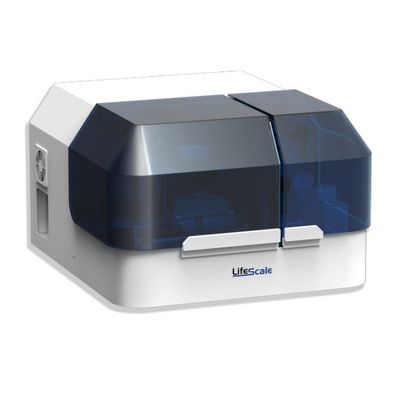
LifeScale - Unique, Automated System for Microbiology Research
LifeScale is a new and unique, automated system for microbiology research. Powered by MEMS technology, LifeScale allows for cell counting, mass measurement, and visual observation of liquid samples. Individual particles, cells and organisms can be detected down to 1fg in liquids with 1% precision. LifeScale is being used for rapid antimicrobial susceptibility testing yielding results in under three hours.
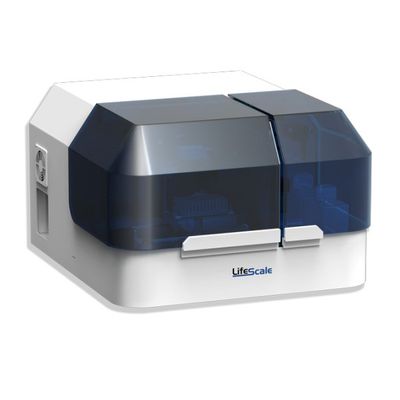
LifeScale - Automated System for Rapid Antimicrobial Susceptibility Testing
LifeScale is a new and unique, automated system for rapid antimicrobial susceptibility testing. Powered by MEMS technology, LifeScale detects positive growth and hence yields MIC and interpretive SIR results in under four hours for the majority of Gram negative species.
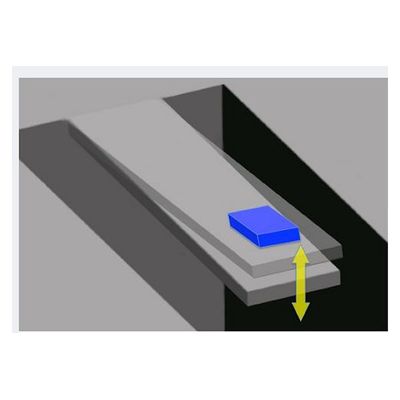
Affinity - Resonant Mass Measurements Technology
A mechanically resonant structure or resonator, such as a beam, suspended at one end resonates at a specific frequency. This frequency is known as the resonant frequency of the lever and is a function of its length and mass. When an additional mass is added to the beam the resonant frequency decreases by an amount that is proportional to the added mass. Therefore, accurately measuring the shift in resonant frequency yields the additional mass to very high precision.
Affinity - LifeScale AST Kit
The LifeScale-AST kit contains all of the consumables necessary to perform a single AST on a single organism. The kit is stored at room temperature (15C - 25C) and has a shelf life of 6 months.
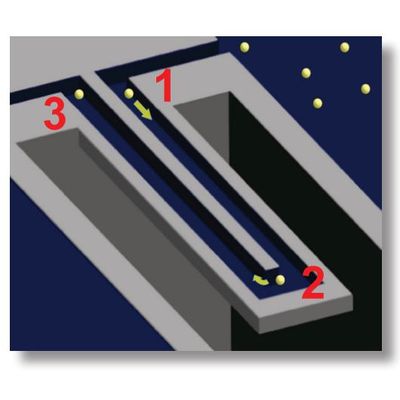
Affinity - Advanced Micro-Electro-Mechanical Systems (MEMS)
Utilizing advanced micro-electro-mechanical systems (MEMS) fabrication methods, a fluidic microchannel is embedded inside the silicon resonator. Figure 1. By suspending the silicon lever in vacuum and embedding the micro-fluidic channel within it, LifeScale is able to exploit the high Q of a vacuum system whilst at the same time allowing microbes suspended in fluid to pass through the resonator. In this way biological samples, such as living microbes, can be measured under physiological conditions. To measure a microbe, the change in resonant frequency of the sensor is monitored as the microbe passes along the micro-channel resonator from position 1 to 3, Figure 1.