


Alemnis products
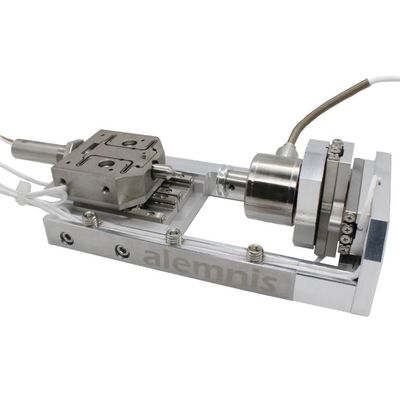
Alemnis - Alemnis Standard Assembly
Alemnis pushes the frontiers of numerous nanomechanical testing methods with a high-precision nanoindenter assembly (the ASA) and a range of complementary accessories, consumables, and controllers.
Controllers
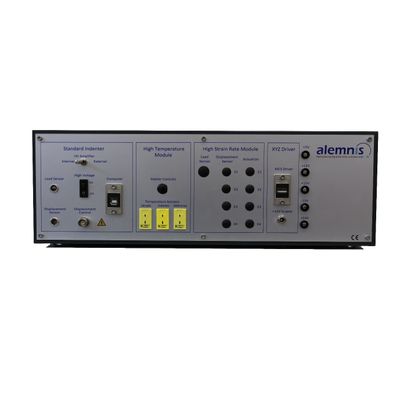
Alemnis - Standard Controller (SCO)
Controller host in a laptop computer for high performances control loop (200Hz frequency): LapTop (dual core i3, 4GB RAM, Windows 10 or newer operating system); Multifunction I/O boards for load and displacement measurements (50k Samples/s) and indentation control (100k samples/s); -30V to + 150V piezo amplifier for driving the indentation head; Driver for micro-positioning system.
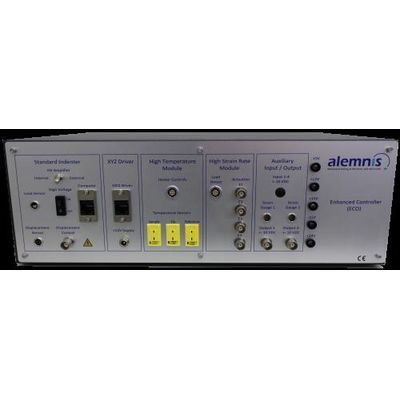
Alemnis - Enhanced Controller (ECO)
Real time controller based on FPGA technology for high performance control loop (up to 5kHz frequency for the indenter with or without the VHSRM, and 100kHz with the optional UHSRM): LapTop (dual core i3, 4GB RAM, Windows 10 or newer operating system); Very high performance multifunction I/O boards (up to 1M samples/s for load measurement with the VHSRM and the UHSRM); -30V to + 150V piezo amplifier for driving the indentation head; Driver for micro-positioning system.
Environmental Control
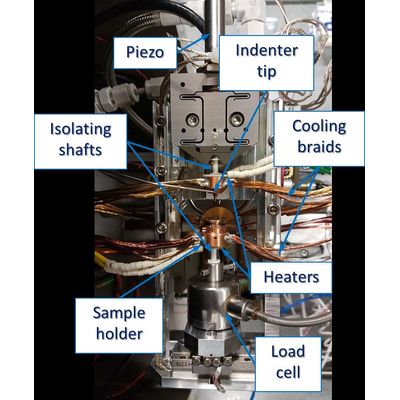
Alemnis - Model LTM-CRYO - Low Temperature Module
The Low Temperature Module (LTM-CRYO) is retrofittable to the Alemnis Standard Assembly (ASA). It can be used in air but condensation may form on the sample surface so ideal operation should be in vacuum (e.g. inside a SEM). It comprises of independent tip and sample heating and cooling.
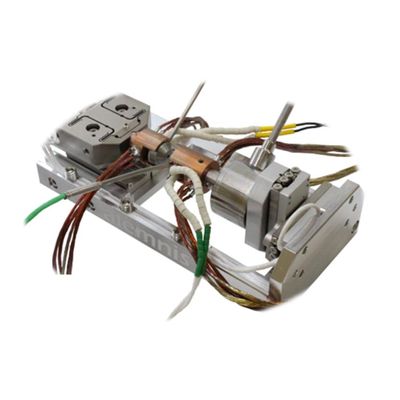
Alemnis - Model HTM-400 - High Temperature Module
The high temperature module is retrofittable to Alemnis Indenter. It can be used in air up to 200°C. For higher temperature, the Indenter should operate in vacuum (e.g. inside a SEM). It comprises of independent tip and sample heating.
Configurations
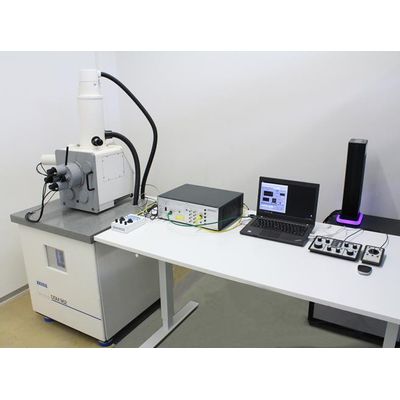
Alemnis - Model In-SEM - Alemnis Standard Assembly (ASA)
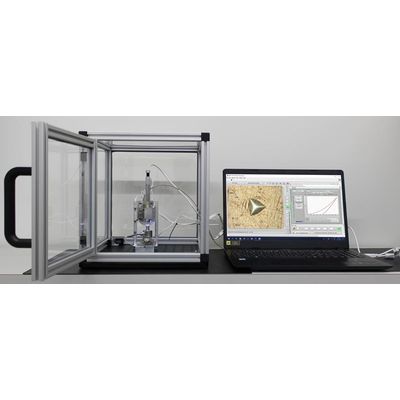
Alemnis - Model STANDALONE - Alemnis Standard Assembly (ASA)
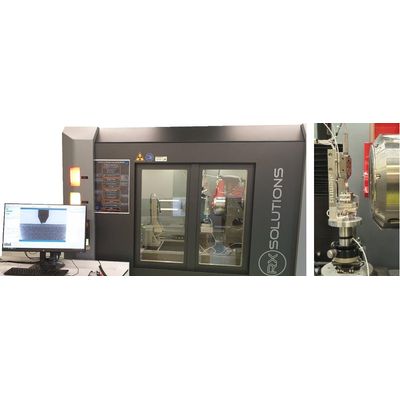
Alemnis - Tomography
Several challenges exist when designing an in-situ mechanical testing assembly compatible with X-ray beamlines for computed tomography. The assembly must be light weight as it must often be mounted on top of several motion stages. Also, the weight of the load frame must be distributed as symmetrically as possible about the rotational axis. In addition, the assembly must be sufficiently open to allow unrestricted passage of the X-ray beam. The Alemnis Standard Assembly (ASA) fulfills all the aforementioned requirements for compatibility: it is lightweight yet rigid, axisymmetric about the rotational axis and has a very open architecture which is more than enough for most experiments. In addition, the compact nature of the ASA means that the sample can be brought closer to the X-ray source, which improves image resolution. For specific angles, or for full rotational tomography, the side-frame elements can be replaced with an X-ray transparent material.
Strain Rate Control
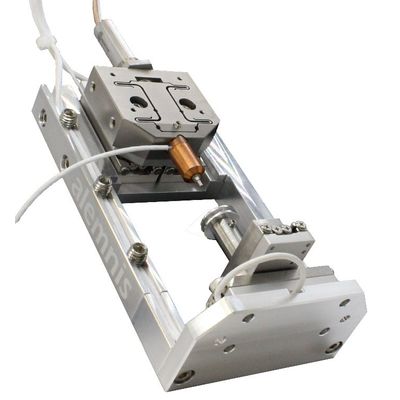
Alemnis - Model VHS-1-1 - Very High Strain Rate Module
Very High-strain rate module, actuating 1-axis, sensing 1-axis, controlled strain rate up to 1’000 s-1 or higher. (requires ECO). The VHS-1-1 can reach a controlled constant strain rate of 1’000 s-1 calculated for a 10 µm micro-pillar. In the case of indentation, the strain rate can be even higher (typical values are 7’000 s-1 at 100 nm depth and 2’000 s-1 at 350 nm depth). The VHS-1-1 is also used for impact testing or fatigue testing up to a frequency of 10kHz.
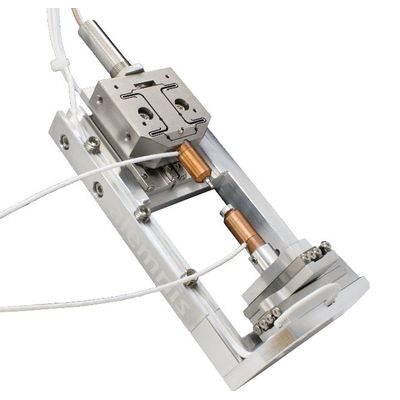
Alemnis - Model UHS-1-1 - Ultra High Strain Rate Module
Ultra High-strain rate module, actuating 1-axis, sensing 1-axis, controlled strain rate up to 10’000 s-1 or higher: (requires ECO). The UHS-1-1 can reach the unique performances of controlled constant strain rate of 10’000 s-1 calculated for a 10 µm micro-pillar. In the case of indentation, the strain rate can be even higher (typical values are 70’000 s-1 at 100nm depth and 20’000 s-1 at 350nm depth). The UHS-1-1 is also used for impact testing or fatigue testing up to a frequency of 10kHz. In this case, the SmarTip actuator and the piezostack actuator can be activated simultaneously, for example to apply a pre-strain superimposed with a fast-varying oscillation for fatigue testing.