


ams-OSRAM AG products
Lasers - Color Lasers (EEL)

ams OSRAM - Model PLPT9 450LB_E A01 - Blue Laser Diode
Lasers - IR Lasers (VCSEL)
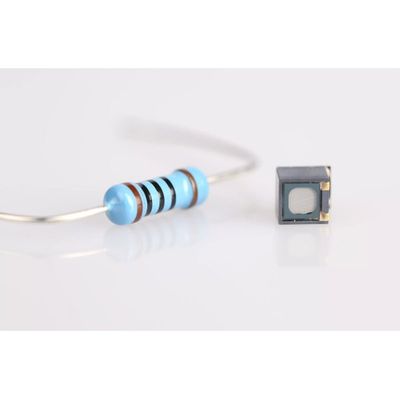
ams OSRAM - Model BELAGO - Proprietary Infrared Dot-Pattern Illuminator
BELAGO is a proprietary infrared dot-pattern illuminator for stereoscropic imaging platforms with eye-safety feature. It produces a very high-contrast dot pattern that stereo-matching algorithms can use to address low-texture situations and achieve high-accuracy depth maps. An additional benefit of the dot pattern is a reduction of the computational load required to perform the depth calculation. The BELAGO dot-pattern illuminator is provided in a miniature package that is compatible with standard lead-free reflow processes. As such, it can be successfully used onboard of a great variety of 3D sensing platforms, from mobile to IoT to robotics. BELAGO emitters produce approximately 5k dots at 940nm.
Sensors - Ambient Light, Color, Spectral And Proximity Sensors
ams OSRAM - Model TSL2521 - Ambient Light Sensor with Flicker Detection
The TSL2521 features ambient light sensing, as well as flicker detection. The device comes in a low-profile and small footprint, L2.0mm x W1.0mm x H0.5mm optical QFN package. The Ambient Light Sensing function provides two concurrent ambient light sensing channels, which can be arbitrarily connected to the photodiodes via a programmable multiplexer. TSL2521 incorporates a set of Infrared photodiodes and a set of clear photodiodes. The clear photodiode area is covered with a UV/IR blocking filter. This architecture accurately measures ambient light and enables the calculation of irradiance of different light sources. Calculation results help to improve display appearance and picture taking. The device also integrates direct detection of ambient light flicker. Flicker detection is executed in parallel with ambient light sensing and has independent gain configuration. The flicker detection engine will sample and buffer data for calculating flicker frequencies externally on a host CPU.
Sensors - CMOS Image Sensors
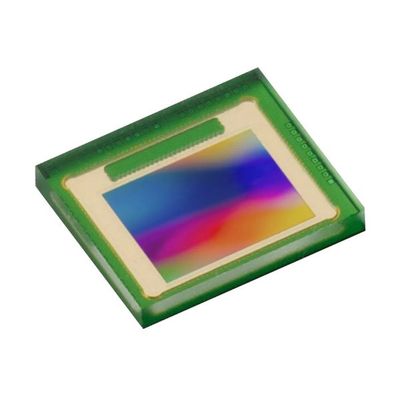
ams OSRAM - Model Mira030 - CMOS Image Sensor
Mira030 is a high speed global shutter image sensor for applications that require compact solutions. It outputs monochrome images with an effective pixel array of 1080H × 1280V, and supports complex on-chip operations such as high dynamic range (HDR) mode, external triggering, windowing, horizontal or vertical mirroring. Its maximum frame rate is 180fps at a full image resolution. On-chip registers can be accessed via the standard I²C interface.
Sensors - Capacitive Sensors
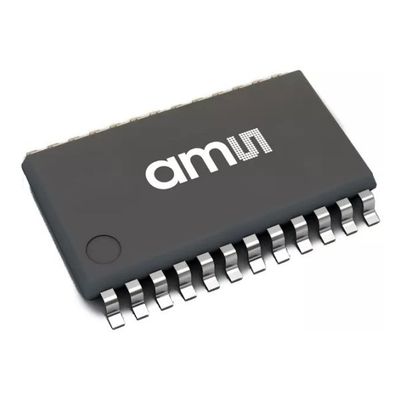
ams OSRAM - Model AS8579 - Capacitive Sensor
The AS8579 is a capacitive sensor that detects the change of capacity in different applications. The capacitive sensor measures the impedance that originates between a conducting surface (metallic object) and a human being. The IC captures the current of a metal object and applies algorithms to determine the capacitive and resistive information. The outcome information can be read through a SPI Interface that can be also used for IC configuration. This high precision performance sensor also supports a multitude of diagnostic features that meet standard functional safety requirements. The capacitive sensing IC is specifically designed to function in an electro-magnetic environment (EMC) with high magnetic disturbances. This allows the sensor to distinguish in a hands-on application if the driver‘s hand is on the steering wheel or not. The AS8579 is available in an SSOP24 package and operates at a supply voltage of 5V.
Sensors - Temperature Sensors
ams OSRAM - Model AS6200 - Temperature Sensor
The AS6200 is a complete digital sensor system. It offers a unique combination of ultra-low power consumption, small form factor and high accuracy. The AS6200 provides a fully calibrated and linearized sensor system that can easily be accessed via an I²C interface. It provides a resolution of 12-bit over the full temperature range of -40°C to 125°C. The integrated alarm functionality enables micro controller wake-up calls on defined temperature thresholds. An internal voltage regulator enables stable accuracy independent of the supply voltage between 1.8 to 3.6V. For power sensitive applications, the device can enter a low-power wait state with 0.1μA current consumption.
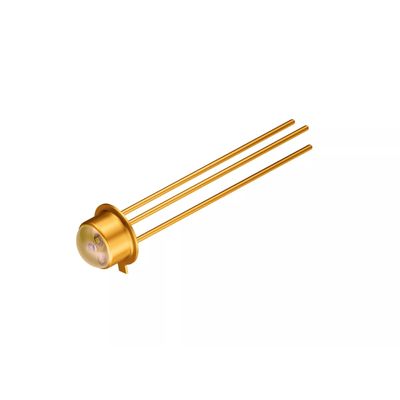
Emitters, Lasers, Sensors - Infrared Emitters
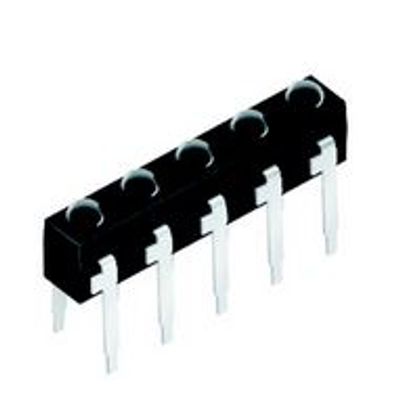
Osram - Model SFH 4940 - Infrared Emitter Array Linear
Infrared Emitter Arrays (940 nm).
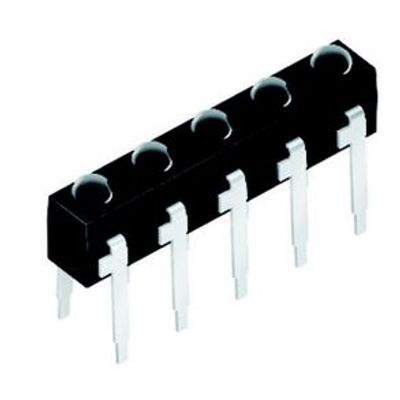
Osram - Model SFH 4942 - Infrared Emitter Array Linear
Infrared Emitter Arrays (940 nm).
Emitters, Lasers, Sensors - Lasers
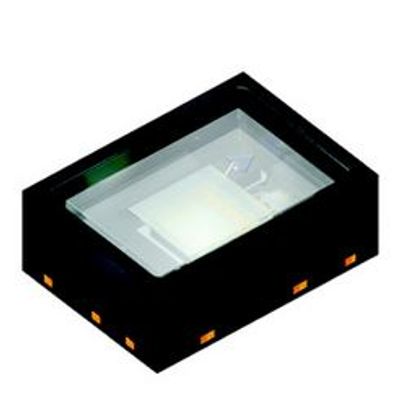
Osram - Model BIDOS P2433 Q, V102Q123A-940 - Power Array
940 nm Multi-Mode VCSEL Power Array.