


- Home
- Companies
- Argolight SA
- Products
Argolight SA products
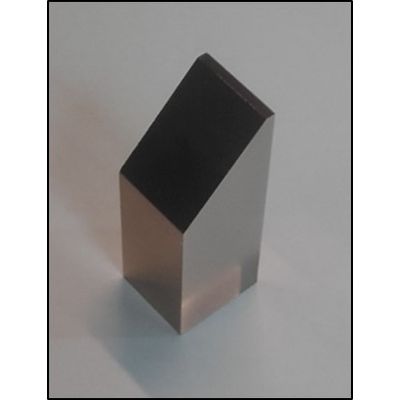
Argoglass - Glass Reference Material
Argoglass fluorescence standards are precision-engineered blocks of fluorescent glass developed for macroscopic and microscopic quality control of both manual and automated instruments used in clinical diagnostics, biomedical research, and pharmaceuticals. These standards are optimized for assessing the reliability and stability of imaging systems, including in-vitro diagnostics and spectroscopy applications. They are particularly useful in applications such as immunoassays for 4-MUP detection, microbiological bacteria detection, and various bioanalytical processes. The glass exhibits an excitation range of 230 – 320 nm and an emission range of 320 – 450 nm, with maximum intensity observed at 280 nm and a corresponding wavelength of 385 nm. The glass dimensions range from 0.5 x 0.5 x 0.5 mm to 30 x 30 x 20 mm, with high surface polishing quality up to λ/20. An optional reflective coating, such as aluminum, can be applied, and connections to a NIST standard are possible.
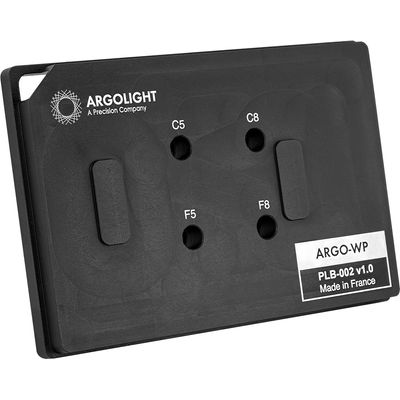
Argolight Argo-WP - Calibration Microplate for Screening Systems
The Argo-WP is an aluminum calibration microplate designed for use in high content screening (HCS), high content imaging (HCI), and high throughput screening (HTS) applications. Each microplate contains four wells with Argolight glass inserts, each showcasing a stable multispectral and broadband fluorescent pattern. The Argo-WP acts as a reference standard, providing precise fluorescent patterns that allow for the evaluation of various imaging systems, such as the Yokogawa Cell Voyager and Perkin Elmer Opera Phenix. It ensures consistent measurement standards across imaging platforms, assisting in troubleshooting, maintenance, and qualification processes. The microplate supports a wide range of excitation wavelengths from 350 nm to 650 nm, with fluorescence emission extending to 800 nm. It helps in identifying deviations in fluorescence intensity, ensuring optimal operation and compliance with IQ/OQ/PQ processes.