


CAMI Depurazioni Green Technology S.r.l. products
Plant - Water Treatment
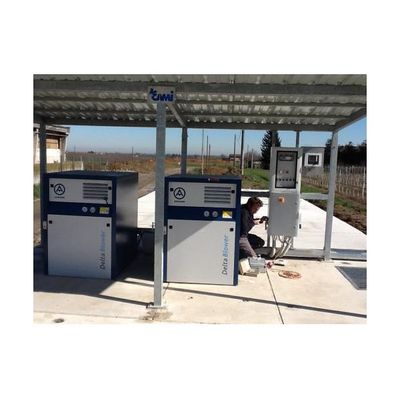
Sequential Batch Reactor (SBR) System
The SBR (Sequential Batch Reactor) system is a discontinuous flow treatment system capable of incorporating the different treatment phases in a single basin; it does not develop in space like traditional activated sludge systems, in which the flow passes from one tank to the next, but is a time-oriented system that allows variations in the flow and volume of the tank in accordance with the different operating strategies.
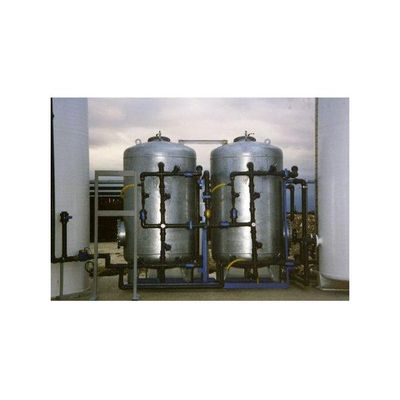
Sand Filters With Automated Cleaning
CAMI produces sand filters (zeolite, anthracite or quartz grit) to remove suspended solids present in the water. The water passes through a filter bed made up of layers of sand with different grain sizes. The filters are available in different models and materials and are available in two types, one with completely manual operation, one with fully automatic operation according to the type of application. The washing is carried out in countercurrent (a current of water crosses the sand bed in the opposite direction to that of filtration, removing and discharging the particles deposited on the filtering bed).
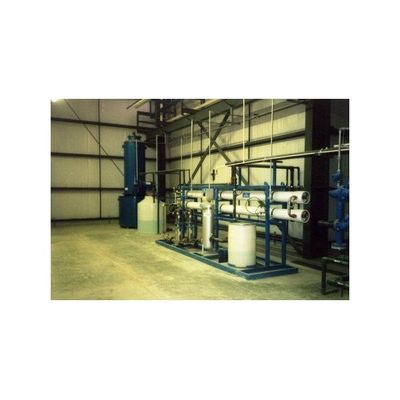
Reverse Osmosis Systems
CAMI uses reverse osmosis in water treatment to remove phosphates, calcium, heavy metals and almost all polluting molecules. Reverse osmosis is carried out with a membrane which, by means of an appropriate pressure, retains the solute on one side, preventing its passage and allowing to obtain the pure solvent on the other. The membranes used in osmosis are generally made of polyamide, chosen mainly for its water permeability and relative impermeability to various dissolved impurities and other small molecules that cannot be filtered.

Softeners System
They represent the most used system to eliminate water hardness. Total hardness expresses the content of calcium and magnesium salts in the water, it creates encrustations. The greater the hardness, the greater the incrustations, and with the increase in temperature, the precipitation of calcium salts increases. The softener through ion exchange resins transforms the calcium salts into more soluble sodium salts thus avoiding encrustations.
Plant - Fumes Depuration
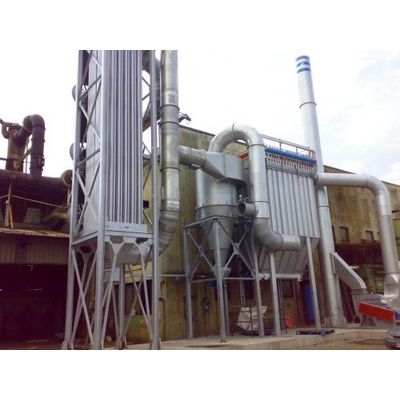
Fumes Depuration Plant
CA.M.I. designs projects, manufactures and installs purification plants for the removal of fume pollution which is released from industrial process kilns applied in the sectors of : raw materials, glass industry, ceramic industry, food industry, incinerators, wood, aluminium, cast iron, plastic, brick, sanitary industries and other sectors. In many cases CA.M.I. combines the physical filtration of the particles with a chemical process of neutralizing injection. Wherever possible, it is better to use dry technology plants which are supported by texture filtering. In fact these filtering supports are chosen depending on the type of fume analysis.
Plant - Dust Extraction and Filtration Systems
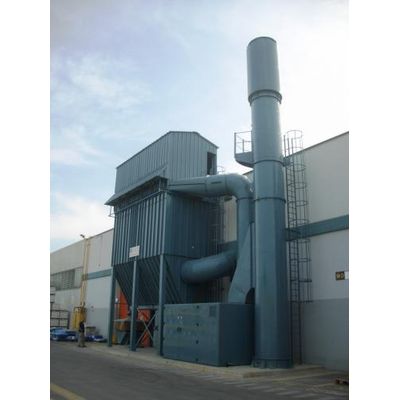
Dust Aspirating Plants
CAMI is proud of 30 years of experience in the designing of De-dusting plant systems: such installations are productive in the following sectors: Ceramic industry, glazing factories , brick industries, cement mixing plants, mining industries, mixing industries, chemicals, mechanical industries, animal fodder industries, wood industries, compression fusing, Raw materials industries, food industries, aluminium foundries, iron cast industries, compost plants, graphic industries, cereal mills, plastic and paper industries, leather industries, metal mechanic industries and various other industries.
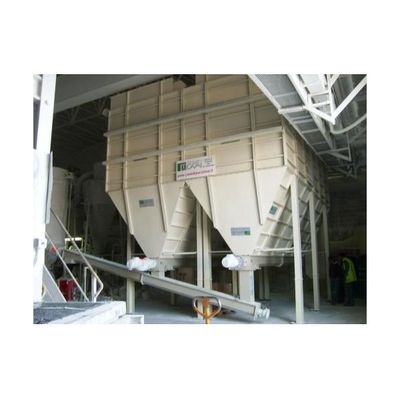
Dust Receiving Filters
CAMI has a large experience in the use of receiving filters used for machinery in the sectors such as: Food producing, ceramic production, raw materials for production, bricks for production, paint producing. For each application, CAMI chooses the right material for the sleeves and the correct cleaning system. During the normal working conditions, when the filter has to work with a high concentration of dust, it is provided with a “lighting chamber”.
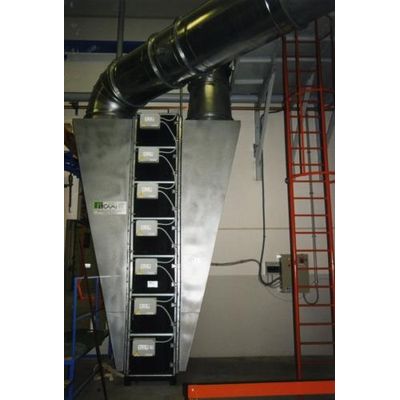
Electrostatic Filters
The electrostatic filter of CAMI permits the separation of the gas flow from the solid and liquid polluting substances. Our filters have two different cleaning systems for the electrodes: a drying system and a humid system.